
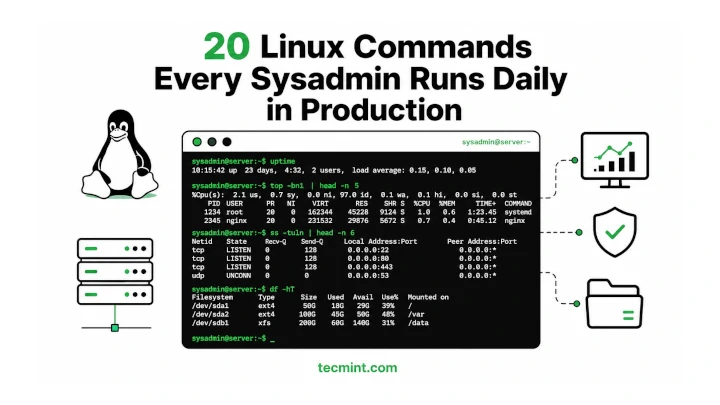
In this article we are going to review some of the useful and frequently used Linux or Unix commands for Linux System Administrators that are used in their daily life.
This is not complete but it’s a compact list of commands to refer to when needed. Let us start one by one how we can use those commands with examples.
1. Uptime Command
In Linux uptime command shows how long your system is running and the number of users who are currently logged in and also displays the load average of a system for 1, 5, and 15 minutes intervals.
# uptime

08:16:26 up 22 min, 1 user, load average: 0.00, 0.03, 0.22
Check Uptime Version
Uptime command don’t have other options other than uptime and version. It gives information only in hours:mins:sec if it is less than 1 day.
# uptime -V
procps version 3.2.8
2. W Command
The w command will display users currently logged in and their process along with showing load averages, login name, tty name, remote host, login time, idle time, JCPU, PCPU, command, and processes.
# w

08:27:44 up 34 min, 1 user, load average: 0.00, 0.00, 0.08
USER TTY FROM LOGIN@ IDLE JCPU PCPU WHAT
tecmint pts/0 192.168.50.1 07:59 0.00s 0.29s 0.09s w
Available Options
- -h : displays no header entries.
- -s : without JCPU and PCPU.
- -f : Removes from the field.
- -V : (upper letter) – Shows versions.
3. Users Command
Users command displays currently logged-in users. This command doesn’t have other parameters other than help and version.
# users

tecmint
4. Who Command
who command simply returns the user name, date, time, and host information. who command is similar to w command. Unlike the w command who doesn’t print what users are doing. Let’s illustrate and see the difference between who and w commands.
# who

tecmint pts/0 2012-09-18 07:59 (192.168.50.1)
# w

08:43:58 up 50 min, 1 user, load average: 0.64, 0.18, 0.06
USER TTY FROM LOGIN@ IDLE JCPU PCPU WHAT
tecmint pts/0 192.168.50.1 07:59 0.00s 0.43s 0.10s w
Who command Options
- -b: Displays last system reboot date and time.
- -r: Shows current runlet.
- -a, –all: Displays all information cumulatively.
5. Whoami Command
In Linux, a whoami command is used to print the currently logged-in username into your Linux system. If you are logged in as a root using sudo command “whoami” command return root as the current user.
# whoami

tecmint
6. ls Command
ls command displays a list of files in a human-readable format.
# ls -l

total 114
dr-xr-xr-x. 2 root root 4096 Sep 18 08:46 bin
dr-xr-xr-x. 5 root root 1024 Sep 8 15:49 boot
Sort file as per last modified time.
# ls -ltr

total 40
-rw-r--r--. 1 root root 6546 Sep 17 18:42 install.log.syslog
-rw-r--r--. 1 root root 22435 Sep 17 18:45 install.log
-rw-------. 1 root root 1003 Sep 17 18:45 anaconda-ks.cfg
For more examples of the ls command, please check out our articles:
- 10 lsof Command Examples in Linux
- 7 Quirky ‘ls’ Command Tricks Every Linux User Should Know
- How to Sort Output of ‘ls’ Command By Last Modified Date and Time
7. Crontab Command
List schedule jobs for current user with crontab command and -l option.
# crontab -l

00 10 * * * /bin/ls >/ls.txt
Edit your crontab with -e the option. In the below example will open schedule jobs in VI editor. Make necessary changes and quit pressing :wq keys that save the setting automatically.
# crontab -e
For more examples of Linux Cron Command, please read our earlier articles:
8. Less Command
less command allows quickly viewing the file. You can page up and down. Press ‘q‘ to quit from less window.
# less install.log

Installing setup-2.8.14-10.el6.noarch
warning: setup-2.8.14-10.el6.noarch: Header V3 RSA/SHA256 Signature, key ID c105b9de: NOKEY
Installing filesystem-2.4.30-2.1.el6.i686
Installing ca-certificates-2010.63-3.el6.noarch
Installing xml-common-0.6.3-32.el6.noarch
Installing tzdata-2010l-1.el6.noarch
Installing iso-codes-3.16-2.el6.noarch
9. More Command
more command allows quickly view file and shows details in percentage. You can page up and down. Press ‘q‘ to quit out from more window.
# more install.log

Installing setup-2.8.14-10.el6.noarch
warning: setup-2.8.14-10.el6.noarch: Header V3 RSA/SHA256 Signature, key ID c105b9de: NOKEY
Installing filesystem-2.4.30-2.1.el6.i686
Installing ca-certificates-2010.63-3.el6.noarch
Installing xml-common-0.6.3-32.el6.noarch
Installing tzdata-2010l-1.el6.noarch
Installing iso-codes-3.16-2.el6.noarch
--More--(10%)
[ You might also like: Learn Why ‘less’ is Faster Than ‘more’ Command for Effective File Navigation ]
10. CP Command
A cp command copies file from source to destination preserving the same mode.
# cp -p fileA fileB
You will be prompted before overwriting to file.
# cp -i fileA fileB
[ You might also like: How to Force cp Command to Overwrite without Confirmation ]
11. MV Command
An mv command renames fileA to fileB using the -i option, which prompts confirmation before overwriting. Ask for confirmation if exist already.
# mv -i fileA fileB
12. Cat Command
The cat command is used to view multiple files at the same time.
# cat fileA fileB
You combine more and less command with cat command to view file contain if that doesn’t fit in single screen/page.
# cat install.log | less

# cat install.log | more
For more examples of Linux, cat commands read our article on 13 Basic Cat Command Examples in Linux.
13. cd command (change directory)
with the cd command (change directory or switch directory) it will go to fileA directory.
# cd /fileA
14. pwd command (print working directory)
A pwd command return with the present working directory.
# pwd

/root
15. Sort command
The sort command is used to sort lines of text files in ascending order. with -r options will sort in descending order.
# sort fileA.txt

# sort -r fileA.txt
16. VI Command
Vi is the most popular text editor available in most UNIX-like OS. Below examples open file in read-only with -R option. Press ‘:q‘ to quit from vi windows.
# vi -R /etc/shadows
To learn more about vi editor, read our articles:
- Learn Useful ‘Vi/Vim’ Editor Tips and Tricks
- 8 Interesting ‘Vi/Vim’ Editor Tips and Tricks for Every Linux Administrator
- How to Install Latest Vim Editor in Linux Systems
17. SSH Command (Secure Shell)
SSH command is used to login into the remote host. For example, the below ssh command will connect to the remote host (192.168.50.2) using the user as Narad.
# ssh [email protected]
To check the version of ssh use the option -V (uppercase) shows version of ssh.
# ssh -V

OpenSSH_8.2p1 Ubuntu-4ubuntu0.3, OpenSSL 1.1.1f 31 Mar 2020
To learn more about SSH, read our articles:
- How to Secure and Harden OpenSSH Server
- How to Set a Custom SSH Warning Banner and MOTD in Linux
- How to Setup SSH Passwordless Login in Linux [3 Easy Steps]
18. Ftp or sftp Command
ftp or sftp command is used to connect to remote ftp host. ftp is (file transfer protocol) and sftp is (secure file transfer protocol). For example, the below commands will connect to ftp host (192.168.50.2).
# ftp 192.168.50.2

# sftp 192.168.50.2
Putting multiple files in remote host with mput similarly, we can do mget to download multiple files from the remote host.
# ftp > mput *.txt

# ftp > mget *.txt
19. Systemctl Command
Systemctl command is a systemd management tool that is used to manage services, check running statuses, start and enable services and work with the configuration files.
# systemctl start httpd.service
# systemctl enable httpd.service
# systemctl status httpd.service
20. Free command
The free command shows free, total, and swap memory information in bytes.
# free
 total used free shared buffers cached
Mem: 1030800 735944 294856 0 51648 547696
-/+ buffers/cache: 136600 894200
Swap: 2064376 0 2064376
Free with -t options show total memory used and available to use in bytes.
# free -t
 total used free shared buffers cached
Mem: 1030800 736096 294704 0 51720 547704
-/+ buffers/cache: 136672 894128
Swap: 2064376 0 2064376
Total: 3095176 736096 2359080
21. Top Command
top command displays processor activity of your system and also displays tasks managed by kernel in real-time. It’ll show processor and memory are being used.
Using the top command with u the option will display specific User process details as shown below. Press ‘O‘ (uppercase letter) to sort as desired by you. Press ‘q‘ to quit from the top screen.
# top -u tecmint

top - 11:13:11 up 3:19, 2 users, load average: 0.00, 0.00, 0.00
Tasks: 116 total, 1 running, 115 sleeping, 0 stopped, 0 zombie
Cpu(s): 0.0%us, 0.3%sy, 0.0%ni, 99.7%id, 0.0%wa, 0.0%hi, 0.0%si, 0.0%st
Mem: 1030800k total, 736188k used, 294612k free, 51760k buffers
Swap: 2064376k total, 0k used, 2064376k free, 547704k cached

PID USER PR NI VIRT RES SHR S %CPU %MEM TIME+ COMMAND
1889 tecmint 20 0 11468 1648 920 S 0.0 0.2 0:00.59 sshd
1890 tecmint 20 0 5124 1668 1416 S 0.0 0.2 0:00.44 bash
6698 tecmint 20 0 11600 1668 924 S 0.0 0.2 0:01.19 sshd
6699 tecmint 20 0 5124 1596 1352 S 0.0 0.2 0:00.11 bash
For more about top command, we’ve already compiled a list of 12 TOP Command Examples in Linux.
22. Tar Command
The tar command is used to compress files and folders in Linux. For example, the below command will create an archive for /home directory with the file name archive-name.tar.
# tar -cvf archive-name.tar /home
To extract the tar archive file use the option as follows.
# tar -xvf archive-name.tar
To understand more about tar command we’ve created a complete how-to guide on tar command at 18 Tar Command Examples in Linux.
23. Grep Command
grep command search for a given string in a file. Only tecmint user displays from /etc/passwd file. we can use -i an option for ignoring case sensitivity.
# grep tecmint /etc/passwd

tecmint:x:500:500::/home/tecmint:/bin/bash
24. Find Command
Find command used to search files, strings, and directories. The below example of find command search tecmint word in ‘/‘ partition and return the output.
# find / -name tecmint

/var/spool/mail/tecmint
/home/tecmint
/root/home/tecmint
For a complete guide on Linux find command examples fount at 35 Practical Examples of Linux Find Command.
25. lsof Command
lsof mean List of all open files. Below lsof a command list of all opened files by user tecmint.
# lsof -u tecmint

COMMAND PID USER FD TYPE DEVICE SIZE/OFF NODE NAME
sshd 1889 tecmint cwd DIR 253,0 4096 2 /
sshd 1889 tecmint txt REG 253,0 532336 298069 /usr/sbin/sshd
sshd 1889 tecmint DEL REG 253,0 412940 /lib/libcom_err.so.2.1
sshd 1889 tecmint DEL REG 253,0 393156 /lib/ld-2.12.so
sshd 1889 tecmint DEL REG 253,0 298643 /usr/lib/libcrypto.so.1.0.0
sshd 1889 tecmint DEL REG 253,0 393173 /lib/libnsl-2.12.so
sshd 1889 tecmint DEL REG 253,0 412937 /lib/libkrb5support.so.0.1
sshd 1889 tecmint DEL REG 253,0 412961 /lib/libplc4.so
For more lsof command examples visit 10 lsof Command Examples in Linux.
26. last command
With the last command, we can watch the user’s activity in the system. This command can execute normal users also. It will display complete user’s info like terminal, time, date, system reboot or boot, and kernel version. A useful command to troubleshoot.
# last

tecmint pts/1 192.168.50.1 Tue Sep 18 08:50 still logged in
tecmint pts/0 192.168.50.1 Tue Sep 18 07:59 still logged in
reboot system boot 2.6.32-279.el6.i Tue Sep 18 07:54 - 11:38 (03:43)
root pts/1 192.168.50.1 Sun Sep 16 10:40 - down (03:53)
root pts/0 :0.0 Sun Sep 16 10:36 - 13:09 (02:32)
root tty1 :0 Sun Sep 16 10:07 - down (04:26)
reboot system boot 2.6.32-279.el6.i Sun Sep 16 09:57 - 14:33 (04:35)
narad pts/2 192.168.50.1 Thu Sep 13 08:07 - down (01:15)
You can use last with username to know for specific user’s activity as shown below.
# last tecmint

tecmint pts/1 192.168.50.1 Tue Sep 18 08:50 still logged in
tecmint pts/0 192.168.50.1 Tue Sep 18 07:59 still logged in
tecmint pts/1 192.168.50.1 Thu Sep 13 08:07 - down (01:15)
tecmint pts/4 192.168.50.1 Wed Sep 12 10:12 - 12:29 (02:17)
27. ps command
The ps command displays processes running in the system. The below example show the init to process only.
# ps -ef | grep init

root 1 0 0 07:53 ? 00:00:04 /sbin/init
root 7508 6825 0 11:48 pts/1 00:00:00 grep init
28. kill command
Use the kill command to terminate the process. First, find process id with ps command as shown below and kill the process with kill -9 command.
# ps -ef | grep init
root 1 0 0 07:53 ? 00:00:04 /sbin/init
root 7508 6825 0 11:48 pts/1 00:00:00 grep init

# kill- 9 7508
29. rm command
rm command used to remove or delete a file without prompting for confirmation.
# rm filename
Use the -i option to get confirmation before removing it. Using options ‘-r‘ and ‘-f‘ will remove the file forcefully without confirmation.
# rm -i test.txt

rm: remove regular file `test.txt'?
30. mkdir command example.
mkdir command is used to create directories under Linux.
# mkdir directoryname
This is a handy day-to-day used basic commands in Linux / Unix-like operating system. Kindly share through our comment box if we missed out.
If this article helped you solve a problem, consider buying a coffee. It helps keep TecMint free, supports the authors, and keeps the project going.



Got Something to Say? Join the Discussion... Cancel reply