|
VOOZH | about |
|
VOOZH | about |
TrueFoundry recognized in Gartner Hype Cycle for Platform Engineering 2026. Read the full report →
Join our VAR & VAD ecosystem — deliver enterprise AI governance across LLMs, MCPs & Agents. Become a Partner →
Get instant access to a live TrueFoundry environment. Deploy models, route LLM traffic, and explore the full platform — your sandbox is ready in seconds, no credit card required.
Blazingly fast way to build, track and deploy your models!
Artificial Intelligence (AI) has evolved from automating simple tasks to enabling complex decision-making processes. At the forefront of this evolution is Agentic AI - autonomous systems capable of executing multi-step tasks with minimal human intervention. These intelligent agents can perceive their environment, reason, and act to achieve specific goals, making them invaluable assets for modern enterprises.
As businesses grapple with increasing complexity and the need for agility, Agentic AI offers a transformative solution. By integrating these agents into various functions, enterprises can enhance efficiency, reduce operational costs, and foster innovation.
Agentic AI refers to systems capable of acting autonomously to achieve specific goals, rather than just responding to prompts. These AI agents can plan, make decisions, execute tasks, and adapt dynamically to changing environments. They can also coordinate with other agents, access external tools, and manage complex workflows, enabling more intelligent, goal-oriented, and scalable AI solutions compared to traditional reactive AI.
The integration of Agentic AI is not just a technological upgrade; it's a strategic necessity. Agentic AI—autonomous systems capable of executing complex tasks with minimal human intervention—is rapidly transitioning from a novel concept to a strategic necessity for enterprises. Its potential to revolutionize operations, decision-making, and scalability positions it as a critical focus for Chief AI Officers (CAIOs) and Chief Information Officers (CIOs) aiming to maintain competitive advantage.
For CAIOs and CIOs, the integration of agentic AI and scaling them necessitates careful planning. Gartner Hype Cycle for Artificial intelligence report for 2025 places Agentic AI at the peak of inflated expectations - while there has been a lot of hype around it, we believe that 2025 and 2026 will be the years when
Agentic AI will actually scale massively in Enterprises, driven by the formulation of a Scalable BluePrint to drive repeatable Agent build outs across various business functions. Each enterprise should recognise where they are in the overall Hype Cycle of Agentic AI and accordingly position themselves for success. Key considerations include:
By addressing these areas, CAIOs and CIOs can effectively harness agentic AI's potential, driving innovation and maintaining a competitive edge in the evolving digital landscape. We cover the next section dedicated to the overall architectural blueprint for managing and scaling Agentic AI in Enterprises.
By 2028, agentic AI in enterprises is expected to transform enterprise capabilities, enabling more autonomous, adaptive, and collaborative workflows across organizations.
| Capability Area | Current (2025) | Future (2028 Projected) |
|---|---|---|
| Decision Autonomy | AI mostly follows human instructions and rules | Agents take initiative, make proactive decisions, and suggest strategies |
| Problem Solving & Planning | Handles defined, short-term tasks | Can navigate complex, multi-step problems with dynamic, adaptive planning |
| Communication & Understanding | Responds to commands in limited context | Understands nuanced language, multiple languages, and intent across domains |
| Workflow Complexity | Simple, linear automation tasks | Manages interdependent, multi-agent workflows with minimal human oversight |
| Collaboration Between Agents | Early-stage collaboration in structured setups | Agents form coordinated networks, distributing specialized skills like a team |
| Enterprise Integration | Limited to individual departments or apps | Full-scale adoption across departments, with low-code/no-code integration options |
| Learning & Adaptation | Learns from explicit feedback | Self-optimizes continuously from interactions, outcomes, and environmental signals |
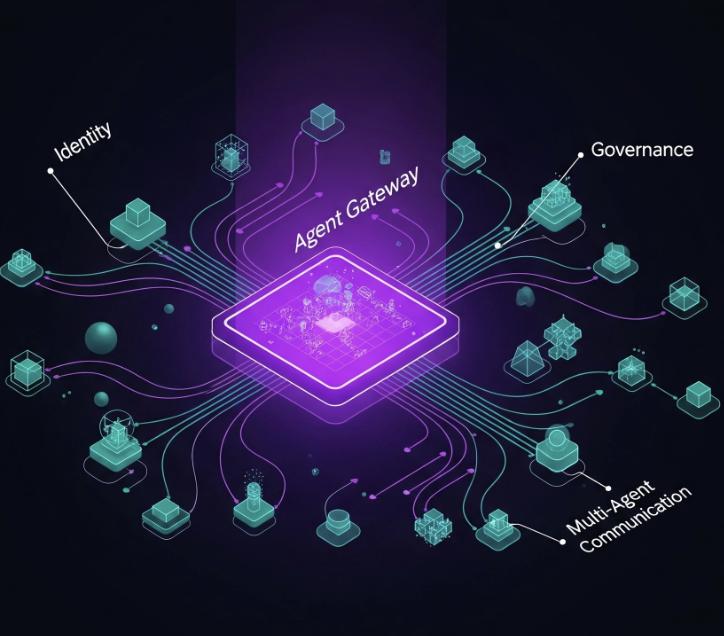
To effectively deploy Agentic AI, enterprises require a robust architecture that ensures seamless integration, scalability, and security. The Gateway Integration Model serves as a comprehensive framework for this purpose, ensuring centralized governance and federated Execution
Architecture for Scaling Agentic AI in Enterprises
The above architecture ensures that Agentic AI systems are modular, scalable, and secure, providing a solid foundation for enterprise-wide adoption. For enterprises to scale and not worry about the data flows, enterprises need a foundation layer to enable and run these systems within their VPC, where a central control plane like TrueFoundry comes into play.
Omitting even one of the key components in an enterprise Agentic AI stack significantly undermines the system's scalability, reliability, and security, introducing risks that ripple across both technical and organizational dimensions. Without GenAI applications like RAG or chatbots, enterprises lack interfaces for end-users and systems to interact with AI capabilities, effectively silencing downstream automation.
Excluding the AI Gateway removes the central orchestration and observability layer, leading to fragmented governance, lack of unified logging, broken authentication pipelines, and an inability to enforce consistent guardrails—putting compliance and auditability at risk. Missing LLM fine-tuning and deployment hinders the ability to adapt models to proprietary contexts, degrading accuracy and efficiency, while lack of integration with diverse APIs and model providers (OpenAI, Anthropic, AWS Bedrock, etc.) constrains flexibility and vendor redundancy, increasing platform lock-in.
Without MCP servers, agents are decoupled from enterprise tools (like Jira, Salesforce, GitHub), turning powerful AI logic into isolated silos with no way to take meaningful action. Ignoring A2A protocols breaks multi-agent collaboration, reducing agentic intelligence to simple task automation rather than enabling complex, cross-functional workflows. Finally, skipping guardrails or failing to enforce them at both input and invocation layers opens the system to misuse, privacy violations, and unreliable outputs—eroding stakeholder trust.
Each missing piece chips away at the enterprise’s ability to scale confidently, govern responsibly, and respond reliably in mission-critical environments. This is why foundational control planes—like TrueFoundry—deployed within the enterprise VPC are essential: they enforce structure, observability, and secure operations at scale across all components of the Agentic AI lifecycle.
Let’s now look at the Enterprise specific real-life use of Agentic AI across the various business functions.
In the context of IT operations, Agentic AI systems can monitor infrastructure, detect anomalies, diagnose issues, and implement resolutions autonomously, thereby enhancing efficiency and building pro-active maintenance capabilities which can be measured in terms of reduction in mean time to resolution (MTTR) and the reduction in number of Service disruptions or downtimes.
A typical Agentic AI-driven incident management architecture encompasses the following components:
Workflow of the above Agentic AI system
Microsoft has implemented Agentic AI to enhance its cloud incident management processes. By leveraging AI agents, Microsoft can autonomously detect service issues, analyze root causes, and implement fixes without human intervention. This approach has led to significant reductions in mean time to resolution (MTTR) and improved overall service reliability.
Additional read: Implementing a Geographically Distributed Agentic AI in Banking
Sales and marketing operations in modern enterprises are increasingly complex, requiring real-time personalization, data-driven outreach, and efficient coordination between platforms. Agentic AI can identify high-intent leads, personalize engagement strategies, and optimize marketing performance through continuous learning and experimentation. The measurable benefits include higher lead conversion rates, improved customer experience, and significantly reduced operational overhead for sales and marketing teams.
A typical Agentic AI architecture for sales and marketing automation includes the following components:
1. Customer Data Sources: Behavioral data from websites, product usage, CRM logs Integrated via MCP Servers (e.g., Salesforce MCP, HubSpot MCP)
2. AI Agents: They Perform lead scoring, segmentation, message personalization, and campaign orchestration and Interact with MCP servers of CRM and marketing tools to fetch, push, and update records.
3. Campaign Platforms: Tools like Mailchimp, HubSpot, and Outreach are invoked through agents to launch email or multichannel campaigns.
4. Lead Intelligence Tools: ZoomInfo, Clearbit, and LinkedIn Sales Navigator MCP servers provide enrichment data that agents use to prioritize leads.
5. A/B Testing & Feedback Analysis: Agents experiment with different subject lines, CTAs, timings and can Use data analytics platforms like Amplitude or internal dashboards to close the feedback loop.
6. Communication Tools: Integration with Slack/Teams MCPs enables agents to notify human sales reps with summaries or meeting suggestions.
7. Voice & Dialer Systems: Tools like Aircall, RingCentral used by agents for automated calling sequences and voicemail drops.
Workflow of the above Agentic AI system
Salesforce has introduced tools like Agentforce AI and Sales Coach, representing real-world applications of Agentic AI. These agents assist sales reps by automatically summarizing customer histories, suggesting talking points, and even recommending negotiation strategies.
Integrated tightly with Salesforce CRM and Slack MCPs, these agents enable reps to personalize outreach instantly and reduce preparation time for meetings. The result: faster sales cycles, higher engagement, and reduced workload. According to recent reports, these tools are already improving lead follow-up efficiency by over 40%, demonstrating the immediate ROI of Agentic AI in enterprise sales and marketing.
Product engineering in the modern enterprise is increasingly complex, involving fast-paced iteration, continuous integration, distributed teams, and data-driven experimentation. Agentic AI unlocks a new layer of efficiency and innovation by enabling autonomous agents to collaborate across the engineering toolchain.
These agents can automate code generation, perform intelligent test orchestration, monitor deployment health, analyze product analytics, and generate insights that feed back into the development process. This results in faster release cycles, reduced errors, improved product-market fit, and enhanced collaboration between engineering and product teams.
A robust Agentic AI architecture for product engineering includes the following interconnected components:
1. Source Code Repositories:GitHub, GitLab, Bitbucket MCP servers:Agents monitor pull requests, issues, and commit patterns
2. AI Agents:Perform code review suggestions, auto-generate unit/integration tests, and optimize CI/CD pipelines.:Can trigger workflows and interact with infrastructure-as-code platforms.
3. CI/CD Systems:Tools like Jenkins, GitHub Actions, CircleCI accessed via MCP servers.Agents ensure tests run, handle rollbacks, and manage deployment approvals.
4. Issue Trackers:Jira, Linear, and Azure Boards MCP integrations help agents triage bugs, assign tasks, and suggest sprint adjustments.
5. Test Automation Frameworks: Selenium, Cypress, Playwright for UI tests.Agents select relevant test suites based on code changes and historical failure patterns.
6. Monitoring and Observability: Datadog, New Relic, or Grafana MCPs feed data to agents for production health tracking.Agents trigger alerts or remediations for anomaly detection.
7. Product Analytics Platform: Amplitude, Mixpanel, PostHog MCPs provide feedback on user engagement.Agents suggest feature improvements or flag churn signals.
Workflow of the above Agentic AI system
In January 2025, Morgan Stanley introduced DevGen.AI, an in-house AI Agent built on OpenAI's GPT models, designed to tackle the challenge of modernizing outdated legacy code—a common issue in large enterprises. Since its launch, DevGen.AI has reviewed over 9 million lines of code, saving developers approximately 280,000 hours.
This significant time savings has allowed Morgan Stanley's 15,000 developers to focus more on strategic initiatives rather than manual code translation. By automating the generation of readable specifications from legacy code, DevGen.AI exemplifies how Agentic AI can streamline the modernization process, reduce the risk of errors, and accelerate the integration of legacy systems into modern architecture
Implementing agentic AI offers powerful capabilities, but it also comes with several practical challenges. From autonomous decision-making to secure multi-agent coordination, organizations must address these complexities to deploy reliable and scalable AI systems.
To ensure AI agents are deployed safely and scale effectively, organizations should implement key controls across access, monitoring, and governance.
Define clear roles, permissions, and authentication to ensure that only authorized agents and users can access tools, data, and workflows.
Maintain detailed records of agent actions, task executions, and decision-making processes to enable traceability, accountability, and post-incident analysis.
Implement mechanisms to pause, stop, or override agent actions in real time, preventing unintended outcomes or harmful behavior.
Continuously observe agent activity and interactions to detect anomalies, performance issues, or deviations from expected behavior.
Track changes to agent logic, workflows, and tool integrations, allowing safe rollbacks to previous stable versions when needed.
Establish policies to ensure agents act within ethical boundaries, adhere to regulations, and respect privacy, fairness, and responsible AI principles.
Agentic AI represents a paradigm shift in how enterprises operate, offering unprecedented levels of automation, efficiency, and intelligence. By adopting the Gateway Integration Model and strategically deploying intelligent agents across core functions, businesses can unlock new potentials and maintain a competitive edge in the digital era.
As with any transformative technology, success lies in thoughtful implementation, continuous learning, and adaptability. Enterprises that embrace Agentic AI today will be the trailblazers of tomorrow's intelligent economy.
With TrueFoundry’s platform to deploy and scale agentic AI systems, teams can move from experimentation to production faster.
Book a demo to see how you can operationalize Agentic AI at scale.
Agentic AI in Enterprise refers to the use of autonomous AI systems that don't just generate text, but can reason, plan, and execute multi-step tasks to achieve specific goals. Unlike basic chatbots, these agents interact with internal tools, databases, and APIs to solve complex problems independently. TrueFoundry provides the essential infrastructure for these systems, offering a secure environment where agents can be governed and scaled without compromising enterprise data privacy.
Common applications for Agentic AI in Enterprise include automating software development cycles, such as code reviews and pull request management, and streamlining customer operations with agents that can access real-time data to resolve tickets. Other use cases include financial trade verification and automated data reporting. TrueFoundry enables these workflows by providing standardized connectors (MCP) that allow agents to safely bridge the gap between intelligent models and sensitive internal data sources.
Building Agentic AI in Enterprise settings requires a specialized stack that includes orchestration frameworks, vector databases for memory, and standardized protocols like the Model Context Protocol (MCP). A central component is a high-performance AI Gateway to manage model failovers, security policies, and rate limits. TrueFoundry serves as a primary platform in this stack, offering a unified control plane that runs inside your own cloud account to ensure that all agentic tool-calling remains secure and auditable.
Yes, Agentic AI in Enterprise workflows can drastically improve productivity by automating time-consuming, repetitive cognitive tasks that previously required human intervention. These agents can execute workflows in parallel and handle complex tool-chains with minimal oversight. TrueFoundry further boosts this productivity by simplifying the deployment and monitoring process, allowing engineering teams to ship production-ready agents in days rather than months while optimizing infrastructure costs by up to 70 percent.
TrueFoundry provides enterprise-grade security by running all agentic AI workloads within your own cloud account, ensuring data never leaves your environment. The platform enforces strict access controls, audit logging, and secure API integrations, allowing agents to interact with internal tools and sensitive data safely. This makes it possible for enterprises to leverage autonomous AI without compromising compliance or privacy standards.
Agentic AI can be resource-intensive, but TrueFoundry’s platform is built for horizontal and vertical scaling. It automatically manages model orchestration, resource allocation, and failover handling, enabling multiple agents to run concurrently across diverse teams and departments. This ensures that enterprise-grade agentic AI solutions remain performant, reliable, and cost-efficient as demand grows.
TrueFoundry AI Gateway delivers ~3–4 ms latency, handles 350+ RPS on 1 vCPU, scales horizontally with ease, and is production-ready, while LiteLLM suffers from high latency, struggles beyond moderate RPS, lacks built-in scaling, and is best for light or prototype workloads.
Product
Company
Resources



.webp)
.webp)
.webp)
.webp)
.webp)





.webp)
.webp)
.webp)
.webp)
.webp)
.webp)

.webp)
.webp)