|
VOOZH | about |
|
VOOZH | about |
TrueFoundry recognized in Gartner Hype Cycle for Platform Engineering 2026. Read the full report →
Join our VAR & VAD ecosystem — deliver enterprise AI governance across LLMs, MCPs & Agents. Become a Partner →
Get instant access to a live TrueFoundry environment. Deploy models, route LLM traffic, and explore the full platform — your sandbox is ready in seconds, no credit card required.
Blazingly fast way to build, track and deploy your models!
Most enterprises do not have a shadow AI problem because employees are reckless. Their problem is structural. The tools work, productivity gains are real, and IT teams have limited infrastructure to channel that AI tool usage through approved paths.
A Gartner survey of 302 cybersecurity leaders found that 69% of organizations suspect or have confirmed evidence that employees use prohibited public GenAI tools. Gartner also predicts that more than 40% of enterprises will face security or compliance incidents linked to unauthorized shadow AI by 2030.
Shadow AI is harder to spot than ordinary shadow IT. AI tools often run inside approved browser sessions, SaaS applications, and everyday apps. This makes them invisible to domain blocklists, standard inventories, and traditional detection workflows.
Most Shadow AI detection tools handle one slice of the problem. Some focus on browser prompts, SaaS discovery, endpoint telemetry, or data security. Few platforms govern every model call, agent action, MCP connection, and infrastructure path.
This guide compares the 10 best Shadow AI detection tools for 2026. It covers where each detection tool helps, where coverage ends, and why TrueFoundry fits enterprises that need enforcement rather than another visibility report.
Shadow AI detection tools must cover more than unauthorized websites. Shadow AI appears across four surfaces, and each surface creates a different risk level for enterprise teams.
| Shadow AI Surface | What Happens | Why It Matters |
|---|---|---|
| SaaS and browser layer | Employees use ChatGPT, Gemini, Claude, or Copilot | Prompts can expose sensitive information |
| API and developer layer | Developers call models through unmanaged API keys | Code, datasets, and credentials can leak |
| Agent and MCP layer | Agents connect with tools and databases | Tool actions can exceed approved access |
| Infrastructure layer | Teams run self-hosted or external models | Governance, pricing, and audit gaps appear |
Employees may use ChatGPT, Gemini, Claude, Copilot, or embedded AI features inside approved SaaS platforms. The prompt becomes the exfiltration path, while the browser becomes the entry point.
Developers may make direct API calls to major AI models outside approved infrastructure. They may commit keys to repositories or wire local agents into production data without security review.
Autonomous agents create a larger problem. They can call databases, MCP servers, internal APIs, and external systems without direct human prompts. Each connection becomes a potential path for data leakage.
Infrastructure-layer usage creates the deepest gap. Teams may self-host models or run AI workloads outside governed platforms. That leaves no central visibility, no cost controls, and weak detailed audit trails.
Bans rarely solve the problem. Employees route around blocked endpoints through personal accounts, unmanaged devices, and approved SaaS features. Detection without enforcement often increases alert volume without reducing risks of shadow AI.
These Shadow AI detection tools help teams identify unmanaged AI usage across browsers, SaaS, developer environments, and infrastructure. The strongest option also enforces governance before exposure happens.
TrueFoundry is the strongest choice for enterprises that need enforcement, not alert volume. Its AI gateway governs model calls, agent actions, and MCP tool connections from one customer-controlled environment. It gives security teams runtime control across the full shadow AI surface.
Pros:
Cons:
TrueFoundry is best for enterprises that need policy enforcement, runtime governance, and unified control across AI models, agents, MCP tools, and infrastructure.
Netskope is useful for AI detection across managed and unmanaged SaaS applications. Its platform offers AI visibility, DLP, AI guardrails, and protection for agentic interactions. Its depth is strongest at the SaaS, browser, and network layers.
Pros:
Cons:
TrueFoundry governs every model call, agent action, and MCP tool connection at runtime. Netskope is stronger for SaaS visibility, while TrueFoundry controls infrastructure-layer execution.
Microsoft Purview helps Microsoft-native enterprises monitor generative AI apps and manage data security controls. It covers Microsoft 365, Copilot, Edge, Chrome extensions, and supported third-party AI sites. Its strongest fit remains Microsoft-centered governance.
Pros:
Cons:
TrueFoundry governs multi-cloud AI workloads beyond Microsoft products. Purview helps Microsoft estates, while TrueFoundry controls models, MCP tools, and agents across providers.
CrowdStrike Falcon Shield supports AI agent visibility inside SaaS environments. It discovers AI agents across platforms and maps access patterns, ownership, and risky behavior. Its strength is SaaS agent oversight inside a broader security workflow.
Pros:
Cons:
TrueFoundry enforces policy before agent or model execution occurs. Falcon Shield improves SaaS agent visibility, while TrueFoundry governs runtime access across AI infrastructure.
Cyberhaven focuses on data flows across endpoints, cloud, SaaS, on-premise systems, and AI tools. Its platform tracks when sensitive information enters an AI tool or approved SaaS AI feature. It is data-centered by design.
Pros:
Cons:
TrueFoundry governs model access, agent actions, and MCP tools before execution. Cyberhaven tracks data movement well, while TrueFoundry prevents unsafe AI execution.
Varonis connects data security, AI risk, and threat detection through data classification and behavioral analytics. It helps identify unknown AI usage interacting with enterprise data. Its value is strongest when data exposure and access patterns drive risk. Varonis announced it will end support for its on-premises, self-hosted Data Security Platform on December 31, 2026, and will redirect all engineering investment to the SaaS product.
Pros:
Cons:
TrueFoundry governs AI requests before they touch data or tools. Varonis helps reduce data risk, while TrueFoundry enforces AI access at runtime.
etwrix focuses on preventing data loss to AI tools through endpoint-level controls. It defines shadow AI as use of AI tools without formal IT oversight. Its strongest coverage sits around data movement, endpoint controls, and user activity.
Pros:
Cons:
TrueFoundry governs AI execution across models, agents, and MCP servers. Netwrix protects endpoints, while TrueFoundry controls the infrastructure path itself.
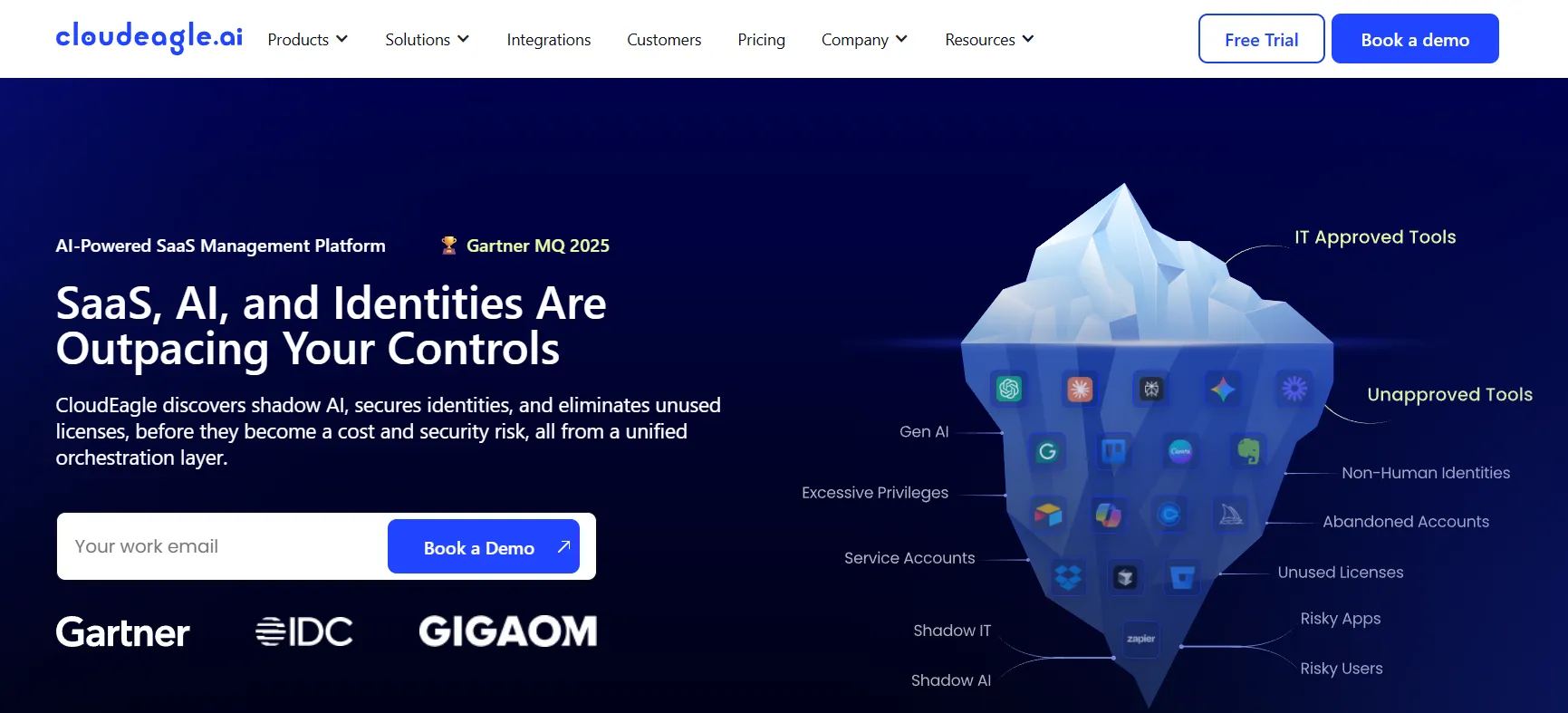
CloudEagle helps IT teams discover shadow AI, shadow IT, and SaaS spend from one orchestration layer. It scans SSO, finance, browser activity, and app integrations. Its strengths sit around SaaS applications, procurement, and hidden app usage.
Pros:
Cons:
TrueFoundry governs AI infrastructure after discovery identifies risk. CloudEagle helps find apps, while TrueFoundry blocks unsafe model, agent, and MCP execution.
Knostic Kirin secures AI coding assistants and developer workflows. It protects tools such as Cursor, Copilot, Claude Code, and Windsurf through MCP and coding assistant controls. Its strongest use cases sit inside developer environments.
Pros:
Cons:
TrueFoundry governs developer, production, and enterprise AI workloads together. Kirin protects coding environments, while TrueFoundry adds broader model, agent, and infrastructure governance.
Obsidian Security delivers SaaS and AI security through visibility, runtime protection, and continuous governance across applications, agents, and integrations. It monitors AI agents, privileges, SaaS connections, and actions. Its center of gravity remains SaaS environments.
Pros:
Cons:
TrueFoundry enforces AI governance across infrastructure, not SaaS alone. Obsidian improves SaaS agent clarity, while TrueFoundry governs every model and tool path.
Every tool above solves a real problem inside its target surface. Working alone, none of them closes the full shadow AI gap. Four blind spots show up across nearly every category we evaluated.
Stitching three or four of these tools together with custom integration code gets you partway to coverage. It does not produce coherent enforcement or a single audit trail. The structural fix is governance at the infrastructure layer — the one place every model calls already has to pass through.
If your team is evaluating shadow AI detection in 2026, the most useful starting question is not which tool produces the cleanest dashboard. The question is which layer of enforcement actually closes the gap.
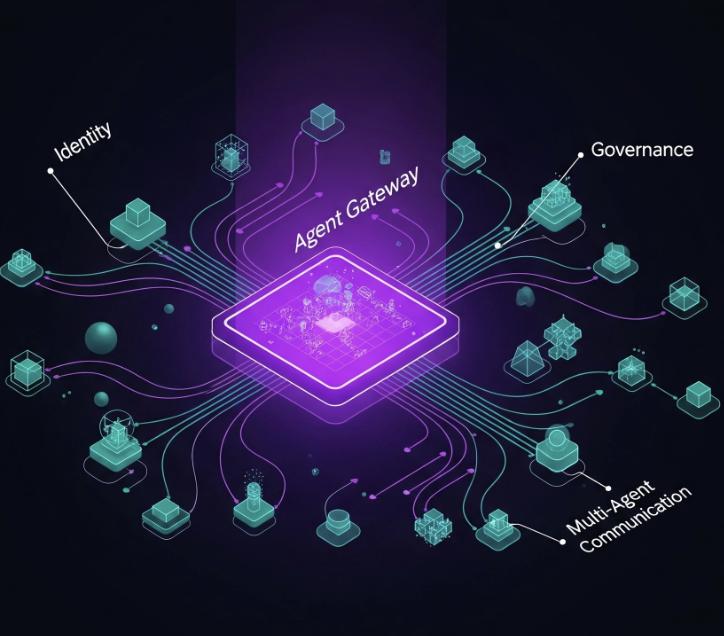
TrueFoundry’s MCP Gateway centralizes governed access to MCP servers. Its Agent Gateway supports governance for autonomous workflows. The LLM Gateway helps centralize provider access, routing, and observability.
We can walk through how TrueFoundry covers all four shadow AI surfaces from a single VPC-native gateway. Book a demo and see the gateway run against your own models and agents.
TrueFoundry AI Gateway delivers ~3–4 ms latency, handles 350+ RPS on 1 vCPU, scales horizontally with ease, and is production-ready, while LiteLLM suffers from high latency, struggles beyond moderate RPS, lacks built-in scaling, and is best for light or prototype workloads.
Shadow IT usually appears as unsanctioned apps that CASB, SSO, or domain-blocking tools can identify. Shadow AI often hides inside approved browsers, SaaS platforms, and embedded AI features. The prompt becomes the data path, which makes Shadow AI detection tools harder to evaluate than standard app discovery platforms.
Most discovery-first and DLP tools have limited coverage for autonomous agents. Agent activity needs governance over tool calls, MCP connections, permissions, and execution paths. Shadow AI detection tools that stay at the browser or SaaS layer usually miss agent actions that happen inside infrastructure or developer workflows.
Shadow AI may leave DNS queries, OAuth grants, browser extension activity, API key usage, SaaS logs, and endpoint telemetry. Each layer leaves a different signal. No single surface gives complete clarity, which is why Shadow AI detection tools need broad coverage across users, apps, models, and infrastructure.
SaaS-focused tools like Microsoft Purview and Obsidian flag AI feature activation at the application or browser layer, but enforcement on what data those features access usually depends on the SaaS vendor's own settings.
Detection identifies that shadow AI exists and produces an alert. Enforcement intercepts the AI request at the gateway layer and blocks the action before execution, eliminating the policy violation rather than logging it after the fact.
Product
Company
Resources



.webp)

.webp)
.webp)
.webp)
.webp)
.webp)
.webp)
.webp)
.webp)
.webp)
.webp)
.webp)





.webp)
.webp)
.webp)
.webp)
.webp)

.webp)
.webp)