|
VOOZH | about |
|
VOOZH | about |
TrueFoundry recognized in Gartner Hype Cycle for Platform Engineering 2026. Read the full report →
Join our VAR & VAD ecosystem — deliver enterprise AI governance across LLMs, MCPs & Agents. Become a Partner →
Get instant access to a live TrueFoundry environment. Deploy models, route LLM traffic, and explore the full platform — your sandbox is ready in seconds, no credit card required.
Blazingly fast way to build, track and deploy your models!
As generative AI and LLMs rapidly enter the enterprise, protecting these powerful new tools has become critical. Traditional security tools can’t see inside an AI model or enforce data-use policies on prompts and outputs, leaving organizations blind to AI-specific risks like prompt injection, data leakage, and rogue “agentic” behavior. In fact, a recent Gartner survey found 81% of organizations are on a GenAI journey, but many are already facing project failures, compliance problems, and misuse incidents due to inadequate AI governance. This visibility gap means that until now there was effectively no AI firewall to inspect or block malicious AI traffic.
Industry analysts now say AI-specific security solutions are urgently needed. Gartner predicts that by 2028 more than half of enterprises will deploy an AI security platform to enforce consistent guardrails across all third-party and custom AI applications. AI security is no longer optional – it’s a foundation for trust. Cited by Gartner as a “Vanguard” technology trend, AI security platforms bring visibility and control over LLMs and multiagent systems in the same way traditional firewalls and gateways protect networks. Without these controls, even well-intentioned AI projects can leak sensitive information or spin out of control. Embedding proactive safety checks and governance in the AI stack is now essential for enterprises scaling LLMs or deploying autonomous AI assistants. In the sections below we’ll explain what “AI Security Platforms” are, why AI security matters more than ever, and why an AI gateway is the practical enforcement layer for AI security. We’ll also show how TrueFoundry’s AI Gateway implements all these requirements in one unified solution – effectively becoming your organization’s AI firewall.
Gartner defines an AI Security Platform (AISP) as a unified security layer for all AI usage – third-party services and in-house models alike. In practice, an AISP combines two pillars: AI Usage Control (AIUC) and AI Application Cybersecurity (AIAC).
By combining AIUC and AIAC, a mature AI Security Platform provides a single pane of glass for AI governance. It centralizes visibility of all model calls, enforces consistent policies (data residency rules, content policies, access controls) across every AI workload, and continuously monitors for AI-specific risks like prompt injections or unauthorized agent activities. Gartner predicts that unified AISPs (offering both AIUC and AIAC) will dominate the market, providing a consolidated solution rather than piecemeal tools. Essentially, an AISP is the AI-era equivalent of an enterprise firewall and SIEM combined – tailored for LLMs and AI agents.
The rapid adoption of LLMs and “agentic AI” (multi-step AI assistants) has vastly expanded the enterprise attack surface. Here are key reasons AI security is now mission-critical for any organization deploying generative AI:
In short, LLM security and AI governance can no longer be ignored. Data scientists and developers are already experimenting with public AI services; the question now is how to do so safely. Enterprises need an “AI firewall” – a control point that understands the semantics of AI traffic and can apply policies dynamically. Enter the AI Gateway: the practical enforcement point where security, compliance, and observability come together at runtime.
An effective AI security platform goes beyond traditional security tools to address the unique business risks introduced by AI systems. Here, have a look at the capabilities of an AI security gateway:
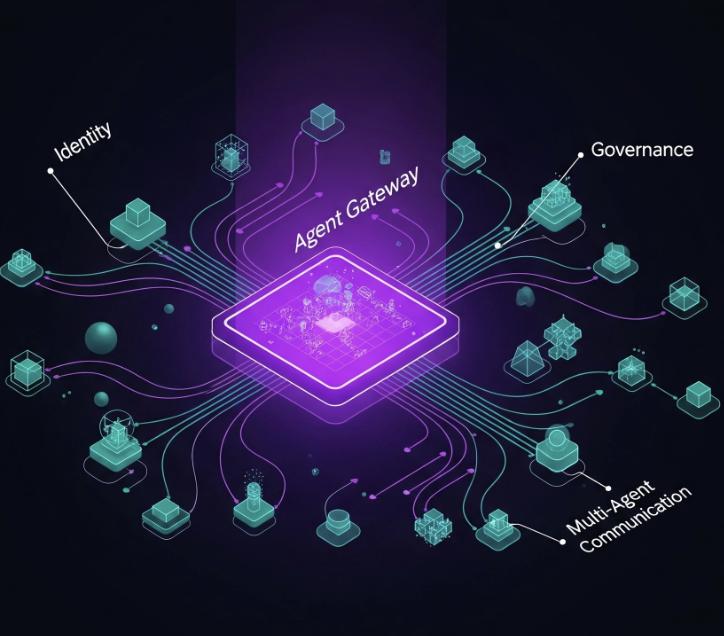
An AI Gateway is a specialized proxy layer that sits between applications (or agents) and AI model services. Gartner describes it as middleware managing security, observability, routing, and cost for AI APIs. In other words, the AI Gateway is the runtime anchor of your AI security platform. It is here that policies from AIUC and AIAC are actually enforced on live traffic. Let’s break down the key roles an AI Gateway plays in securing AI:
In essence, the AI Gateway is the enforcement engine of your AI Security Platform. It turns abstract policies into action at the point of integration with models. Gartner notes that modern gateways are evolving “from simple traffic routers to intelligent governance engines”. Organizations use AI Gateways to handle everything from cost optimization to AI trust/risk management. For example, the tasks: authenticating and authorizing AI calls, balancing load across endpoints, logging interactions, and enforcing token quotas – are listed as exactly the controls needed for secure AI deployment.
TrueFoundry’s AI Gateway is built precisely to fulfill the role of a comprehensive AI Security Platform. Gartner has even recognized TrueFoundry as a representative vendor in this fast-evolving category. The Gateway acts as a unified control layer for AI – offering observability, governance, cost control, and security for your AI environment. Here’s how it meets the key requirements:
For example, upon receiving a user prompt, the gateway can run an integrated privacy filter to redact any sensitive PII before calling the model. After the model returns an answer, the gateway can apply another policy (e.g. “no medical advice allowed”) and block any responses that violate enterprise policy. The gateway also handles credential rotation and RBAC for AI keys: individual developers or services get only the permissions they need. By default it enforces OAuth2/OIDC, so your standard identity controls govern who can query which model. In short, it acts as an AI firewall and content filter on every interaction – a central enforcement point for AI governance.
Example Use Case: Consider a financial firm building an AI-powered assistant for customer service. Using TrueFoundry AI Gateway, the company can set a policy that any prompt to the assistant first passes through a compliance filter (blocking any request containing account numbers or instructions to execute trades). The assistant’s responses are similarly filtered for inappropriate financial advice. All interactions are logged for auditing. Moreover, the gateway can route regulatory-sensitive queries to an internally-hosted LLM (ensuring data never goes to an external cloud), while other traffic uses a public model for general knowledge. Meanwhile, token usage by the assistant is tracked and capped, preventing surprises in the cloud bill. In this way, the gateway operationalizes the firm’s AI governance rules end-to-end.
In summary, AI gateways are central to any modern AI security strategy. They serve as the operational enforcement point for the Gartner-defined AI Security Platform, applying centralized policies and guardrails at the point of inference. By inspecting every prompt and output, controlling model access, and providing full observability, AI gateways transform the distributed chaos of AI usage into a governable, secure system.
TrueFoundry’s AI Gateway embodies this vision as a unified AI firewall and control plane. It delivers AI security platform capabilities, from prompt injection protection and data loss prevention to agentic AI risk management, all in one technical stack. Gartner even recognizes TrueFoundry’s offering as a leader in this space. For CTOs and AI platform teams, deploying an AI Gateway from a solution like TrueFoundry is the fastest way to operationalize AI security: it enforces usage policies, performs continuous risk testing, and ensures enterprise-grade compliance across your LLM and agent use cases.
With generative AI adoption surging, the time to act is now. An AI gateway turns AI security policies from hope into practice, blocking threats in real time and providing a single pane of glass for AI governance. By unifying third-party and custom AI under one roof, TrueFoundry AI Gateway helps enterprises “secure the path to AI adoption,” enabling innovation without compromising trust.
See how TrueFoundry’s AI Gateway can protect your LLMs, enforce policies, and provide full visibility across your AI stack, book a demo today.
AI security tools are solutions designed to protect AI systems, models, and data from threats like prompt injection, data leakage, and adversarial attacks. They provide monitoring, access control, content filtering, and policy enforcement to ensure safe, compliant, and reliable AI usage.
If you’re deploying AI in production, an AI security gateway helps centralize control, enforce policies, and monitor usage. It protects against threats like prompt injection and data leaks while ensuring compliance, making it essential for scaling AI applications securely and reliably.
Some leading AI security platforms include Lakera, Protect AI, HiddenLayer, Robust Intelligence, and TrueFoundry. These tools offer capabilities like threat detection, model monitoring, policy enforcement, and secure deployment, helping organizations protect AI systems across development and production environments.
AI security platforms protect against exploitation by intercepting malicious inputs, such as prompt injections or jailbreaking attempts, before they reach the model. TrueFoundry enhances this defense by integrating real-time guardrails and input sanitization, ensuring that model interactions stay within safe, predefined boundaries while mitigating the risk of unauthorized command execution.
Modern AI security platforms replace fragmented, hardcoded credentials with centralized secret management. TrueFoundry’s gateway allows developers to access multiple model providers using a single, secure identity via RBAC. By managing provider keys internally and supporting automated rotation, it ensures that sensitive API secrets are never exposed to end users or stored in application code.
Yes, AI security platforms are specifically designed to prevent sensitive corporate data from being sent to external model providers. TrueFoundry provides automated PII masking and log scrubbing to redact confidential information in real time. Because the platform deploys within your own VPC, it ensures that proprietary data remains under your direct control, satisfying strict data residency requirements.
AI security platforms act as a secure proxy layer that enforces consistent policies across all model endpoints. TrueFoundry secures these gateways by providing federated authentication and comprehensive audit trails for every request. This centralized approach allows teams to apply rate limits, cost controls, and security filters across the entire organization through a single control plane.
While traditional tools focus on network-level threats like IP filtering or firewalls, AI security platforms operate at the semantic level. They are designed to understand prompts, tokens, and model outputs, allowing them to detect AI-specific risks like data poisoning or toxic content. TrueFoundry provides this specialized intelligence, offering a security layer that traditional WAFs cannot provide for complex LLM workloads.
TrueFoundry AI Gateway delivers ~3–4 ms latency, handles 350+ RPS on 1 vCPU, scales horizontally with ease, and is production-ready, while LiteLLM suffers from high latency, struggles beyond moderate RPS, lacks built-in scaling, and is best for light or prototype workloads.
Product
Company
Resources



.webp)
.webp)
.webp)
.webp)
.webp)





.webp)
.webp)
.webp)
.webp)
.webp)
.webp)

.webp)
.webp)