VOOZH about

URL: https://www.truefoundry.com/blog/benchmarking-llama-2-70b

⇱ Benchmarking Llama-2-70B | TrueFoundry


πŸ‘ Blank white background with no objects or features visible.

TrueFoundry recognized in Gartner Hype Cycle for Platform Engineering 2026. Read the full report β†’

Join our VAR & VAD ecosystem β€” deliver enterprise AI governance across LLMs, MCPs & Agents. Become a Partner β†’
πŸ‘ logo
Sign Up
Login
πŸ‘ Three horizontal black bars of varying lengths on a white background, menu or list icon symbol.

Benchmarking Llama-2-70B

πŸ‘ Image
By TrueFoundry

Published: May 9, 20255

Built for Speed: ~10ms Latency, Even Under Load

Blazingly fast way to build, track and deploy your models!

  • Handles 350+ RPS on just 1 vCPU β€” no tuning needed
  • Production-ready with full enterprise support

We benchmark the performance of LLama2-70B in this article from latency, cost, and requests per second perspective. This will help us evaluate if it can be a good choice based on the business requirements. Please note that we don't cover the qualitative performance in this article - there are different methods to compare LLMs which can be found here.

Model: Llama2-70B

In this blog, we have benchmarked the Llama-2-70B model from NousResearch. This is a pre-trained version of Llama-2 with 70 billion parameters.

‍

Meta developed and publicly released the Llama 2 family of large language models (LLMs), a collection of pre-trained and fine-tuned generative text models ranging in scale from 7 billion to 70 billion parameters.

Metrics to Benchmark

  1. Requests per second. (RPS): Requests per second that the model is handling. With higher RPS, the latency usually goes up.
  2. Latency: How much time is taken to complete an inference request?
  3. Economics: What are the costs associated with deploying an LLM?

Use cases & Deployment Modes Benchmarked

The key factors across which we benchmarked are:

GPU Type:

  1. 4 x A100 40GB GPU

Prompt Length:

  1. 1500 Input tokens, 100 output tokens (Similar to Retrieval Augmented Generation use cases)
  2. 50 Input tokens, 500 output tokens (Generation Heavy use cases)

Benchmarking Setup

For benchmarking, we have used locust, an open-source load-testing tool. Locust works by creating users/workers to send requests in parallel. At the beginning of each test, we can set the Number of Users and Spawn Rate. Here the Number of Users signify the Maximum number of users that can spawn/run concurrently, whereas the Spawn Rate signifies how many users will be spawned per second.

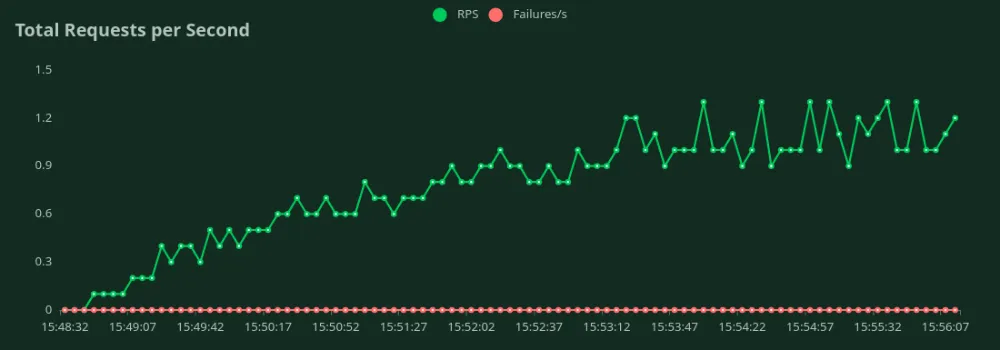
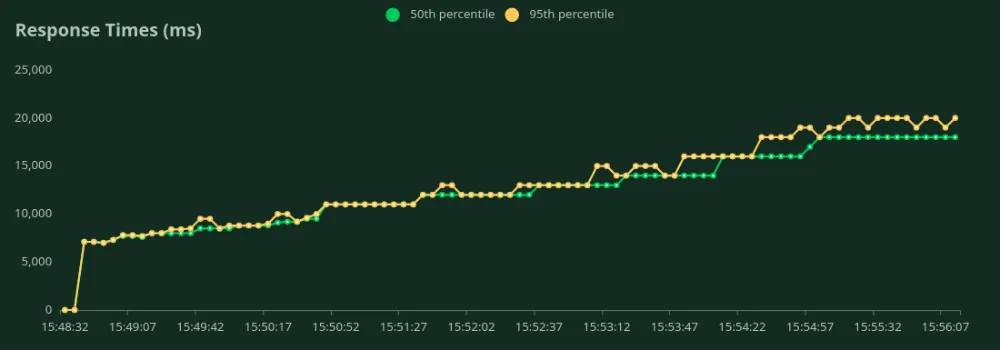
In each benchmarking test for a deployment config, we started from 1 user and kept increasing the Number of Users gradually till we saw a steady increase in the RPS. During the test, we also plotted the response times (in ms) and total requests per second.

In each of the 2 deployment configurations, we have used the huggingface text-generation-inference model server having version=0.9.4. The following are the parameters passed to the text-generation-inference image for different model configurations:

‍

PARAMETERS LLAMA-2-70B ON A100
Max Batch Prefill Tokens 14000

‍

Benchmarking Results Summary

Latency, RPS, and Cost

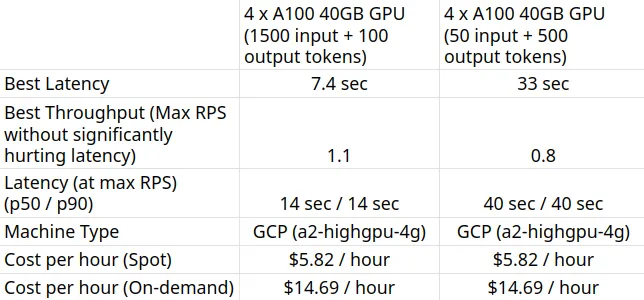
We calculate the best latency based on sending only one request at a time. To increase throughput, we send requests parallelly to the LLM. The max throughput is the case when the model is able to process the input requests without significant deterioration in latency.

Benchmarking Results for LLama-2 70B

Tokens Per Second

LLMs process input tokens and generation differently - hence we have calculated the input tokens and output tokens processing rate differently.

Detailed Results

4 x A100 40GB GPU (1500 input + 100 output tokens)

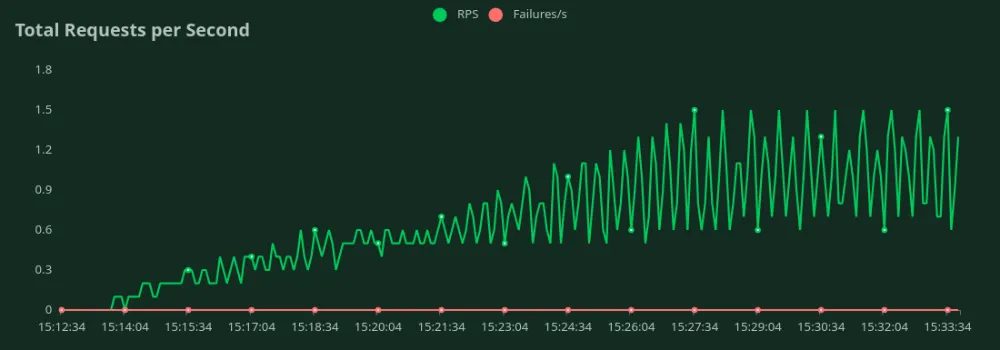
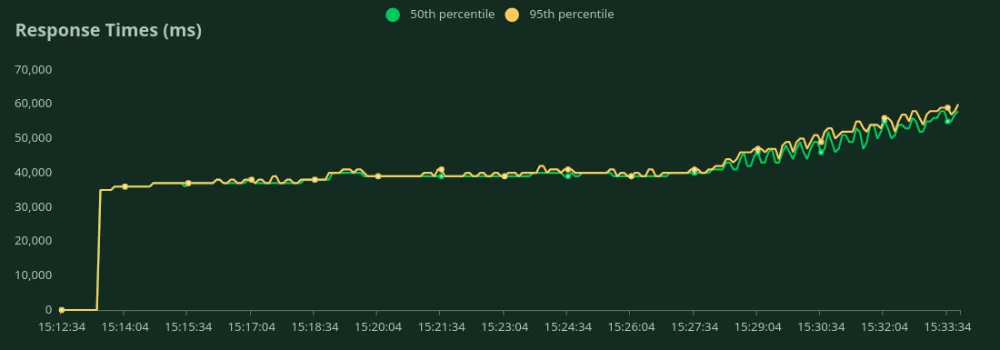
We can observe in the above graphs that the Best Response Time (at 1 user) is 7.4 seconds. We can increase the number of users to throw more traffic at the model - we can see the throughput increasing till 1.1 RPS without a significant drop in latency. Beyond 1.1 RPS, the latency increases drastically which means requests are being queued up.

4 x A100 40GB GPU (50 input + 500 output tokens)

We can observe in the above graphs that the Best Response Time (at 1 user) is 33 seconds. We can increase the number of users to throw more traffic at the model - we can see the throughput increasing till 0.8 RPS without a significant drop in latency. Beyond 0.8 RPS, the latency increases drastically which means requests are being queued up.

Hopefully, this will be useful for you to decide if LLama2-70B will suit your use case and the costs you can expect to incur while hosting LLama2-70B.

TrueFoundry AI Gateway delivers ~3–4 ms latency, handles 350+ RPS on 1 vCPU, scales horizontally with ease, and is production-ready, while LiteLLM suffers from high latency, struggles beyond moderate RPS, lacks built-in scaling, and is best for light or prototype workloads.

Built for Speed: ~10ms Latency, Even Under Load

The fastest way to build, govern and scale your AI

Sign Up
Gartner Hype Cycle for Platform Engineering 2026
πŸ‘ Image

One Layer of Control for All AI

Route and govern model and tool traffic with a centralized AI Gateway
Table of Contents
πŸ‘ logo

One Gateway for Every LLM, Agent and MCP Server

Book a 30-min with our AI expert

Book a Demo

The fastest way to build, govern and scale your AI

Book Demo

Discover More

πŸ‘ Image
November 13, 2025
|
5 min read

GPT-5.1 vs GPT-5: 9 Major Improvements You Need to Know

πŸ‘ Image
August 27, 2025
|
5 min read

Mapping the On-Prem AI Market: From Chips to Control Planes

πŸ‘ Image
August 27, 2025
|
5 min read

AI Gateways: From Outage Panic to Enterprise Backbone

πŸ‘ Image
April 16, 2024
|
5 min read

Cognita: Building an Open Source, Modular, RAG applications for Production

πŸ‘ Image
June 19, 2026
|
5 min read

Governing Multi-Agent Systems: Agent Identity, A2A, and the Agent Gateway

No items found.
πŸ‘ Image
June 19, 2026
|
5 min read

TOKENMAXXING TRILOGY Β· PART 2 OF 3: The Architecture of Governed AI Usage

No items found.
πŸ‘ Image
June 19, 2026
|
5 min read

Grok 4.3 on Amazon Bedrock: We Routed Four Frontier Models Through One Gateway and Measured the Cost

LLM Tools
comparison
πŸ‘ Image
June 19, 2026
|
5 min read

Top 5 LiteLLM Alternatives for Enterprises in 2026

No items found.
πŸ‘ Image
June 14, 2026
|
5 min read

Understanding LLAMA 2 Model Benchmarks for Performance Evaluation

LLMs & GenAI
πŸ‘ Image
August 6, 2024
|
5 min read

Benchmarking Llama-2-13B

LLMs & GenAI
πŸ‘ Image
April 30, 2026
|
5 min read

Benchmarking Falcon-40B

LLMs & GenAI
πŸ‘ Image
August 6, 2024
|
5 min read

Benchmarking Mistral-7B

LLMs & GenAI
πŸ‘ Image
April 27, 2026
|
5 min read

Llama 2 LLM: Deploy & Fine Tune on your cloud

Engineering and Product
LLMs & GenAI

Recent Blogs

Governing Multi-Agent Systems: Agent Identity, A2A, and the Agent Gateway

June 19, 2026

Boyu Wang

Grok 4.3 on Amazon Bedrock: We Routed Four Frontier Models Through One Gateway and Measured the Cost

June 19, 2026

Amrutha Potluri

JIT Context: Why the Best Agents Load Late and Load Little

June 18, 2026

Boyu Wang

Best AI Cost Optimization Tools in 2026: Compared for Enterprise Teams

June 18, 2026

Ashish Dubey

AI Cost Optimization Strategies in 2026: A Practical Guide for Enterprise Teams

June 18, 2026

Ashish Dubey

Claude MCP Registry: A Complete Guide for Developers and Enterprise Teams

June 17, 2026

Ashish Dubey

AI Policy Enforcement: A Complete Guide for Enterprise Teams

June 17, 2026

Ashish Dubey

AI Utility: A Complete Guide to AI in Energy and Utilities for 2026

June 17, 2026

Ashish Dubey

10 Best Shadow AI Detection Tools for 2026: Compared for Enterprise Security Teams

June 18, 2026

Ashish Dubey

Field Notes: When AI Cost Control Becomes a Switch β€” and Why It Should Be a Gateway

June 17, 2026

Boyu Wang

What Is AI Orchestration? A Complete Guide

June 16, 2026

Ashish Dubey

Best Multi-Agent Orchestration Tools in 2026: Compared for Enterprise and Developer Teams

June 16, 2026

Ashish Dubey

Multi-agent Orchestration Frameworks in 2026: Compared for Enterprise Teams

June 16, 2026

Ashish Dubey

The Claude Fable 5 / Mythos 5 Ban and Why You Need a Multi-Provider AI Gateway

June 16, 2026

Ashish Dubey

What Is Multi-Model Orchestration? A Practical Guide for Enterprise Teams

June 16, 2026

Ashish Dubey

Take a quick product tour
Start Product Tour
Product Tour

Β© 2026 All rights reserved.

πŸ‘ Github icon
πŸ‘ LinkedIn Icon
πŸ‘ Blurry blue crisscross lines on white background forming an X shape with dotted lines.
πŸ‘ LinkedIn logo for social media link