|
VOOZH | about |
|
VOOZH | about |
TrueFoundry recognized in Gartner Hype Cycle for Platform Engineering 2026. Read the full report →
Join our VAR & VAD ecosystem — deliver enterprise AI governance across LLMs, MCPs & Agents. Become a Partner →
Get instant access to a live TrueFoundry environment. Deploy models, route LLM traffic, and explore the full platform — your sandbox is ready in seconds, no credit card required.
Blazingly fast way to build, track and deploy your models!
Artificial Intelligence initiatives rarely start with cost in mind.
They begin as experiments, teams testing ideas, integrating APIs, and building prototypes. But as success grows, so does usage. Soon, multiple teams are running AI workloads, deploying models, and scaling infrastructure, often without clear visibility into costs.
This is where problems begin.
Unlike traditional software, AI costs are dynamic, usage-based, and often unpredictable. A single change in prompt design, model choice, or user behavior can dramatically increase expenses overnight.
This is why FinOps for AI has become essential.
Financial Operations (FinOps) brings together engineering, finance, and business teams to ensure that AI investments are efficient, accountable, and aligned with business value. In the AI era, managing cost is just as critical as model performance or uptime.
In the sections below, we’ll break down how each FinOps principle applies to AI and, crucially, how TrueFoundry’s platform helps implement them in a practical, engineering-friendly way.
FinOps for AI is the application of financial accountability and cost optimization practices to AI workloads, including model training, inference, GPU usage, and token-based consumption.
It enables organizations to:
Without FinOps, AI costs can scale rapidly due to:
While FinOps originated in cloud cost management, AI introduces fundamentally different cost dynamics.
| Feature | Traditional FinOps | FinOps for AI |
|---|---|---|
| Cost Unit | Compute, storage | Tokens, inference, GPU time |
| Predictability | Relatively stable | Highly variable |
| Scaling Factor | Users / traffic | Complexity & usage patterns |
| Optimization Focus | Infrastructure efficiency | Model + prompt + architecture efficiency |
| Cost Visibility | Billing dashboards | Real-time, per-request tracking |
In AI, costs are not just about infrastructure, they are tied to how intelligence is used, making FinOps more granular and complex.
To effectively control AI costs, it’s essential to understand the key factors that influence how spending scales. Unlike traditional software, AI costs are not just driven by usage volume, but by how models are used, configured, and integrated into workflows.
Most modern AI models (especially LLMs) are priced based on tokens:
In many cases, output tokens are priced higher than input tokens. This means longer responses, verbose prompts, or unnecessary context can significantly increase costs. Since billing is proportional to total tokens processed, even small inefficiencies can compound at scale.
AI providers offer models with varying capabilities, latency, and pricing tiers. More advanced models (with better reasoning, accuracy, or multimodal capabilities) typically cost significantly more per token or per request.
Using high-end models for simple or repetitive tasks leads to overpaying for capability that isn’t required. Cost-efficient systems often rely on model right-sizing, matching task complexity with the appropriate model.
Large language models process all input tokens in every request. This includes:
Sending large contexts repeatedly increases token usage linearly per request, often referred to as the “context tax.” In chat-based or document-heavy applications, this can become one of the biggest cost drivers if not managed carefully.
The length and structure of both prompts and outputs directly impact cost.
If a model generates a paragraph where a sentence would suffice, you pay for the extra tokens without proportional value. Optimizing for concise prompts and controlled outputs is one of the simplest and most effective ways to reduce cost.
While these are the primary cost drivers, many teams overlook a second layer of expenses that quietly inflate AI budgets.
These hidden costs often exceed model usage costs if not managed properly.
FinOps for AI is built on four pillars: Visibility, Accountability, Optimization, and Insights (Dashboards), helping organizations track, control, and continuously optimize AI spend while aligning it with business value. Here, have a look:
The first principle of FinOps is simple: you can’t optimize what you can’t see. In AI systems, visibility means tracking every model call, token, and GPU second in real time.
TrueFoundry enables this through a centralized AI Gateway that acts as a single entry point for all model interactions, whether you're calling external APIs or running models in-house. This eliminates fragmented tracking and creates a unified view of usage.
Every request flowing through the gateway is automatically logged with rich metadata, including model name, token counts, latency, user identity, and custom tags like application, environment, or customer_id. This makes it easy to attribute usage across teams, features, or customers.
Beyond logging, the gateway emits real-time metrics such as token consumption and cost per request. These metrics are labeled with dimensions like model, user, and metadata, making it easy to break down costs in meaningful ways.
All of this integrates seamlessly with tools like Prometheus, Grafana, or Datadog, enabling teams to build dashboards that answer critical questions instantly:
This level of visibility turns AI usage from a black box into a transparent, measurable system.
Once visibility is in place, the next step is ensuring teams are accountable for what they spend, and that guardrails are in place to prevent overspend.
Because every request is tagged and tracked, costs can be attributed at a granular level. This enables chargeback or showback models, where teams or customers clearly see their AI usage and associated costs. Transparency naturally drives more responsible usage.
TrueFoundry also enforces governance through role-based access control (RBAC). Organizations can restrict access to expensive models, ensuring that only authorized users or environments can use them. For example, production systems might access premium models, while development environments are limited to cheaper alternatives.
To prevent runaway usage, rate limiting policies can be applied across users, teams, models, or custom dimensions like project IDs. These limits act as real-time guardrails, stopping unexpected spikes caused by bugs or misuse.
In addition, budget thresholds and alerts allow teams to define spending caps. When limits are approached, alerts are triggered, or usage can be automatically throttled or paused. This shifts cost control from reactive (end-of-month surprises) to proactive (real-time intervention).
Finally, prompt guardrails help enforce efficient usage patterns by blocking overly long or inefficient prompts and encouraging structured outputs, reducing unnecessary token consumption.
With visibility and governance in place, organizations can focus on optimization, getting the most value out of every dollar spent.
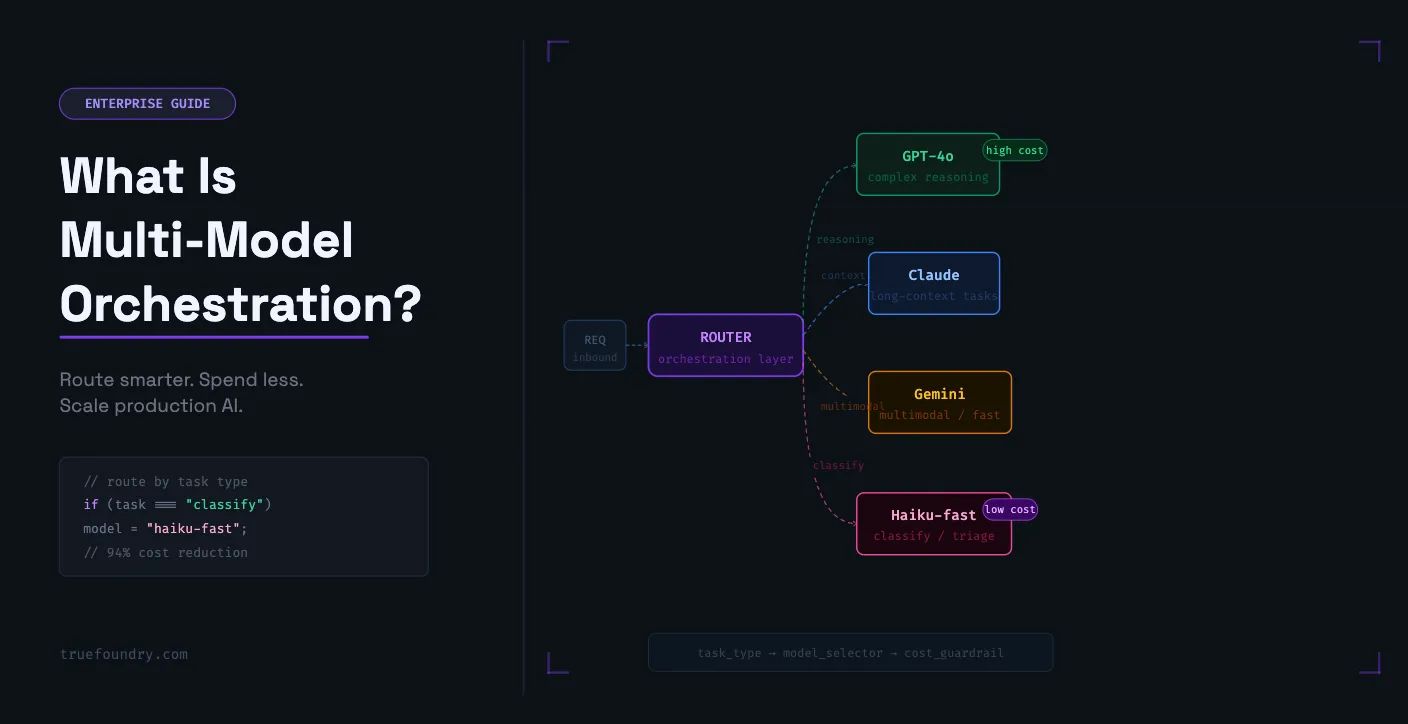
One of the biggest levers is smart model selection. Not every request needs a premium model. TrueFoundry enables intelligent routing so that simple queries are handled by cheaper models, while only complex tasks use expensive ones. This avoids paying for unnecessary capability.
Efficiency can be further improved through batching and caching. Repeated or similar requests can be cached, while batch processing reduces per-request overhead, cutting down both latency and cost.
Another high-impact area is prompt optimization. By reducing prompt size, through better structuring, trimming context, or using techniques like Retrieval-Augmented Generation (RAG), teams can significantly lower token usage without sacrificing output quality.
For teams running their own models, infrastructure optimization becomes critical. TrueFoundry supports:
These capabilities ensure high utilization and minimal waste across GPU workloads.
The final piece of the puzzle is making all this data usable through clear, real-time dashboards.
TrueFoundry makes this straightforward by exposing structured, attribution-rich metrics from the AI Gateway.
Teams can use these metrics in Grafana, Datadog, or BI tools to track key views such as cost by team, token usage by model, and cost per customer, feature, or environment. Because every request is tagged with metadata, dashboards can be dynamically filtered, making it easy to drill down into a specific customer or project in seconds.
These dashboards integrate seamlessly with existing observability and finance systems via OpenTelemetry or APIs, creating a unified view of both AI and infrastructure costs.
The result is true cross-functional visibility: engineering understands the cost impact of their decisions, finance gets real-time cost tracking, and leadership can align AI spend with business outcomes.
Implementing FinOps for AI is an ongoing journey. It starts with awareness and grows into a discipline embedded in the AI development lifecycle. By establishing visibility, accountability, and optimization practices, organizations progress in FinOps maturity – from reactive cost reports to real-time cost control to eventually predictive optimization. Most importantly, building a FinOps culture around AI ensures sustainability.
AI adoption will stall if costs grow unchecked or unpredictably. By viewing AI through a FinOps lens, organizations treat model access and GPU time as valuable resources to be managed, not limitless magic. This cultural shift is enabled by tooling: when teams have self-service access to metrics and cost reports, they can take ownership.
TrueFoundry’s solution accelerates this cultural adoption by making AI usage transparent and governed by design – cost visibility and controls come baked into the platform, not as an afterthought.
Start building cost-efficient AI systems today with TrueFoundry. Sign up today.
TrueFoundry AI Gateway delivers ~3–4 ms latency, handles 350+ RPS on 1 vCPU, scales horizontally with ease, and is production-ready, while LiteLLM suffers from high latency, struggles beyond moderate RPS, lacks built-in scaling, and is best for light or prototype workloads.
FinOps for AI is the practice of managing and optimizing AI-related costs by combining engineering, finance, and business insights. It focuses on tracking usage, attributing spend, and improving efficiency across models, infrastructure, and workflows while aligning AI investments with measurable business value.
AIOps focuses on using AI to improve IT operations like monitoring, incident detection, and automation. FinOps, on the other hand, is about managing and optimizing costs. FinOps for AI specifically ensures AI usage is financially efficient, accountable, and aligned with business goals.
FinOps will not be replaced by AI, but it will be enhanced by it. AI can automate cost analysis, anomaly detection, and optimization recommendations, but human oversight is still required to align spending decisions with business priorities and strategic goals.
Product
Company
Resources



.webp)

.webp)
.webp)
.webp)
.webp)






.webp)
.webp)
.webp)
.webp)
.webp)
.webp)

.webp)
.webp)