|
VOOZH | about |
|
VOOZH | about |
TrueFoundry recognized in Gartner Hype Cycle for Platform Engineering 2026. Read the full report →
Join our VAR & VAD ecosystem — deliver enterprise AI governance across LLMs, MCPs & Agents. Become a Partner →
Get instant access to a live TrueFoundry environment. Deploy models, route LLM traffic, and explore the full platform — your sandbox is ready in seconds, no credit card required.
Blazingly fast way to build, track and deploy your models!
In the public sector today, we are witnessing a collision. On one side, we have the Unstoppable Force of Generative AI. Agency leaders know that Large Language Models (LLMs) can reduce document processing times from days to seconds. They see the potential for massive efficiency gains.
On the other side sits the Immovable Object: Compliance. Specifically, the Federal Information Processing Standards (FIPS) requirements. These aren't just red tape; they are the non-negotiable laws of physics for government data.
The common belief is that you must choose: Speed or Security. You can either have a modern, agile AI stack that breaks the rules, or a compliant, "safe" stack that is years behind the curve.
We disagree. You don't have to choose. You just need the right architecture, which we deliver through the Truefoundry AI Gateway. We call it the "On-Prem Cloud" Strategy.
Before we talk about the solution, let’s be diplomatic but direct about the problem. Why do we need FIPS? Why can't we just use the standard API keys for OpenAI or Anthropic?
Before we discuss the solution, we must clearly define the constraint.
FIPS (Federal Information Processing Standards), specifically FIPS 140-3 (https://csrc.nist.gov/pubs/fips/140-3/final), is the official U.S. government standard for cryptographic modules. It does not simply ask, "Is your data encrypted?" It asks a far more rigorous question: "Is the specific mathematical module performing the encryption validated by a NIST-accredited laboratory?"
For government agencies, this is non-negotiable. If data—or the secrets protecting that data—is handled by a non-validated module (like standard OpenSSL found in most commercial software), it is effectively considered "plaintext" in the eyes of an auditor.
The Conflict with Modern AI: Custody of Secrets The intersection of FIPS and Generative AI creates a critical vulnerability regarding API Keys. Modern LLMs (like GPT-4 or Claude 3.5) function by exchanging long-term secrets—API keys—that grant access to your agency's data and budget.
The Shadow AI Consequence: When agencies fail to provide a compliant architecture for these keys, teams are forced to go rogue.
The takeaway: If you don't give your teams a secure, compliant way to use AI, they will find an insecure way to do it.
Truefoundry is an AI Gateway—a control plane that manages your LLM interactions. It brings Frontier-Class Capabilities like model routing, caching, and cost tracking.
Now, let's address the elephant in the room: Truefoundry's software itself is not FIPS 140-2 validated. It holds robust commercial certifications like SOC 2 Type II and HIPAA, which proves it is mature and secure for enterprise use. But it does not carry the specific FedRAMP High badge required for defense workloads.
So, how do we use it in a government environment?
We use the "Fortress Strategy."
We deploy Truefoundry’s Data Plane as a self-hosted ("On-Prem") workload inside your existing AWS GovCloud or Azure Government by Microsoft Azure or Google Public Sector from GCP (in the rest of the blog, we use AWS GovCloud to illustrate but the same principle applies to Azure and GCP) environment.
By nesting the application inside the secure infrastructure, we achieve compliance through inheritance.
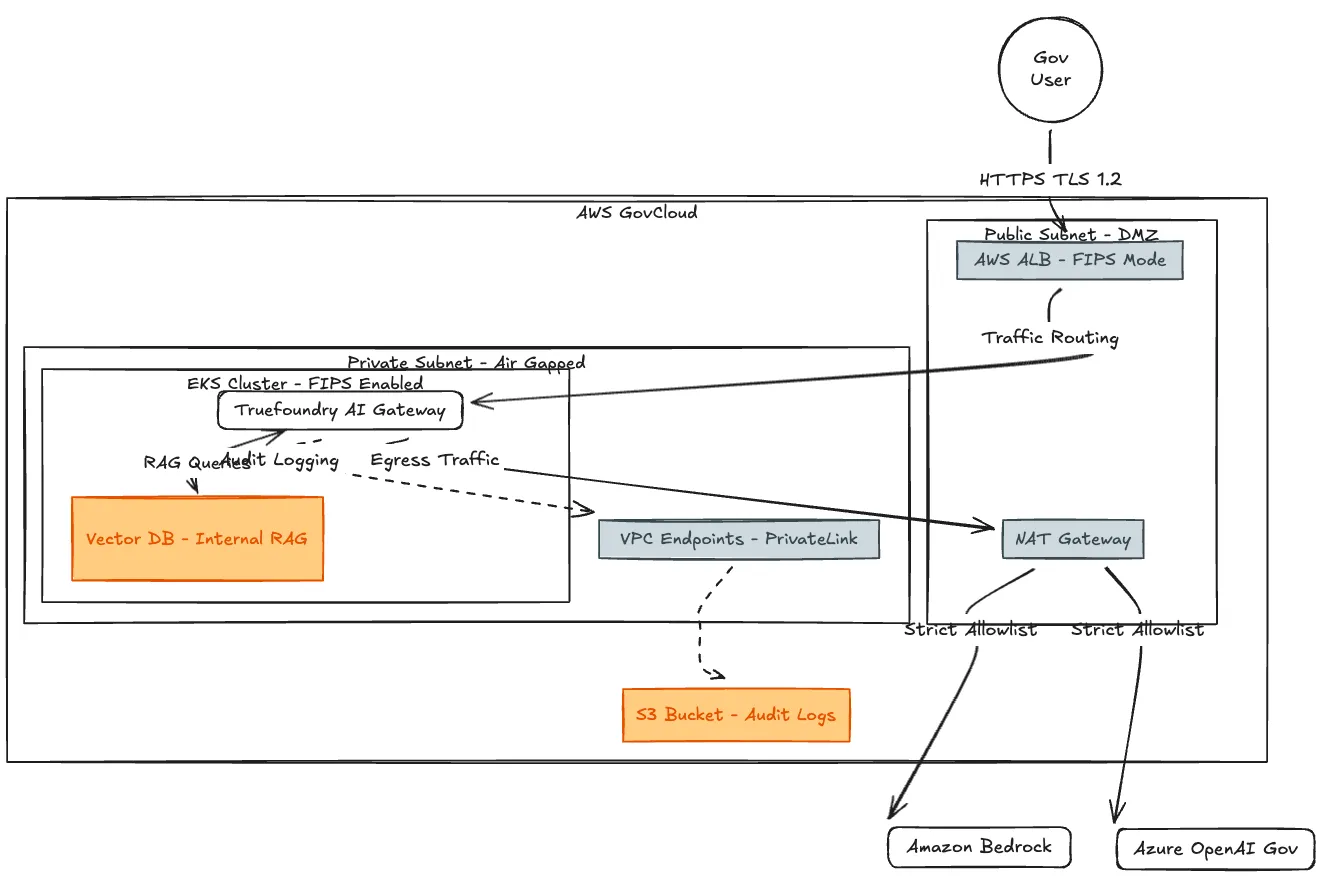
How do we isolate the non-FIPS software inside a FIPS-compliant shell? We treat the Truefoundry Gateway as a "Black Box" protected by AWS services.
Fig 1: Overall Conceptual Model
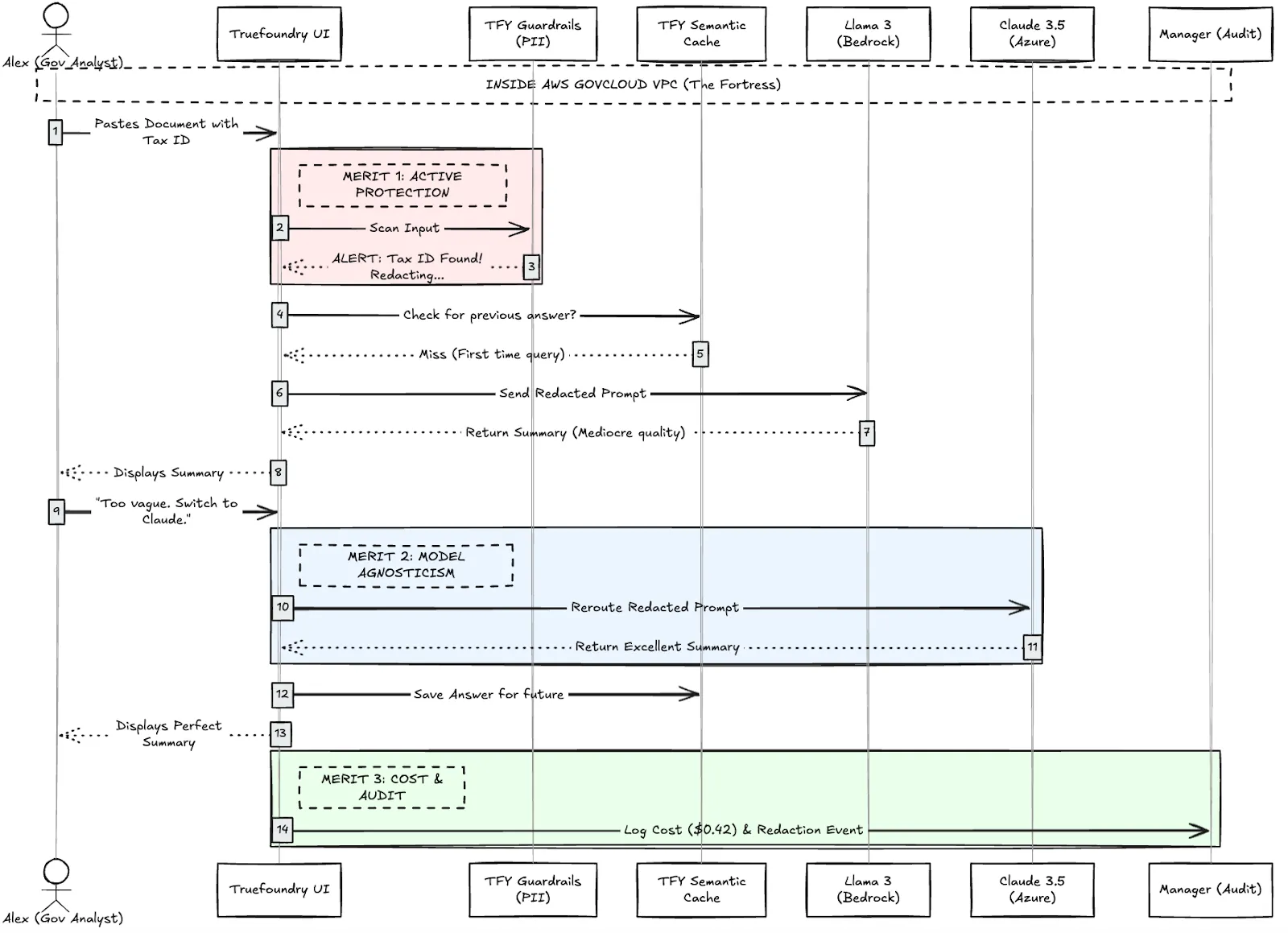
Architecture diagrams are great for engineers, but let’s look at how this changes the daily reality for Alex, a Senior Analyst. This workflow demonstrates how the "Fortress" handles a real-world task while protecting the agency from mistakes.
The Mission: Alex has a vendor proposal containing Controlled Unclassified Information (CUI) and potential PII. He needs a summary in 20 minutes.
Fig 2: User workflow with Merits by TrueFoundry
Alex pastes the text into the Truefoundry UI. He doesn't notice that page 4 contains a vendor's Tax ID.
The system routes the redacted prompt to Llama 3 on Bedrock. The summary comes back "mediocre."
Once Alex gets his "Perfect Summary," two background processes trigger:
Truefoundry’s "On-Prem" approach allows government agencies to have their cake and eat it too.
By nesting the Truefoundry Data Plane inside AWS GovCloud, you create a system that is:
This isn't just about checking a box on a compliance form. It's about empowering people like Alex to do their jobs safely, efficiently, and without fear of becoming the next headline.
TrueFoundry AI Gateway delivers ~3–4 ms latency, handles 350+ RPS on 1 vCPU, scales horizontally with ease, and is production-ready, while LiteLLM suffers from high latency, struggles beyond moderate RPS, lacks built-in scaling, and is best for light or prototype workloads.
Product
Company
Resources








.webp)
.webp)
.webp)
.webp)
.webp)
.webp)

.webp)
.webp)