|
VOOZH | about |
|
VOOZH | about |
TrueFoundry recognized in Gartner Hype Cycle for Platform Engineering 2026. Read the full report →
Join our VAR & VAD ecosystem — deliver enterprise AI governance across LLMs, MCPs & Agents. Become a Partner →
Get instant access to a live TrueFoundry environment. Deploy models, route LLM traffic, and explore the full platform — your sandbox is ready in seconds, no credit card required.
Blazingly fast way to build, track and deploy your models!
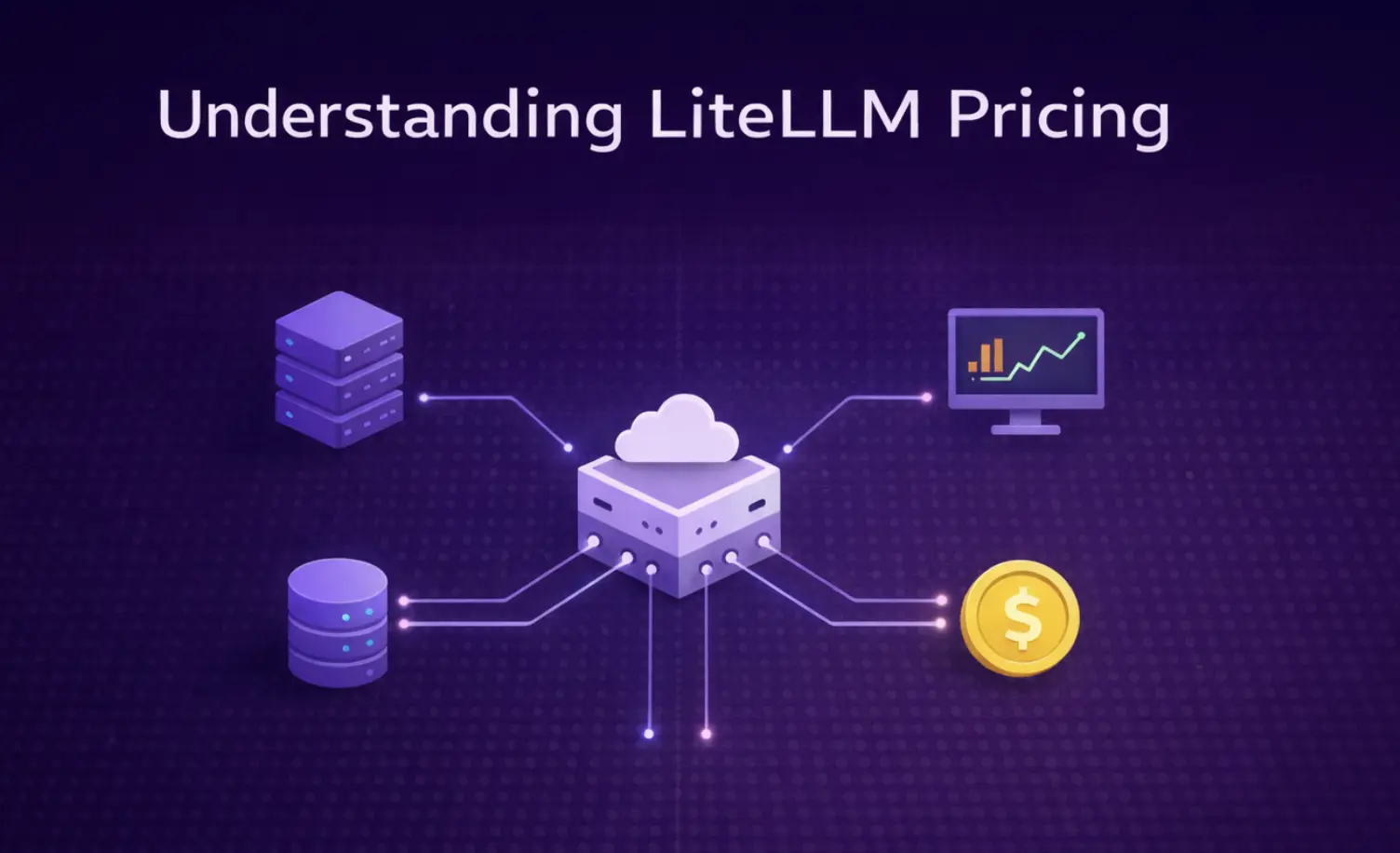
LiteLLM pricing has two layers: the open-source gateway is free to self-host, while LiteLLM enterprise pricing starts around $250/month (Enterprise Basic) and scales to roughly $30,000/year (Enterprise Premium) — but the biggest cost is usually the infrastructure, DevOps and observability you run around it.
LiteLLM is an open source proxy that's free to use and community-maintained. Best for teams with strong DevOps expertise who want complete infrastructure control and can handle self-hosting complexity without enterprise SLAs or dedicated support.
LiteLLM AI gateway is an open source Python SDK and proxy server that provides a unified interface to call 100+ LLM APIs using an OpenAI-compatible format. The project started as a simple wrapper library to standardize LLM calls across different LLM providers like OpenAI, Anthropic, Azure, Vertex AI, Bedrock, and others.
Unlike managed AI gateways that offer hosted infrastructure and enterprise support, LiteLLM AI gateway operates on a fundamentally different model. You download the open source code, deploy it on your own infrastructure, and maintain it yourself. There are no usage-based fees, no log limits, and no request quotas imposed by LiteLLM AI gateway itself.
However, this "free" approach comes with hidden costs that many teams underestimate during evaluation.
LiteLLM pricing philosophy is straightforward: the software is free (MIT licensed), but you own the entire operational burden.
1. LiteLLM Software License
The proxy server software itself is $0. You can fork it, modify it, and use it commercially without any licensing fees. This often leads teams to compare infrastructure spend with broader LLM licenses, especially when deciding between open-source gateways and commercial AI platforms that bundle software, support, and governance into one contract.
2. Infrastructure Costs
You pay for servers, databases, monitoring tools, load balancing, and all supporting infrastructure. For a production deployment handling moderate traffic, typical infrastructure costs range from $200-$500 monthly depending on traffic volume, redundancy requirements, and cloud provider.
3. LLM Provider Costs
You pay LLM providers (OpenAI, Anthropic, etc.) directly at their standard API rates. LiteLLM doesn't add any markup or transaction fees.
In 2024, LiteLLM introduced commercial enterprise offerings for teams that want additional features and support:
Most teams evaluating LiteLLM are considering the free open source version, not these enterprise tiers.
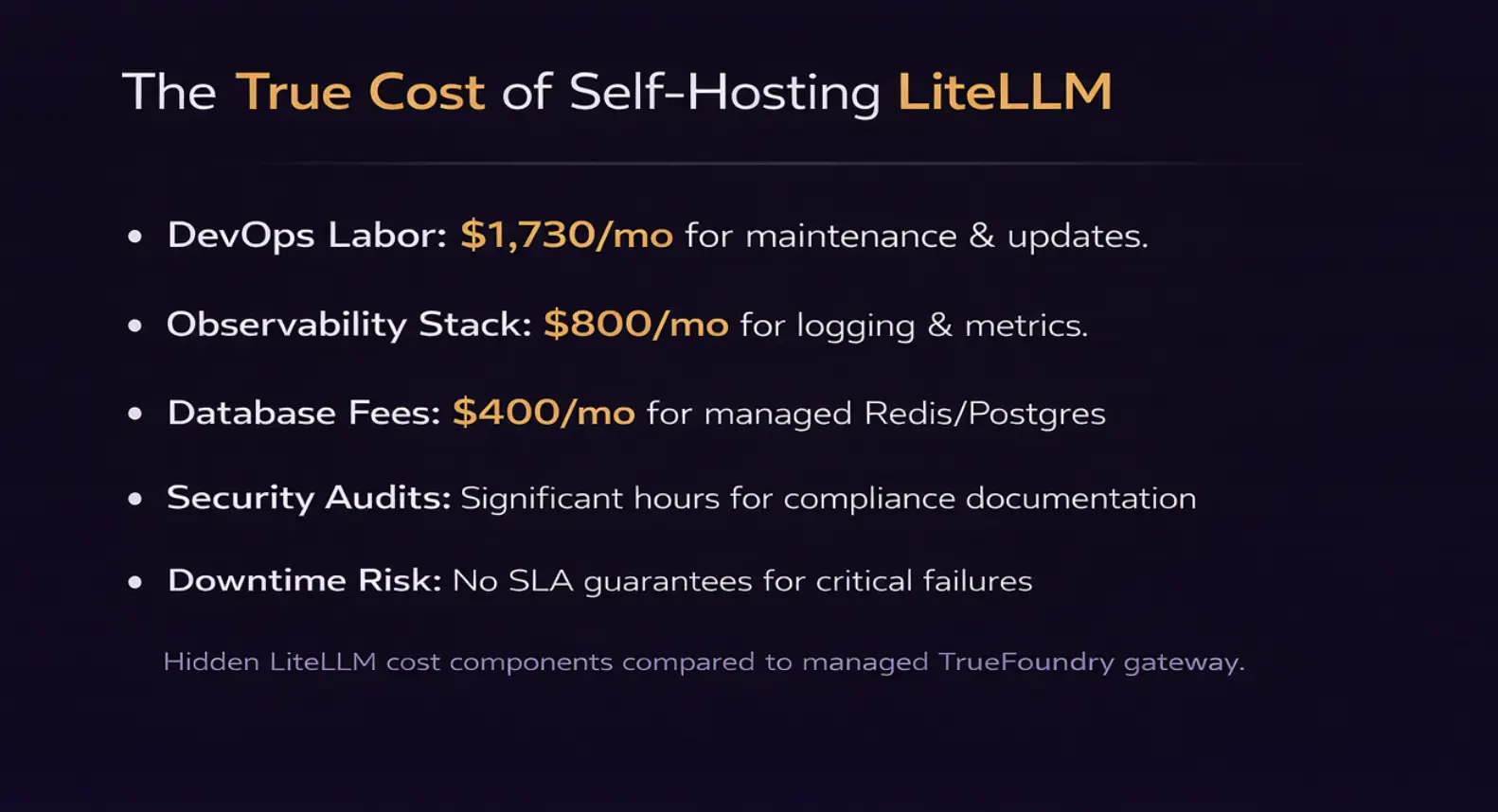
When engineering teams evaluate LiteLLM pricing, they often focus on the $0 price tag without accounting for total cost of ownership (TCO). Here are the hidden costs that emerge in production:
Running LiteLLM gateway in production requires dedicated engineering time for:
For a senior DevOps engineer at $150K annual salary, 20 hours monthly of maintenance translates to approximately $1,730 in labor costs per month.
LiteLLM gateway features in the open source version don't include production-grade observability out of the box. You need to integrate:
Setting up and maintaining this observability stack adds another $200-$800 monthly in infrastructure costs, plus engineering time for configuration and tuning.
The LiteLLM proxy requires a database (typically PostgreSQL or Redis) for:
For production LLM deployments, you need managed database services with backups, replication, and high availability. Expect $100-$400 monthly depending on scale.
Without a vendor managing security updates, your team is responsible for:
For enterprises with compliance requirements, the lack of vendor-provided security certifications and SLAs creates significant audit friction.
LiteLLM AI is community-maintained, which means:
For startups and small teams, this community-driven model can work well. For enterprises running mission-critical AI applications serving millions of users, the lack of dedicated support is a significant risk.
Price: $0 for software license | Infrastructure: $200-$500/month typical
Best For: Teams with strong DevOps capabilities who need complete infrastructure control and can handle self-hosting complexity.
The open source version includes unified API access to 100+ LLM providers, virtual key management, budget tracking per key/user, load balancing and fallback routing, rate limiting (RPM/TPM), and integrations with Langfuse, LangSmith, and OpenTelemetry logging.
What You Manage:
Real-World TCO Example:
For a mid-sized team running LiteLLM Gateway in production on AWS with moderate traffic (1-5M requests/month), typical monthly costs look like:
| Cost Component | Monthly Cost |
|---|---|
| EC2 instances (3x for HA) | $150–$250 |
| RDS PostgreSQL (managed) | $100–$200 |
| Load balancer | $30–$50 |
| CloudWatch monitoring | $50–$100 |
| DevOps maintenance (20 hrs) | $1,730 |
| Total Monthly TCO | $2,060–$2,330 |
This doesn't include initial setup time (2-4 weeks) or incident response costs.
Price: $250/month | Deployment: Cloud or self-hosted
Best For: Teams who want enterprise features but still manage infrastructure
Enterprise Basic adds Prometheus metrics and custom callbacks, LLM guardrails for content filtering, JWT authorization for API security, SSO integration (Okta, Azure AD), and audit logs for compliance.
What You Still Manage:
The $250/month fee covers software licensing and access to LiteLLM gateway features, but you still handle all operational aspects. Total TCO is $250 + infrastructure costs ($300-$700) + DevOps time ($1,730) = approximately $2,280-$2,680/month.
Price: $30,000 annually ($2,500/month) | Deployment: Cloud or self-hosted
Best For: Large organizations with substantial token usage who need advanced compliance features and priority support
Enterprise Premium includes all Enterprise Basic features plus priority support with faster response times, dedicated account management, custom feature development, and assistance with compliance certifications (SOC 2, HIPAA).
What You Still Manage:
Total TCO is $2,500 + infrastructure costs ($300-$700) + reduced DevOps time (10-15 hrs, approximately $865-$1,300) = approximately $3,665-$4,500/month.
Here's how LiteLLM pricing compares to managed AI gateway alternatives across pricing models and operational burden:
| Dimension | LiteLLM (OSS) | TrueFoundry | Portkey | Kong |
|---|---|---|---|---|
| Software License | Free | Included in plans | Included in plans | Per-model pricing |
| Infrastructure | You manage | Fully managed | Fully managed | Fully managed |
| Pricing Model | Infrastructure + labor | Per request | Per log | Per model |
| Free Tier | Unlimited (you pay infra) | 50K requests/month | 10K logs/month | None |
| Entry Price | $0 (+ $2K TCO) | $499/month (1M reqs) | $9 per 100K logs | $100/model/month |
| DevOps Burden | High | None | None | Low-Medium |
| SLA Guarantees | None | 99.9% uptime | 99.9% uptime | 99.95% uptime |
| Support | Community | Dedicated | Email/chat | Enterprise |
| Deployment | Self-hosted only | Hybrid/VPC from Enterprise tier | Cloud (VPC at Enterprise) | Cloud/hybrid |
| Monthly Requests | LiteLLM OSS (TCO) | TrueFoundry | Portkey | Kong (2 models) |
|---|---|---|---|---|
| 100K | ~$2,100 (infra + labor) | Free tier | Free tier | $200 |
| 500K | ~$2,200 | Free tier | $45–$90 | $200 |
| 1M | ~$2,300 | $499 | $171–$231 | $200 |
| 5M | ~$2,500 | $499 (Pro) or custom | $5,000+ (Enterprise) | $200 |
| 50M | ~$3,500+ | Custom (Enterprise) | Custom | Custom |
Key Insight: LiteLLM's TCO remains relatively flat because labor costs dominate. At low volumes (<500K requests/month), LiteLLM AI is actually more expensive than managed alternatives when you account for DevOps time. LiteLLM only becomes cost-competitive at very high scales (>50M requests/month) where the $2,500-$3,500 monthly TCO is significantly less than enterprise pricing from managed vendors.
LiteLLM gateway self-hosted model is ideal for specific use cases where operational control justifies the DevOps burden:
If your team already runs complex infrastructure (Kubernetes, observability stacks, CI/CD pipelines) and has dedicated platform teams, the incremental cost of managing LiteLLM AI gateway is relatively low. Your DevOps team can integrate LiteLLM into existing infrastructure-as-code workflows without significant overhead.
Ideal Profile:
For teams with strict data residency requirements, air-gapped environments, or regulatory constraints that prohibit third-party SaaS vendors, self-hosting is often the only option. LiteLLM AI provides a production-ready proxy that you can deploy entirely within your controlled environment.
Use Cases:
If you're building an AI application platform that serves other businesses (B2B2C model), you may want to manage the gateway infrastructure yourself to:
Self-hosting LiteLLM gateway gives you complete control to modify the proxy code for your specific platform requirements.
At extremely high request volumes, the fixed costs of DevOps labor become a smaller percentage of total spend. A $3,500/month TCO for infrastructure and maintenance is attractive when managed vendor pricing reaches $20,000-$50,000/month at equivalent scale.
Breakeven Analysis:
If your use case is straightforward (basic load balancing, simple fallback routing, minimal observability), LiteLLM gateway features in the open source set may suffice. Teams that don't require semantic caching, prompt registries, advanced RBAC, or compliance certifications can avoid paying for enterprise features they won't use.
Despite the $0 software license, many enterprises and high-growth startups choose managed AI gateways over LiteLLM for several reasons:
Deploying and configuring LiteLLM for production takes 2-4 weeks of engineering time. For startups racing to launch new AI features or enterprises with aggressive roadmaps, this setup time represents opportunity cost. Managed gateways like TrueFoundry or Portkey offer instant deployment with production-grade infrastructure in minutes, not weeks.
Example Scenario: A fintech startup is launching an AI-powered financial advisor chatbot. Delaying launch by 3 weeks to set up LiteLLM infrastructure means lost revenue, competitive disadvantage, and missed investor milestones. The team opts for TrueFoundry's managed gateway to launch in 2 days instead of 3 weeks.
Every hour your DevOps team spends managing LiteLLM infrastructure is an hour not spent building product features that differentiate your business. For most companies, the AI gateway is critical infrastructure but not a competitive advantage in itself.
Opportunity Cost Calculation:
Community-maintained open source projects don't provide uptime SLAs or legally binding support commitments. If a critical bug in LiteLLM causes your production AI application to fail, you're dependent on GitHub issues and community response times.
Risk Scenario: Your AI customer support chatbot (serving 100K users daily) goes down due to a LiteLLM proxy bug. Without vendor SLA commitments, you have no recourse for damages, no guaranteed fix timeline, and no dedicated support engineer to investigate. Your reputation and customer trust suffer.
Managed vendors provide 99.9% uptime SLAs with financial penalties if they fail to meet commitments.
LiteLLM focuses on basic proxy functionality (unified API, load balancing, rate limiting). It lacks advanced capabilities that modern AI applications need:
For teams building sophisticated agentic AI applications, these missing features force additional engineering work or push teams toward managed platforms.
During SOC 2, ISO 27001, or HIPAA audits, self-hosted infrastructure creates documentation overhead. You must demonstrate:
Managed vendors provide pre-certified infrastructure and audit support, reducing compliance burden significantly.
TrueFoundry offers a fully managed AI gateway that eliminates LiteLLM's operational burden while providing enterprise-grade features for agentic AI applications.
1. Zero Infrastructure Management
TrueFoundry handles all server provisioning, scaling, monitoring, security patches, and incident response. Your team deploys AI applications in minutes without touching Kubernetes, databases, or Docker containers.
2. Built for Agentic AI with MCP
TrueFoundry natively supports Model Context Protocol (MCP), enabling sophisticated agentic workflows where AI models interact with external tools, databases, and APIs. This is critical for modern AI applications that go beyond simple chat interfaces.
3. Better Cost Structure for Growth
While LiteLLM's TCO remains flat at $2,000-$3,500/month regardless of usage, TrueFoundry offers:
4. Enterprise Governance from Day One
Unlike LiteLLM which requires Enterprise Premium ($30K/year) for compliance features, TrueFoundry Pro ($499/month) includes:
5. VPC and On-Premises DeploymentFor enterprises with data residency requirements, TrueFoundry offers VPC and on-premises deployment at Enterprise tier (similar to Portkey), but without requiring you to manage the underlying infrastructure. You get the control benefits of self-hosting without the operational burden.
Scenario 1: Fast-Growing AI Startup
A Series A startup building an AI coding assistant needs to launch quickly, scale unpredictably, and focus engineering resources on product differentiation rather than infrastructure management. TrueFoundry's managed platform lets them go from zero to production in 2 days with built-in observability, guardrails, and MCP support for agentic workflows.
Scenario 2: Enterprise with Compliance Requirements
A healthcare company building AI-powered clinical decision support needs HIPAA compliance, audit logs, and guaranteed uptime SLAs. Self-hosting LiteLLM creates significant audit overhead and support risk. TrueFoundry provides pre-certified infrastructure with BAAs (Business Associate Agreements) and dedicated compliance support.
Scenario 3: Multi-Model Agentic Application
A fintech company is building an AI financial advisor that uses multiple models (GPT-4 for conversation, Claude for analysis, Gemini for multimodal, and open source models for specialized tasks) and needs to orchestrate tool calls, maintain conversation context, and implement semantic caching. LiteLLM provides basic load balancing but lacks MCP support and semantic caching. TrueFoundry's purpose-built agentic AI platform handles the complexity natively.
LiteLLM pricing and its "free and open source" promise are compelling, but the reality is more nuanced. While the software license costs $0, total cost of ownership (infrastructure, labor, monitoring, support) typically ranges from $2,000-$3,500/month for production deployments. This makes LiteLLM more expensive than managed alternatives at low-to-medium request volumes (<5M requests/month).
LiteLLM makes sense for teams with strong DevOps expertise who need complete infrastructure control for data residency, air-gapped environments, or highly customized platform requirements. It can also be cost-effective at massive scale (>50M requests/month) where fixed DevOps costs become a smaller percentage of total spend.
However, for most teams evaluating AI gateways in 2026, the operational burden of self-hosting LiteLLM outweighs the licensing cost savings. Key disadvantages include:
TrueFoundry provides a managed alternative that eliminates operational burden while offering superior capabilities for modern AI applications. With native MCP support for agentic workflows, semantic caching, comprehensive observability, and enterprise governance features from Pro tier ($499/month), TrueFoundry delivers better value for teams focused on building AI products rather than managing infrastructure.
If your team has dedicated platform engineers, operates in strictly regulated environments requiring self-hosting, or runs traffic exceeding 50 million requests monthly, LiteLLM is worth evaluating. For everyone else, managed platforms like TrueFoundry offer faster deployment, lower TCO at typical scales, and enterprise capabilities that LiteLLM doesn't provide.
The right choice depends on your team's strengths. If infrastructure operations are a core competency and competitive advantage, self-host LiteLLM. If AI product development is your focus, choose a managed platform and invest engineering time in features that differentiate your business.
The software license is free, but total cost of ownership includes infrastructure ($200-$500/month), DevOps labor ($1,500-$2,000/month), monitoring tools ($200-$800/month), and incident response costs. Real-world TCO for production deployments typically ranges from $2,000-$3,500/month, which is higher than managed alternatives at low-to-medium request volumes.
Yes, LiteLLM can scale to handle high request volumes if you architect the infrastructure properly with load balancing, database replication, and horizontal scaling. However, you're responsible for all capacity planning, performance tuning, and incident response. Managed vendors handle this complexity for you.
No, LiteLLM does not currently support MCP natively. It focuses on proxying requests to LLM providers with basic routing and observability. For sophisticated agentic AI workflows, you need a platform like TrueFoundry with native MCP support.
LiteLLM's open source code is auditable, which is a security advantage for teams that can conduct thorough code reviews. However, you're responsible for all security operations: vulnerability patching, dependency updates, access controls, secrets management, and audit logging. Managed vendors provide SOC 2 certified infrastructure, dedicated security teams, and automated patch management, reducing your security operational burden significantly.
You rely on community response via GitHub issues. There's no guaranteed fix timeline, no dedicated support engineer, and no SLA commitment. For mission-critical applications, this support risk can be unacceptable. LiteLLM Enterprise Premium ($30K/year) provides priority support but still requires you to manage infrastructure. Managed vendors provide 24/7 support with guaranteed response times.
Yes, but migration complexity depends on how deeply you've customized LiteLLM. If you're using standard features (unified API, basic routing), migration to TrueFoundry or Portkey is straightforward since they offer OpenAI-compatible APIs. If you've heavily modified LiteLLM's code or built custom integrations, migration requires more engineering effort. Starting with a managed platform reduces future migration risk.
TrueFoundry AI Gateway delivers ~3–4 ms latency, handles 350+ RPS on 1 vCPU, scales horizontally with ease, and is production-ready, while LiteLLM suffers from high latency, struggles beyond moderate RPS, lacks built-in scaling, and is best for light or prototype workloads.
Product
Company
Resources









.webp)
.webp)
.webp)
.webp)
.webp)
.webp)

.webp)
.webp)