|
VOOZH | about |
|
VOOZH | about |
TrueFoundry recognized in Gartner Hype Cycle for Platform Engineering 2026. Read the full report →
Join our VAR & VAD ecosystem — deliver enterprise AI governance across LLMs, MCPs & Agents. Become a Partner →
Get instant access to a live TrueFoundry environment. Deploy models, route LLM traffic, and explore the full platform — your sandbox is ready in seconds, no credit card required.
Blazingly fast way to build, track and deploy your models!
As AI adoption accelerates, teams are no longer relying on a single model provider. Instead, they’re experimenting with multiple large language model (LLM) providers like OpenAI, Anthropic, Google, and Mistral, each offering different strengths in cost, performance, and capabilities.
But this flexibility comes with a cost: complexity.
Managing multiple providers means juggling APIs, billing systems, SDKs, and reliability concerns. As systems grow, what starts as experimentation quickly becomes an operational challenge.
This is where two architectural solutions come into play: OpenRouter and AI Gateway.
While they may seem similar at first glance, they solve very different problems.
Let’s compare OpenRouter vs AI Gateway here.
Most teams creating AI-enabled applications face a similar problem: managing multiple model providers is difficult.
Each provider typically brings:
When developers want to try out different modeling options, this adds extra integration work. This is manageable in the early days of experimentation, but as systems grow, the number of integrations and operational dependencies can become overwhelming.
Model routing platforms, like OpenRouter, can help solve this issue by offering a few interfaces that work with many model providers.
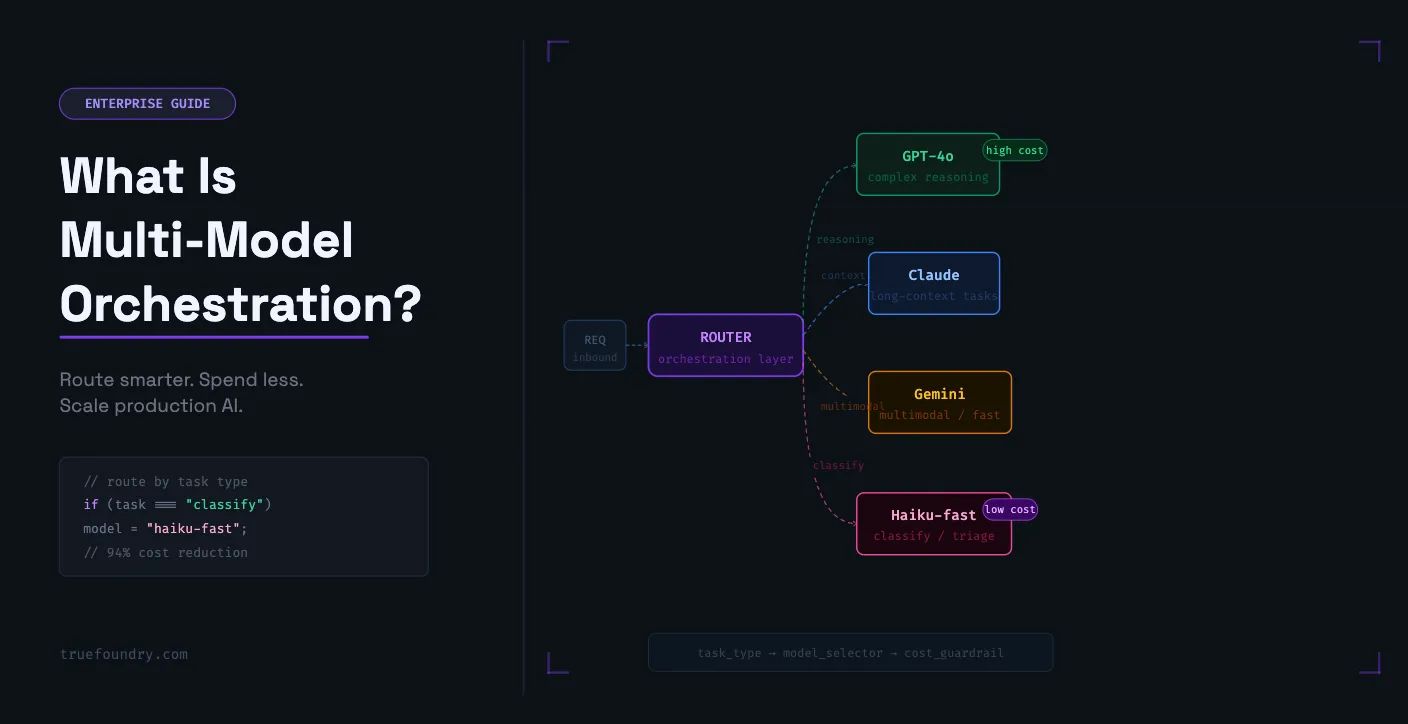
OpenRouter is a powerful model routing service that allows developers to access multiple large language models (LLMs) through a single API. Instead of integrating individually with each model provider, applications send requests to OpenRouter, which then intelligently routes them to the selected provider.
In this setup, OpenRouter acts as an aggregation layer between applications and multiple model APIs, simplifying development while providing flexibility. Developers can choose the model they want and interact with it through one unified integration endpoint, eliminating the complexity of managing multiple APIs.
OpenRouter simplifies access to multiple LLMs through a single API, making experimentation faster and integration easier. Key features include:
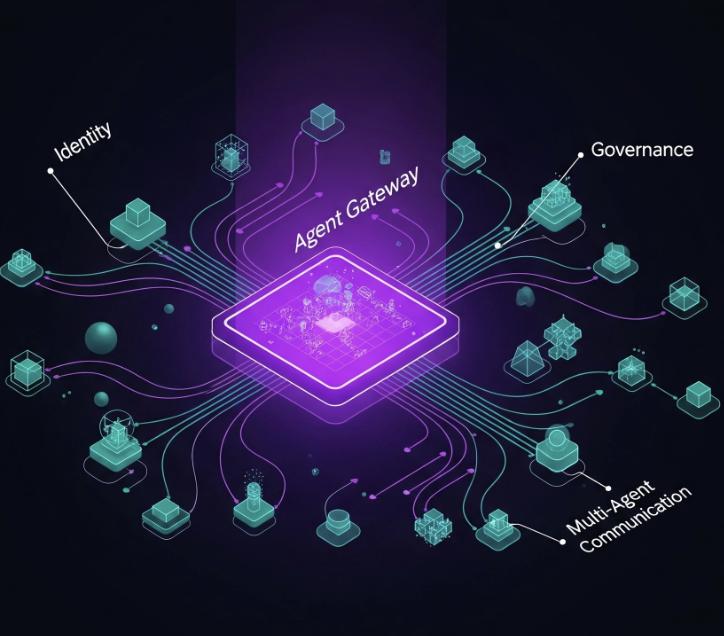
An AI gateway is a centralized infrastructure layer that sits between applications and AI providers, acting as a control plane for production AI workloads. Unlike model routers, which primarily simplify access to multiple models, an AI gateway manages and governs AI traffic across an organization.
Every AI request passes through the gateway before reaching the provider, allowing organizations to enforce policies, maintain security, and monitor AI usage across their infrastructure.
By acting as part of the production inference path, an AI gateway ensures that AI workloads are secure, compliant, and efficiently managed across the organization.
The primary difference between OpenRouter and AI gateway lies in their system architecture and intended purpose.
A model router provides a direct path to multiple model providers, focusing on simplifying access and integration:
Key Focus: Fast, flexible access to multiple models for prototyping and experimentation.
An AI gateway functions as a centralized control plane for all AI workloads within an organization:
Key Focus: Ensuring reliability, security, and governance for production-level AI infrastructure.
The following table highlights the core distinctions between OpenRouter and an AI Gateway:
| Capability | OpenRouter | AI Gateway |
|---|---|---|
| Primary purpose | Model routing and aggregation | Centralized AI infrastructure |
| Deployment | Managed SaaS | VPC, on-prem, hybrid |
| Governance | Limited | RBAC, quotas, audit logs |
| Observability | Basic usage metrics | Full monitoring and tracing |
| Security guardrails | Limited | Policy enforcement and filtering |
| Self-hosted model support | Not supported | Supported |
| Compliance controls | Limited | Enterprise compliance features |
| Infrastructure scope | Developer tooling | Organization-wide control layer |
These differences become even more pronounced at scale, especially when multiple teams share AI workloads across an organization.
OpenRouter is ideal for experimentation and prototyping, offering a lightweight approach for fast iteration. Typical use cases include:
In these scenarios, having a unified API is a major advantage for speed and flexibility.
As AI usage grows, teams need more than model routing. AI Gateways become essential when:
Bottom Line:
Exploring OpenRouter alternatives can help you get the most out of your business needs. Comparing a model router like OpenRouter with an enterprise AI gateway such as TrueFoundry highlights the differences between developer-focused model access and production-grade AI infrastructure.
| Dimension | OpenRouter | TrueFoundry AI Gateway |
|---|---|---|
| Primary purpose | Model routing | Enterprise AI control plane |
| Deployment | Managed SaaS | VPC, on-prem, air-gapped |
| Data privacy | Requests pass through OpenRouter | Requests remain within organization infrastructure |
| Governance | API key controls | RBAC, quotas, audit logs |
| Observability | Basic dashboard | Monitoring across models and teams |
| Guardrails | Limited | Safety policy enforcement |
| Self-hosted models | Not supported | Supports internal model deployments |
| Routing policies | Basic routing | Advanced routing and fallback |
| Compliance | Limited | Enterprise compliance support |
TrueFoundry stands out as a comprehensive AI gateway solution that empowers organizations to scale their AI initiatives safely and efficiently. By combining robust governance, advanced routing, observability, and compliance capabilities, TrueFoundry ensures that AI workloads are secure, reliable, and production-ready. Its support for self-hosted and hybrid models gives teams the flexibility to integrate both internal and external AI systems seamlessly, making it an ideal choice for enterprises looking to elevate their AI infrastructure.
Discover how TrueFoundry can transform your AI operations and streamline model management at scale.
OpenRouter and similar platforms provide a single API to multiple AI models, making prototyping and benchmarking easy. However, for production use, organizations need governance, observability, security, and compliance. AI Gateways deliver this with centralized control, routing policies, usage insights, and support for self-hosted models, enabling a smooth transition from experimentation to production-ready AI infrastructure.
A model router simplifies access to multiple AI providers through a single API, focusing on speed and experimentation. An AI gateway, by contrast, provides a centralized control plane with governance, security, monitoring, routing policies, and compliance, making it suitable for production-scale AI workloads across teams and organizations
No. OpenRouter enables easy access to multiple AI models but lacks production infrastructure features such as governance, compliance enforcement, access controls, and private deployment options. It is ideal for prototyping and experimentation but cannot fulfill the enterprise requirements needed for secure, production-ready AI operations.
Yes. Enterprises running AI in production require centralized systems to manage governance, security, compliance, cost tracking, and monitoring. An AI gateway provides these capabilities, enabling organizations to control AI workloads across teams, enforce policies, integrate internal or external models, and ensure operational reliability and regulatory compliance
No. OpenRouter is a model routing tool, not a full AI Gateway. It simplifies access to multiple AI models but does not provide enterprise-grade governance, security, compliance, monitoring, or infrastructure control, which are essential for production-scale AI workloads.
An AI Gateway is better for production workloads. While OpenRouter is ideal for experimentation, an AI Gateway offers centralized governance, security, observability, compliance, and support for self-hosted models, making it essential for reliable, scalable, and regulated enterprise AI deployments.
Teams should use OpenRouter during prototyping, rapid experimentation, or model benchmarking. It is best for small teams or early-stage projects that need quick access to multiple AI models without the overhead of governance, security, or compliance infrastructure required in production environments.
TrueFoundry is a full enterprise AI Gateway, offering advanced governance, observability, security, compliance, and support for self-hosted models. OpenRouter focuses on model routing and prototyping. TrueFoundry is suitable for production-scale, regulated AI workloads, whereas OpenRouter is best for experimentation and developer testing.
TrueFoundry AI Gateway delivers ~3–4 ms latency, handles 350+ RPS on 1 vCPU, scales horizontally with ease, and is production-ready, while LiteLLM suffers from high latency, struggles beyond moderate RPS, lacks built-in scaling, and is best for light or prototype workloads.
Product
Company
Resources



.webp)
.webp)
.webp)





.webp)
.webp)
.webp)
.webp)
.webp)
.webp)

.webp)
.webp)