|
VOOZH | about |
|
VOOZH | about |
TrueFoundry recognized in Gartner Hype Cycle for Platform Engineering 2026. Read the full report →
Join our VAR & VAD ecosystem — deliver enterprise AI governance across LLMs, MCPs & Agents. Become a Partner →
Get instant access to a live TrueFoundry environment. Deploy models, route LLM traffic, and explore the full platform — your sandbox is ready in seconds, no credit card required.
Blazingly fast way to build, track and deploy your models!
Choosing which type of AI agent to deploy is an architecture decision, not a vocabulary exercise. The agent type determines how it reasons and acts without human intervention. It also determines how far its actions cascade and what governance layer it requires before production deployment.
A simple reflex agent reading a sensor value needs different controls than a multi-agent system coordinating across CRM, database, and communications stacks. Classification shapes the infrastructure decision. Infrastructure decisions shape the risk profile.
This guide covers each agent category, the work it does, where it fits in enterprise use cases, and how TrueFoundry approaches governance across all of them.
Also Read: What Is AI Observability
An AI agent is an autonomous software system that perceives inputs, reasons over them using a model or logic system, and takes actions toward a goal. Human instruction is not required at every step.
The autonomy loop separates an agent from an ordinary model call. The loop runs: evaluate, decide, act, observe, and continue based on what surfaces. That loop is where enterprise workflow value lives. It is also where governance risk concentrates the moment an agent starts operating without controls.
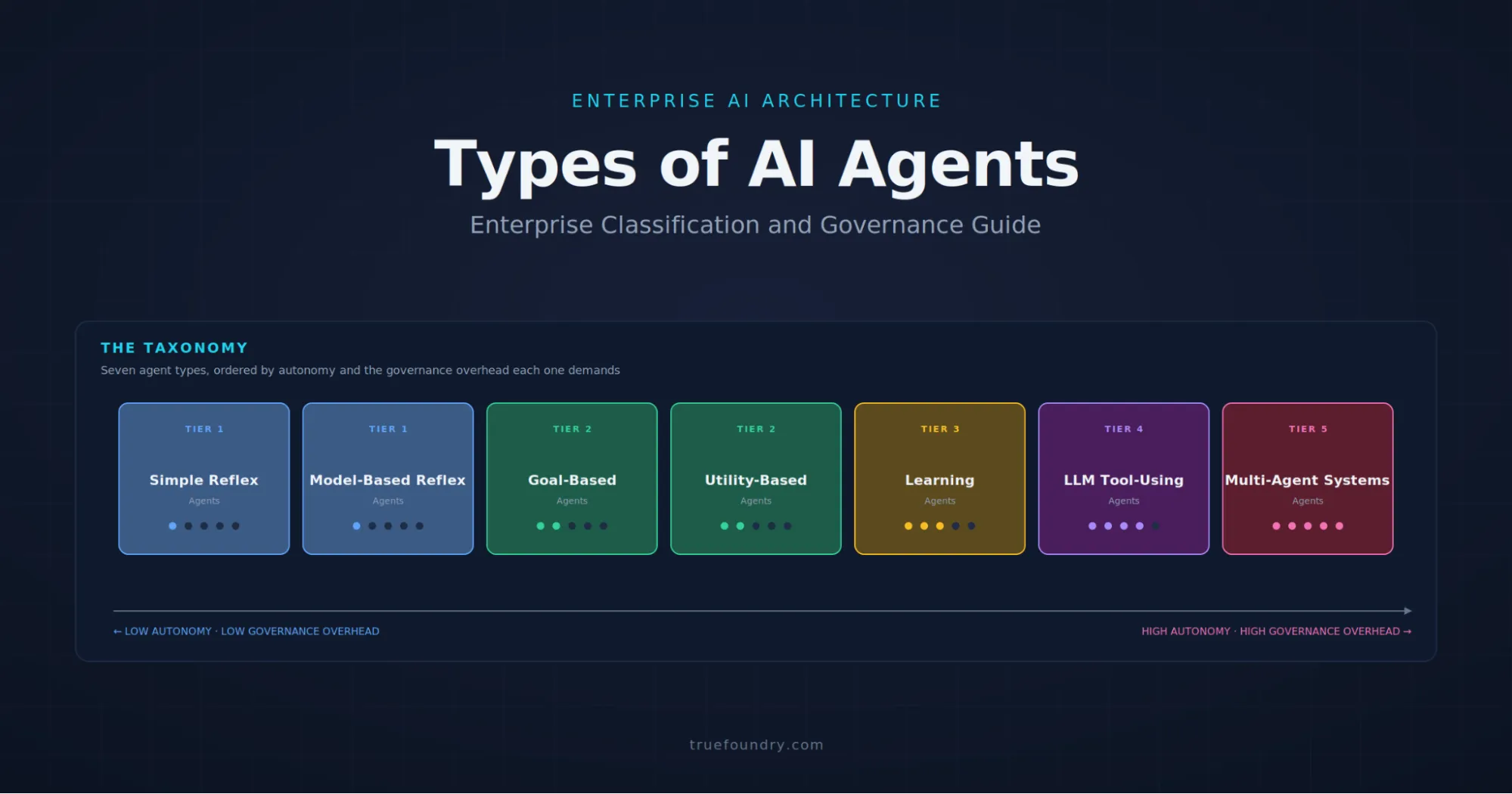
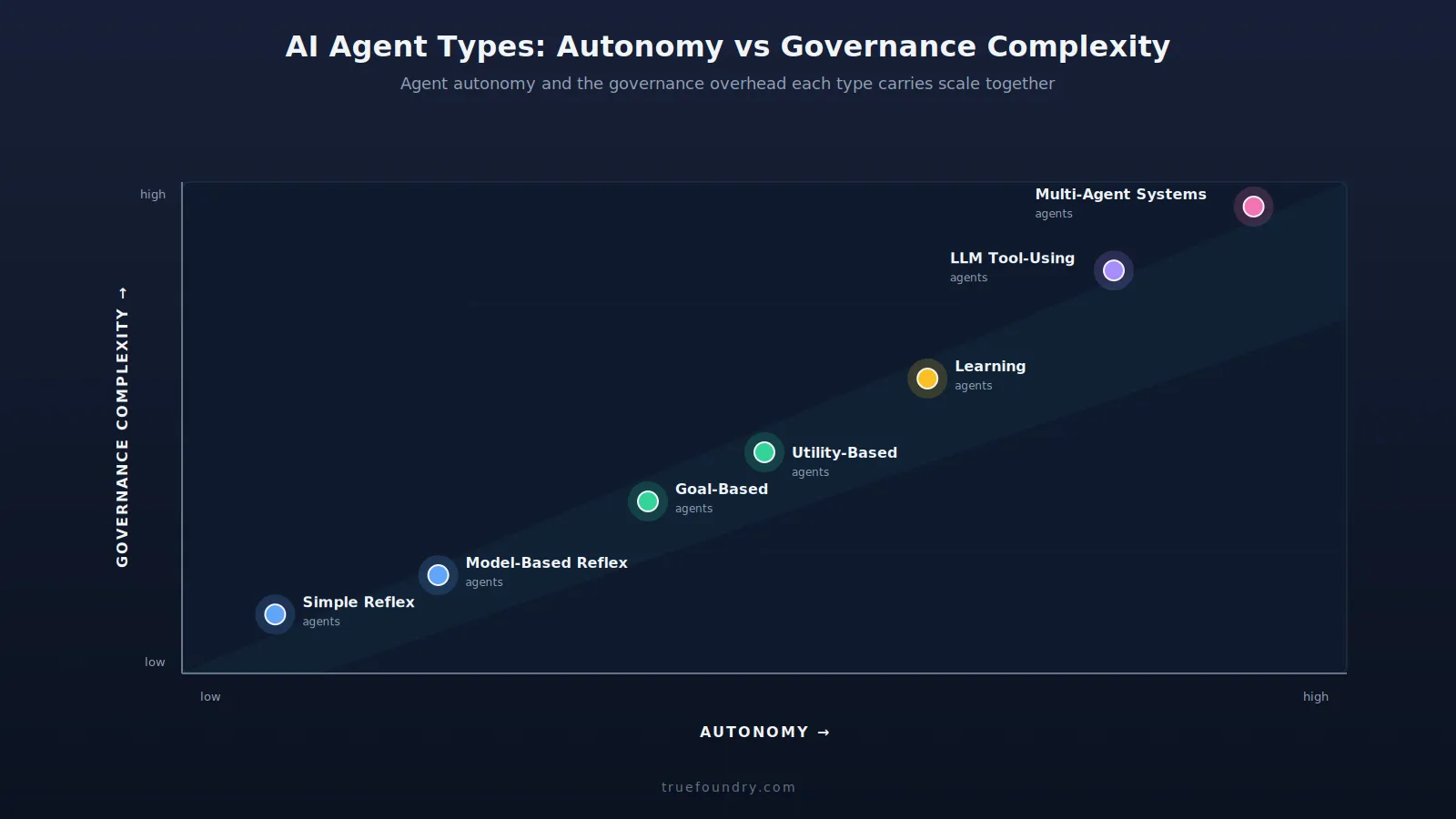
The taxonomy below moves from simpler agents, fixed rules and no memory, to the most complex multi-agent systems. The further down, the more autonomy each agent type carries.
This progression is central to understanding different types of AI agents and what each requires in production infrastructure.
The simplest pattern in the types of AI agents taxonomy. The simple reflex agent acts strictly on the current input using predefined condition-action rules. It stores no memory of prior interactions and makes no plans for future states.
Key characteristics:
| Attribute | Detail |
|---|---|
| Memory | None |
| Planning | None |
| Environment fit | Fully observable environments |
| Input type | Environmental stimuli only |
| Reasoning | If-then rule matching on current state |
What breaks at the edges: Anything outside the ruleset falls through. There is no reasoning, no adaptation, and no path to completing multi-step tasks.
Where it fits: Spam filters, industrial sensor data monitors, rule-based alert systems, and anywhere a consistent response to known patterns is the entire job. These agents excel at repetitive tasks that require speed and precision over adaptability.
A step beyond the simple reflex agent pattern. This agent type carries an internal model of the environment that represents how the world changes over time, allowing it to handle incomplete or ambiguous inputs by filling in from the model of the world rather than failing.
The agent uses its internal state to make better decisions across incomplete information. The internal state must still be programmed manually. The agent does not learn from experience, which puts a hard ceiling on adaptability in dynamic environments.
Where it fits: Autonomous vehicle navigation, robotics, computer vision systems, and industrial control systems, where tracking the internal state of the environment improves the quality of each decision in partially observable environments.
Goal-based agents evaluate possible actions against a defined goal state and select the sequence of steps most likely to lead the system from its current state to the target, reasoning about future consequences of each available path.
Where it goes wrong: Performance tracks the quality of goal definition. A poorly specified goal produces an agent that hits the literal objective while missing the intended outcome, a classic specification-gaming failure.
Where it fits: Route optimization, supply chain optimization, and workflow automation. These agents excel anywhere the end state is clearly definable, and the agent's job is to find the optimal path.
A close cousin of the goal-based agent, with one addition. This type of AI agent assigns a utility function to different possible outcomes and picks actions that maximize expected utility. The result is principled trade-off behavior when objectives compete, rather than binary goal-hitting.
Specifying utility function values correctly at scale is the hard part. Misaligned functions produce agents that optimize aggressively for the wrong measure, which is Goodhart's law appearing in production.
Where it fits: Financial portfolio optimization, resource allocation systems, and recommendation engines. These are contexts where the agent must rank outcomes by business value under uncertainty.
A learning agent architecture has four main components working together:
Active concerns: Training stability and safety are both genuine risks. Learning agents exhibit unexpected behaviors when reward signals are misspecified or when the environment shifts during deployment. Robust feedback loops are required to catch emergent behavior before it reaches users.
Where it fits: Personalization engines, dynamic pricing systems, and fraud detection, and predictive analytics. These are contexts where optimal behavior keeps shifting and manual rule updates cannot keep pace. Reinforcement learning and machine learning, powered by carefully curated training data, are the core mechanisms powering this agent type.
Most enterprise interest in types of AI agents currently flows toward this category. The agent uses large language models for reasoning, planning, and natural language communication, paired with the ability to invoke external tools, APIs, databases, search, code execution to take real-world actions.
Three concerns stack here:
Generative AI and natural language processing power the interface layer, while the tool-calling layer is where agentic AI risks concentrate.
Where it fits: Customer support automation, internal knowledge assistants, developer copilots, and agentic AI workflows wired into CRM, ticketing, and data systems via the TrueFoundry MCP Gateway.
These are the highest-governance AI agents in any enterprise stack. For a detailed breakdown of the security risks specific to this type, see MCP Security Risks and Best Practices.
The pattern: distribute complex tasks among several hierarchical agents, each handling manageable subtasks and reporting back to an orchestrator that coordinates the overall workflow toward a shared goal.
Governance complexity scales faster than the number of agents. A single misconfigured permission in a single agent propagates to every other agent the workflow touches.
| Risk Layer | Specific Risk | Control Required |
|---|---|---|
| Identity | Over-permissioned service accounts | Per-agent OAuth scoping |
| Cost | Runaway token spend across loops | Per-workflow budget limits |
| Audit | Incomplete action traces | Structured per-agent logging |
| Access | Agent-to-agent trust assumptions | Gateway-enforced RBAC |
Use cases: End-to-end workflow agents for business processes automation, research and analysis pipelines, data agents for analytics workflows, software development agents, and anything requiring several specialized AI systems running in sequence across various industries.
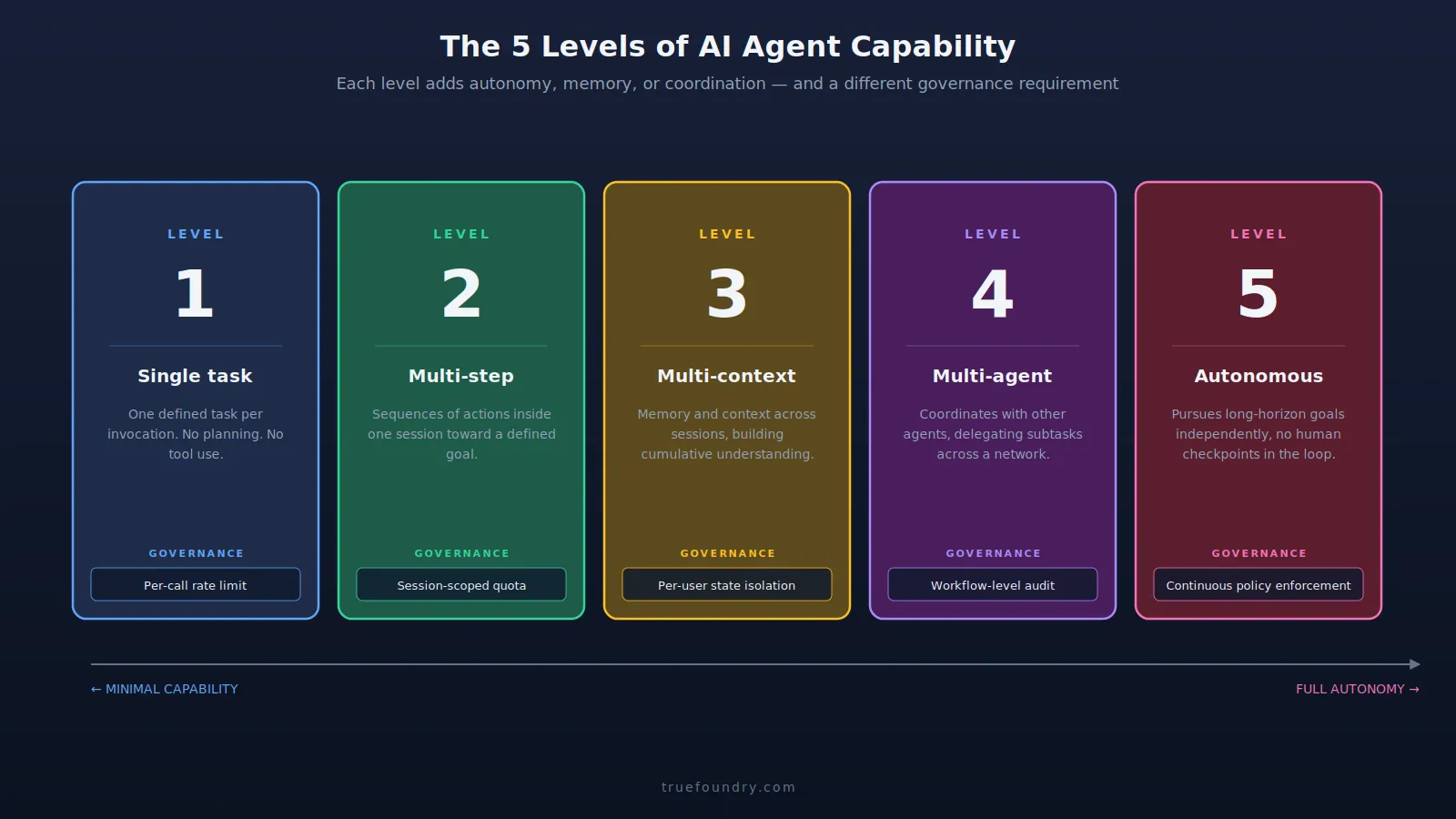
A complementary way to think about types of AI agents, by capability level rather than architecture. The five levels describe the extent of autonomy and coordination an agent can sustain, regardless of its underlying agent type.
| Level | Name | Key Capability | Governance Implication |
|---|---|---|---|
| Level 1 | Single Task | One task per invocation, no planning | Minimal |
| Level 2 | Multi-Step | Sequences of actions within one session | Session-level logging |
| Level 3 | Multi-Context | Memory and context across sessions | Persistent state audit |
| Level 4 | Multi-Agent | Coordination across agent networks | Per-agent identity controls |
| Level 5 | Autonomous | Long-horizon goals, no human checkpoints | Full governance stack required |
The level of autonomy an agent operates at directly determines the governance infrastructure required. A Level 1 agent handling simple tasks in a single-agent setup and a Level 5 autonomous agent in production require fundamentally different control layers.
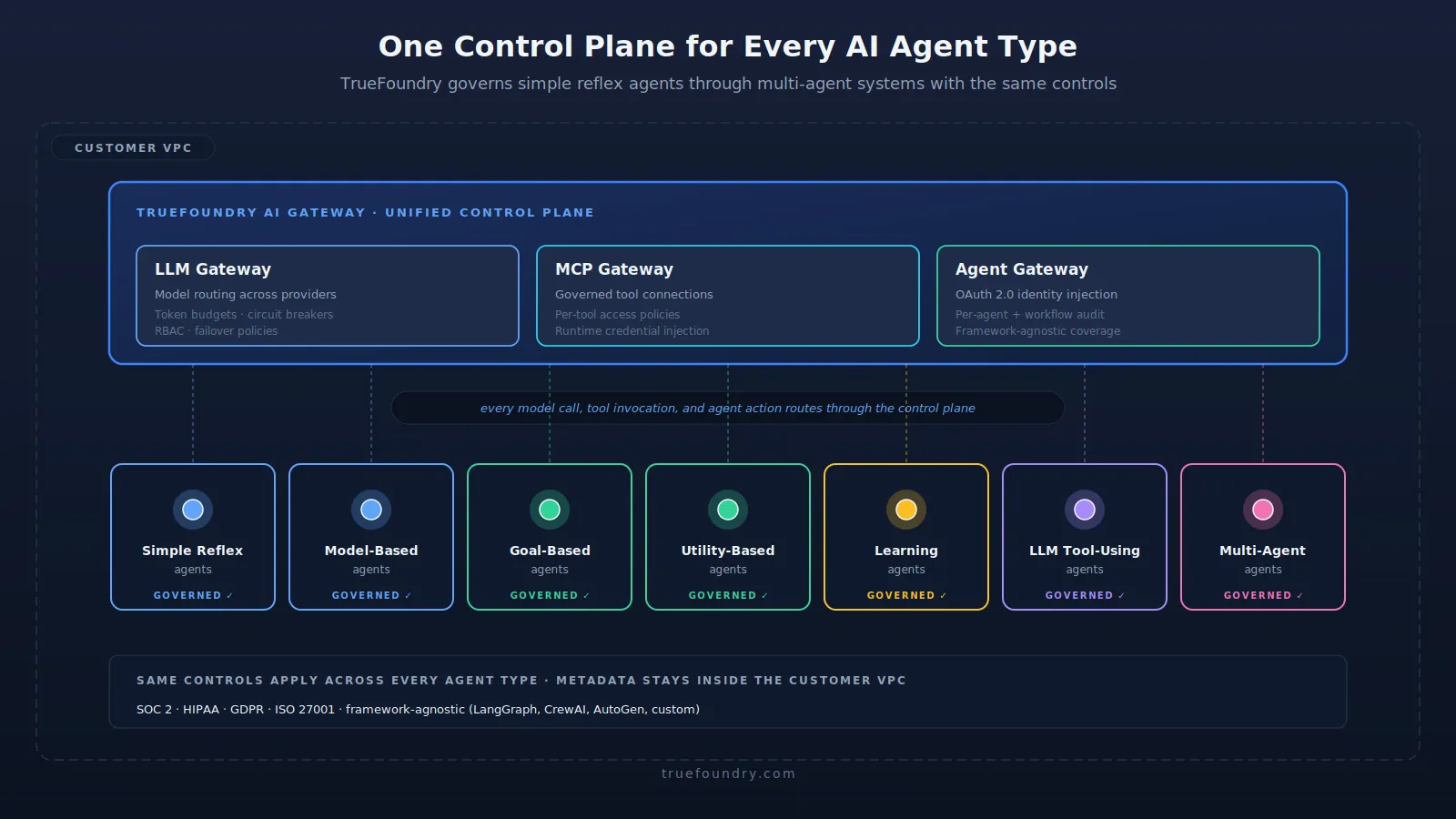
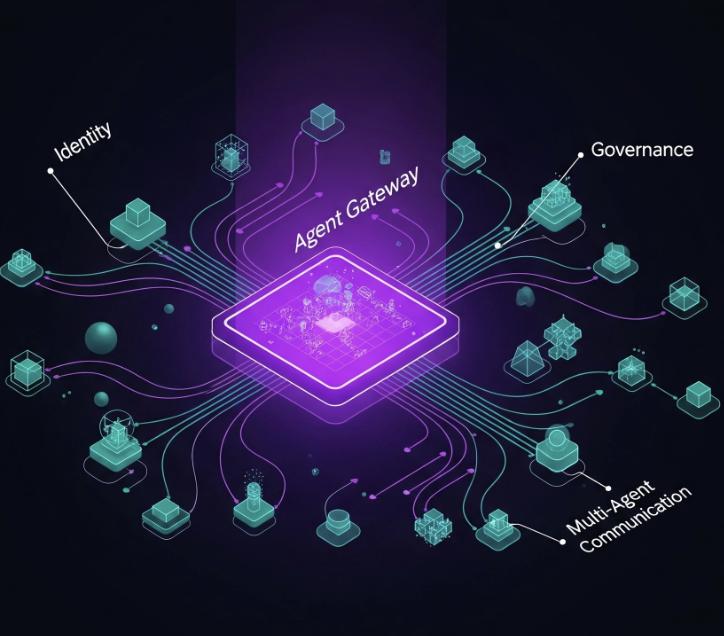
The TrueFoundry AI Gateway bundles an LLM Gateway, an MCP Gateway, and an Agent Gateway to govern every agent category from a single VPC-native control plane. The same controls cover a tool-using customer service agent and a coordinated multi-agent research system.
For teams running multiple agent types in production, or planning a multi-agent rollout, book a demo with the TrueFoundry team.
TrueFoundry AI Gateway delivers ~3–4 ms latency, handles 350+ RPS on 1 vCPU, scales horizontally with ease, and is production-ready, while LiteLLM suffers from high latency, struggles beyond moderate RPS, lacks built-in scaling, and is best for light or prototype workloads.
LLM-powered tool-using AI agents dominate enterprise rollouts, with multi-agent systems gaining ground quickly. Customer service chatbots, developer copilots, internal knowledge assistants, and agentic AI workflows wired into CRM and ticketing via MCP make up most production deployments. Most run on LangGraph, CrewAI, or AutoGen, with governance handled at the gateway layer for natural language processing and tool-call security.
Seven agent categories make up the standard taxonomy: simple reflex agent, model-based reflex, goal-based, utility-based, learning agent, LLM-powered tool-using, and multi-agent systems. The first four belong to classical artificial intelligence. The last three are where modern enterprise deployments concentrate, with LLM-powered and multi-agent patterns requiring the most governance overhead in production AI systems handling complex tasks.
The levels run from Level 1 single-agent task completion per invocation, through multi-step and multi-context AI agents that hold session and cross-session memory, to multi-agent systems that delegate across networks, and finally to Level 5 autonomous agents pursuing long-horizon goals. The level of autonomy determines the governance infrastructure required for each deployment in dynamic environments and enterprise business processes.
Traditional automation runs a fixed script and stops at an unexpected current state. An AI agent reasons about the state it observes, selects the best course of action based on that reasoning, and continues iterating until the goal is reached or a stop condition is met. This shift moves from deterministic execution to autonomous decision-making, requiring a fundamentally different governance posture in complex problems across dynamic environments.
Simple reflex agent types hold no state. Model-based AI agents carry an internal model but no session history. LLM-powered conversational agents usually scope memory to the active session unless an external store extends it. Multi-agent systems and higher-level autonomous agents hold a persistent state across sessions. This drives their power in complex workflows and makes per-workflow audit trails non-negotiable for compliance.
Product
Company
Resources




.webp)





.webp)
.webp)
.webp)
.webp)
.webp)
.webp)

.webp)
.webp)