|
VOOZH | about |
|
VOOZH | about |
TrueFoundry recognized in Gartner Hype Cycle for Platform Engineering 2026. Read the full report →
Join our VAR & VAD ecosystem — deliver enterprise AI governance across LLMs, MCPs & Agents. Become a Partner →
Get instant access to a live TrueFoundry environment. Deploy models, route LLM traffic, and explore the full platform — your sandbox is ready in seconds, no credit card required.
Blazingly fast way to build, track and deploy your models!
As teams adopt large language models across products and internal systems, AI gateways have become a common architectural layer. Instead of integrating separately with each model provider, teams increasingly look for a single API that abstracts provider differences, simplifies routing, and reduces integration overhead.
This has led to the rise of gateway-style offerings that promise faster development and easier experimentation. Among these, Vercel AI Gateway and OpenRouter are frequently compared - often because they both sit between applications and multiple LLM providers.
However, while they appear similar on the surface, the two are built for very different needs and stages of AI adoption. One is optimized for frontend developer experience, while the other prioritizes broad access to models and rapid experimentation.
The goal of this comparison is to clarify those differences across scope, architecture, and production readiness - so teams can choose the right gateway for their use case.
To learn more about the AI Gateway landscape and considerations to take into account before choosing a vendor, read the full Gartner Market Guide for AI Gateways 2025 here.
Vercel AI Gateway is part of Vercel’s broader application platform and is designed to make it easy for developers to consume LLMs inside web and frontend-driven applications.
At a high level, Vercel AI Gateway:
Its primary focus is developer experience. Developers building applications on Vercel can add LLM capabilities with minimal setup, without worrying about provider-specific SDKs or credentials.
Importantly, Vercel AI Gateway is best understood as an application-layer gateway. It is optimized for simplifying LLM usage inside Vercel-hosted apps, rather than acting as an infrastructure-level control plane for AI across teams, environments, or deployments.
OpenRouter is a cloud-based model routing and aggregation platform that provides a single API for accessing a wide range of LLMs across providers
OpenRouter’s core strengths include:
This makes OpenRouter particularly attractive for:
OpenRouter is intentionally lightweight. It focuses on routing and aggregation, not on deployment, governance, or infrastructure management. As a result, it works well as a model router, but is not designed to serve as a centralized AI control layer for production systems.
Also Read: OpenRouter Alternatives
Key Metrics for Evaluating Gateway
| Criteria | What should you evaluate ? | Priority | TrueFoundry |
|---|---|---|---|
| Latency | Adds <10ms p95 overhead for time-to-first-token? | Must Have | ✅ Supported |
| Data Residency | Keeps logs within your region (EU/US)? | Depends on use case | ✅ Supported |
| Latency-Based Routing | Automatically reroutes based on real-time latency/failures? | Must Have | ✅ Supported |
| Key Rotation & Revocation | Rotate or revoke keys without downtime? | Must Have | ✅ Supported |
| Key Rotation & Revocation | Rotate or revoke keys without downtime? | Must Have | ✅ Supported |
| Key Rotation & Revocation | Rotate or revoke keys without downtime? | Must Have | ✅ Supported |
| Key Rotation & Revocation | Rotate or revoke keys without downtime? | Must Have | ✅ Supported |
| Key Rotation & Revocation | Rotate or revoke keys without downtime? | Must Have | ✅ Supported |
| Feature | Vercel AI Gateway | OpenRouter |
|---|---|---|
| Primary audience | Frontend and full-stack developers | LLM developers, researchers, early adopters |
| Core goal | Simplify LLM usage inside Vercel apps | Aggregate and route across many LLM providers |
| Integration focus | Tight coupling with Vercel AI SDK and Next.js | Provider-agnostic API for experimentation |
| Model catalog | Curated set of supported models | Very large catalog (hundreds of models) |
| Deployment model | Fully Vercel-managed cloud | Fully OpenRouter-managed cloud |
| On-prem / VPC support | ❌ Not supported | ❌ Not supported |
| Governance & access control | Minimal | Minimal |
| Observability & cost controls | Limited to app-level usage | Limited, provider-centric |
| Best suited for | Production web apps on Vercel | Rapid model testing and comparison |
| Not designed for | Enterprise-wide AI governance | Production AI control plane |
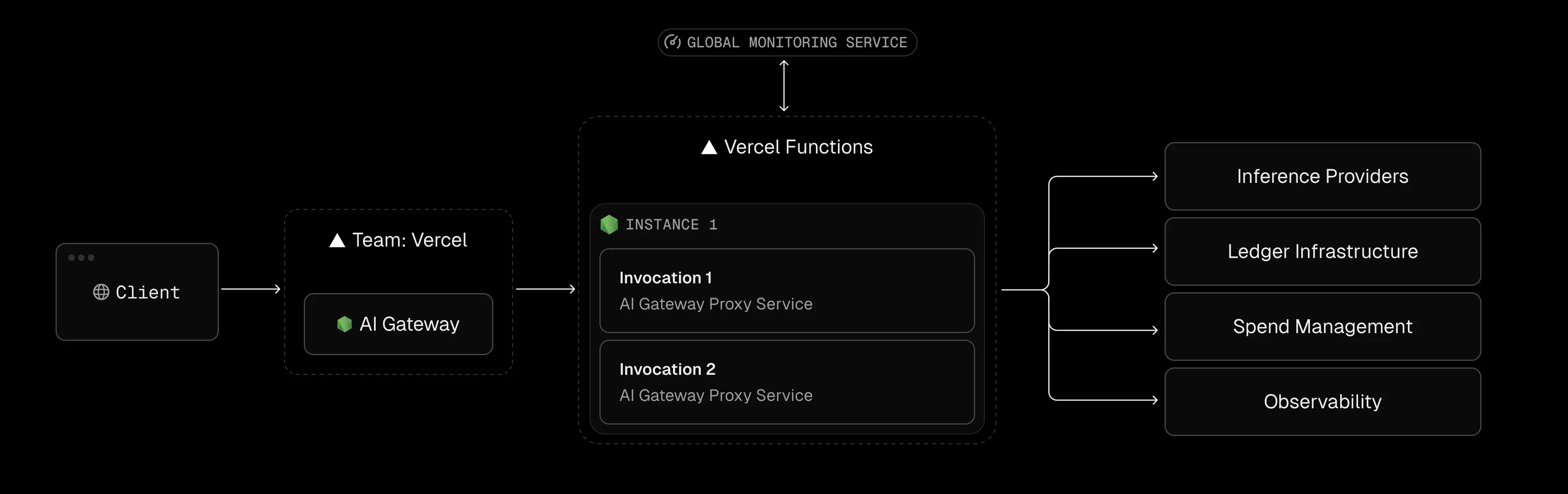
Vercel AI Gateway is built as a managed gateway inside the Vercel ecosystem. Your app (often using the Vercel AI SDK) sends requests to the gateway, and Vercel handles provider connectivity, routing behavior, and usage controls. The gateway is positioned to help teams ship faster without managing provider accounts and keys, while offering operational knobs like budgets, usage monitoring, load-balancing, and fallbacks.
Scope implication: it’s optimized for Vercel-hosted apps and developer workflows, not for running the gateway inside your own private infra.
OpenRouter is a cloud routing layer: your application calls OpenRouter’s API, and OpenRouter routes traffic to the chosen model/provider. It supports routing controls like provider routing, and offers features like Auto Router for selecting between models based on the prompt, plus model fallbacks/load balancing depending on availability.
From a data/ops standpoint, OpenRouter documents that it logs basic request metadata and that prompts/completions are not logged by default (unless you opt in).
It also supports team usage patterns via Organizations (shared credits, centralized key management, and usage tracking).
Scope implication: it’s great for multi-model access and routing, but still fundamentally a managed cloud service rather than something you deploy inside your network boundary.
Vercel AI Gateway and OpenRouter both help unify model access, but many teams encounter a new set of requirements as they move from single applications or experimentation to enterprise-scale AI deployments. At this stage, convenience alone is no longer sufficient.
Common requirements that emerge include:
This is the gap that TrueFoundry is designed to fill.
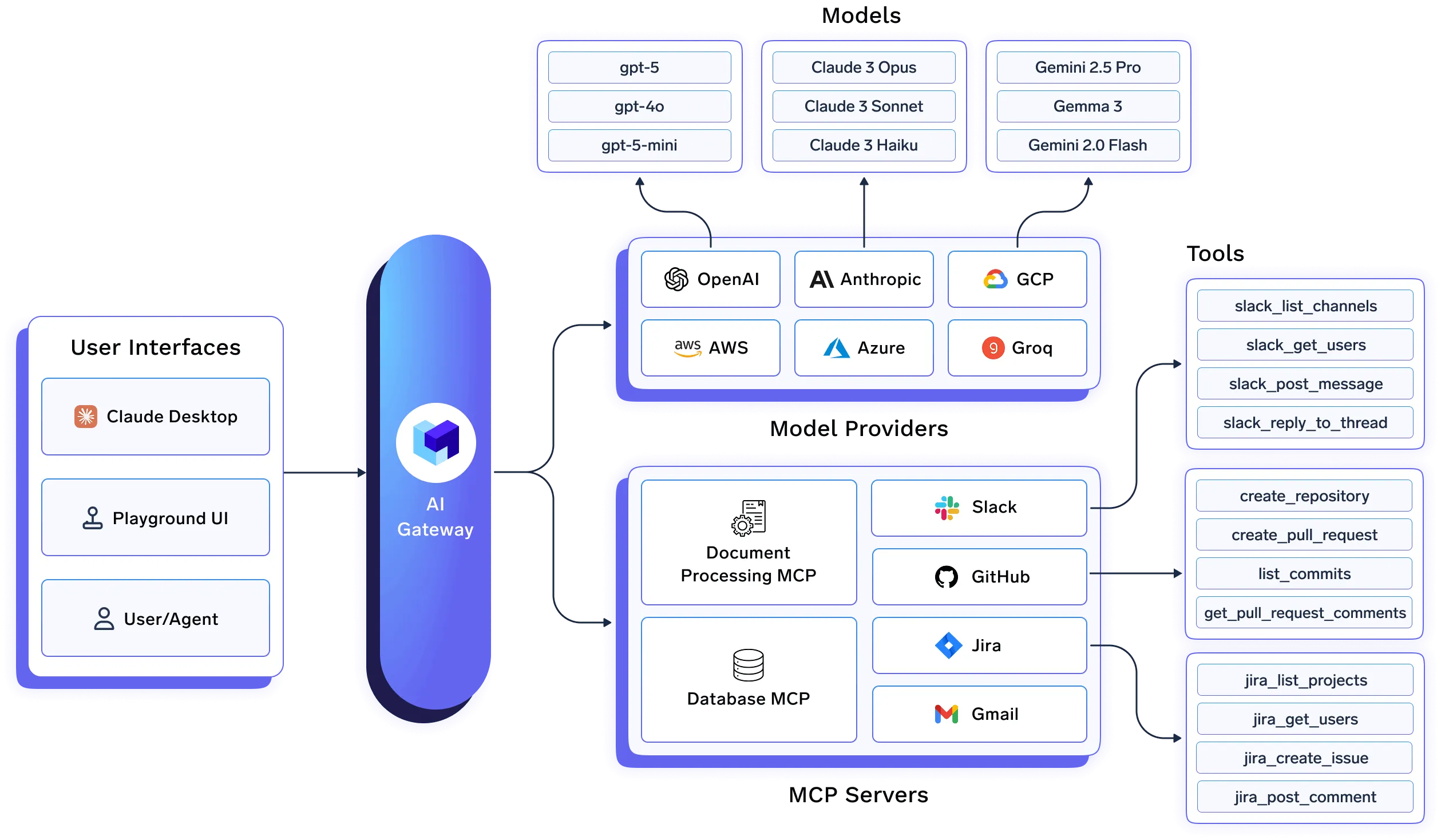
TrueFoundry’s AI Gateway is built as an infrastructure-level control plane, not just a routing or application convenience layer. It can be deployed as SaaS or self-hosted inside your own cloud or on-premise infrastructure, allowing organizations to keep LLM traffic within their security and compliance boundaries while still standardizing access behind a single gateway.
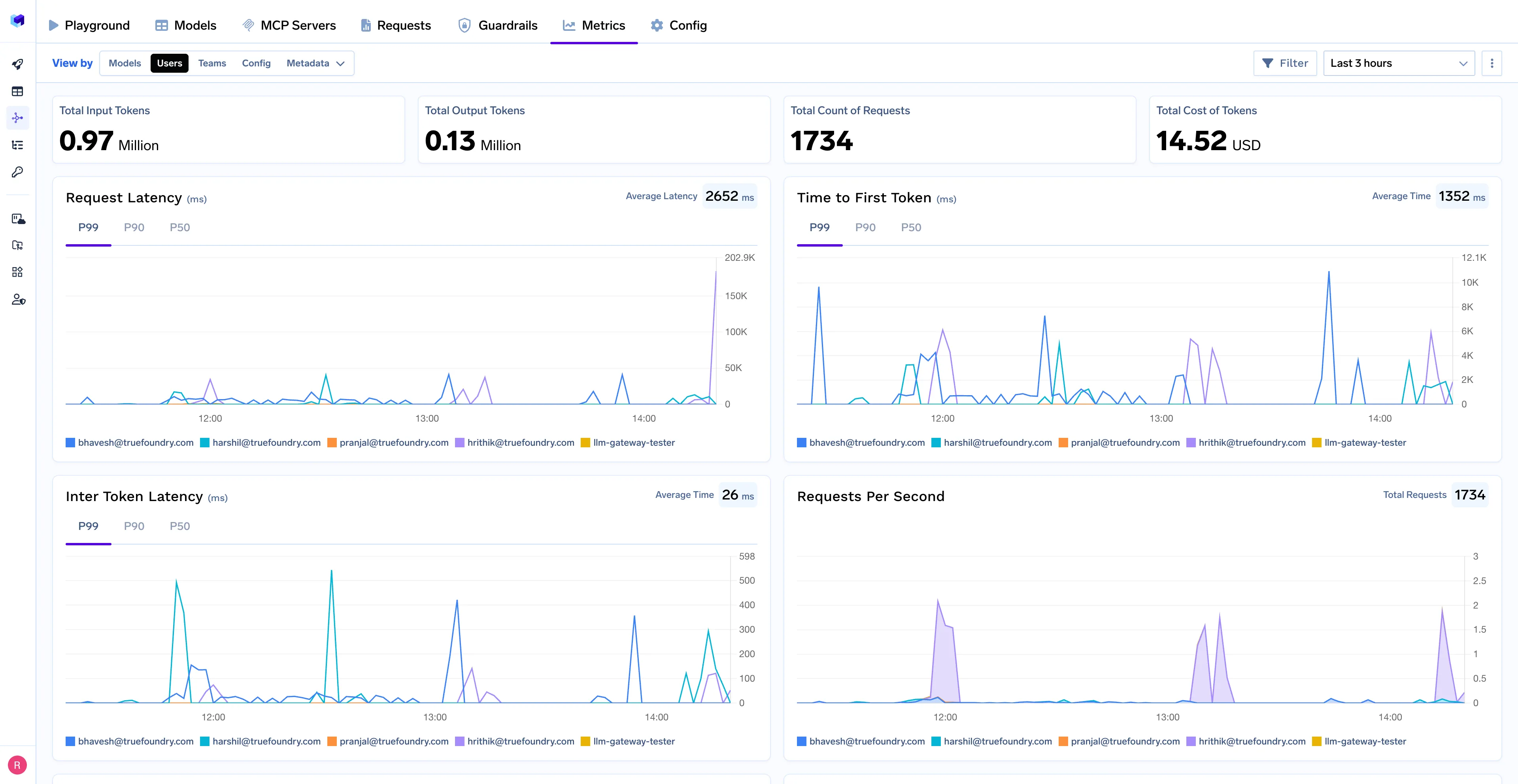
Beyond basic routing, the TrueFoundry gateway provides:
Rather than replacing developer-focused tools, TrueFoundry complements them as organizations mature. It is built for teams that need enterprise-grade security, compliance, and operational visibility as LLMs move from isolated experiments into core business workflows.
In practice, this means treating LLM access as shared infrastructure, not application-specific logic - where policies, observability, cost controls, and deployment boundaries are enforced centrally, independent of how individual teams build or deploy their applications.
Vercel AI Gateway and OpenRouter both play an important role in simplifying access to large language models, but they are built for different stages of AI adoption. Vercel AI Gateway prioritizes developer experience within the Vercel ecosystem, while OpenRouter excels at model aggregation and rapid experimentation.
As organizations scale beyond individual applications, new requirements emerge - around governance, observability, deployment control, and compliance. At this stage, application-level or routing-only gateways often become limiting.
This is where infrastructure-level gateways like TrueFoundry come into play. By treating LLM access as shared enterprise infrastructure rather than application logic, teams gain the control and visibility needed to operate AI systems reliably in production.
Choosing the right gateway ultimately depends on where your organization is in its AI journey and understanding these distinctions early helps avoid architectural rework as AI becomes core to the business.
OpenRouter is a unified API that lets developers access many AI models (OpenAI, Anthropic, etc.) through one endpoint. Vercel’s Vercel AI SDK is a toolkit for building AI apps and chat interfaces in web frameworks like Next.js. OpenRouter focuses on model routing; Vercel AI focuses on frontend AI app development.
The Vercel AI Gateway is better if you already deploy apps on Vercel and want integrated logging, caching, and routing inside your project. OpenRouter is better for accessing many AI models from different providers in one place with flexible pricing and model switching across platforms.
No, Vercel and OpenRouter are not the same. Vercel is mainly a cloud platform for deploying web applications and includes AI development tools. OpenRouter is specifically an API service that routes requests to multiple AI models. They overlap in AI usage but serve different primary purposes.
No. Both are fully managed cloud services with no support for private or on-premise hosting. Enterprise deployments requiring VPC, air-gapped, or private-cloud environments should consider platforms like TrueFoundry.
No. Vercel AI Gateway focuses on simplifying LLM usage inside Vercel apps. It does not support experimenting across multiple models or providers. For multi-model testing, switching, and comparison, OpenRouter or an enterprise-grade platform like TrueFoundry is more suitable.
TrueFoundry is an enterprise-grade AI gateway providing centralized governance, observability, access control, and compliance. Unlike Vercel AI (frontend-focused) or OpenRouter (multi-model routing), it manages LLM traffic across teams and environments, enabling secure, production-ready, infrastructure-level management of models.
TrueFoundry AI Gateway delivers ~3–4 ms latency, handles 350+ RPS on 1 vCPU, scales horizontally with ease, and is production-ready, while LiteLLM suffers from high latency, struggles beyond moderate RPS, lacks built-in scaling, and is best for light or prototype workloads.
Product
Company
Resources









.webp)
.webp)
.webp)
.webp)
.webp)
.webp)

.webp)
.webp)