
Let's say you open a 2026 AAA title and see 120 FPS on your counter, but your mouse feels like it's dragging through mud, and you're unable to click or fire as you typically would. GPU manufacturers, like Nvidia and AMD, have seemingly successfully redefined the word "performance." It used to mean how fast your PC can process a game, but now it feels like it actually means how smooth the video output looks.
Frame generation is a post-processing trick that adds visual smoothness while actually increasing input latency. It's being used as a crutch by developers to launch unoptimized games that can't hit a stable native 60 frames per second on high-end hardware. So, while you might be getting 120 frames per second, your PC is actually slowing down your input latency significantly justto achieve this. Is it really worth it?
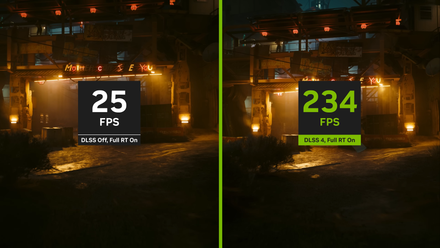
Nvidia's DLSS 4 multi frame generation works best when it doesn't make sense to use it
If you want to use Nvidia's new multi frame generation, keep in mind that there are very specific times where it can actually make a difference.
More frames, but more lag
What use are frames that are unresponsive?
When looking at the technicalities of frame generation, it's worth noting that it requires a minimum base frame rate to function correctly. So let's say your GPU is rendering 30 frames, and then AI generates 90 more, giving you 120 frames per second. The reality here is that your input latency is still tied to that original 30 frames per second.
Alongside this, generating frames isn't "free." The GPU has to allocate some of its power to the AI model, which actually reduces your native rendering capacity. As a result, you get input lag inflation. Every generated frame inserted between real frames is one in which the game is not listening to your mouse or keyboard.
Some developers may be using frame generation as a crutch. Optimization can be hard, especially when games are huge and contain countless assets. So many Unreal Engine 5 titles are increasingly launching with DLSS/FSR required specifications, which should never be the case. Rather than optimizing draw cells or asset streaming to ensure a game loads correctly and maintains an optimal frame rate, they skip these steps entirely because they know frame generation can mask stutter.
As a result, we're seeing more micro-stuttering and 1% low issues because frame generation simply cannot fix CPU bottlenecks. It can only hide them behind a smoother motion blur. Another downside to DLSS or FSR is that if you feed it garbage, it spits out garbage. If your base frame rate is low, let's say below 60, the AI has less data to work with, which can result in really poor frame generation. As a result, you'll get ghosting, shimmering, and UI warping. Frame generation can't save games that are so poorly optimized that there aren't enough frames generated in the first place for AI to even fill in the gaps. You might notice that fast-moving objects, like a sword swinging or a racing car flying past you, can often break the frame generation algorithm. They then create a smearing look that native rendering just would never have.
Anti-latency tech should solve the issue...
...or does it just look like it's solving the issue?
There's been an attempt to rectify this issue with the implementation of NVIDIA Reflex and AMD Anti-Lag+, anti-latency technologies. Whilst these tools reduce latency, they only bring you back to a baseline level. They don't actually make frame generation faster than native frames. They just make the penalty less severe.
Even with the rise of Reflex 2 and Frame Wrap, it just feels like the anti-latency technology hasn't come far enough to offset the issues caused by frame generation. These technologies use AI to shift the camera angle of a frame after it's been rendered, but before it hits your screen, based on your latest mouse movement. If your PC is having to use AI to guess where your mouse moved because the frame was rendered too slowly, then your game isn't performing well. You're playing a simulation of your own inputs leading to input prediction rather than input processing. This can cause severe issues when you need those fast reaction times.
Alongside this, both Reflex and Anti-Lag+ require GPU and CPU resources to synchronize the render queue. This synchronization tax further lowers your native 1% lows. By enabling Frame Generation and its seemingly mandatory Latency Reduction partners, you are spending roughly 10-15% of your hardware's raw potential just to manage the overhead of the fake performance you're being granted in return.
If you need a secondary technology just to make your primary performance boost feel playable, then the primary technology probably isn't a performance boost; it's more of a trade-off.
Frame generation should never be an expectation
Native frames win over frame gen any day
Frame generation is a great tool, don't get me wrong. It can really help with path tracing and cinematic 4K experiences. But it should be an option, not a requirement. So many AAA titles can feel like they're barely playable without having DLSS or FSR switched on, even when you're running them on a super high-end machine. This should never be the case, and developers should prioritize optimizing their games rather than relying on AI to smooth out stuttering.