
If you're someone who's finally switching from a mechanical hard drive to an SSD, that's great news. You're making one of the best upgrades you'll ever make to your PC. However, you might be confused between SATA and NVMe SSDs on the market. While virtually any SSD will be significantly faster than your old hard drive, buying an NVMe drive will be better for your PC in multiple ways. The newer storage interface not only leverages your other hardware a lot better, but the enhanced performance can actually benefit some real-world workloads. The price isn't a differentiator between SATA and NVMe SSDs anymore, so there's no reason to pick the older format over the newer one.

5 reasons you should replace your regular SSD with an NVMe if you haven't already
Still stuck on slower SATA SSDs? Supercharge your system with NVMe storage.
NVMe SSDs are orders of magnitude faster
It's not even a contest
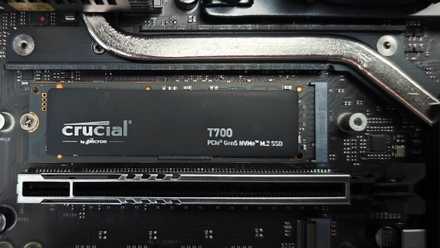
Let's talk numbers. SATA SSDs typically support speeds of around 500MB/s, which is easily 3–4 times faster than a hard drive. These speeds pale in comparison to even a PCIe 3.0 (Gen3) NVMe SSD, which can reach 3,500 MB/s of sequential speeds, 7 times faster than a SATA SSD. Gen4 and Gen5 NVMe drives have taken this to around 7,000 and 14,000MB/s, respectively. Most people today are buying Gen4 NVMe SSDs as they fall in the performance and price sweet spot. A typical Gen4 drive will make your system feel more responsive than a SATA SSD, thanks to the much higher read/write speeds and lower latency owing to the NVMe interface. While blazing-fast speeds alone don't mean that your PC will magically boot faster or that games will load instantaneously on a Gen5 SSD, the faster interface can have some tangible benefits in the real world.
For instance, productivity users and professionals relying on video editing and rendering software will benefit from the cutting-edge speeds of Gen5 SSDs when rendering or exporting files. Even when transferring tons of data between drives, the higher sequential speeds of a Gen5 NVMe drive will matter. Gen5 SSDs haven't begun to help gaming workloads yet, but developers have started to optimize games for faster storage. Technologies like DirectStorage will soon be seen supporting more titles, finally leveraging Gen5 NVMe speeds. Right now, for most people, the difference in performance between different NVMe generations might mean very little, but any NVMe drive will be significantly faster than a SATA SSD in terms of the overall experience.
6 tricks to get the most out of an NVMe SSD (without killing it)
These small changes can make a big impact on your NVMe SSD’s speed and lifespan
SATA SSDs don't even have price on their side anymore
Why pick inferior tech at the same price?
A few years ago, when Gen4 SSDs were still new, SATA SSDs used to be much more affordable, offering consumers a real differentiator. Someone who didn't need the extra performance of an NVMe drive could buy a cheaper SATA SSD and call it a day. Today, however, if you compare the prices of SATA and Gen4 NVMe SSDs, you'll see the same $130 price tag for a 2TB drive. Even 4TB and 8TB models are following the same trend, converging around the $230 and $630 price points. The one advantage that SATA SSDs had over NVMe drives has disappeared, making the older technology obsolete in yet another way. Of course, you don't need to rush to replace every single SATA SSD already present on your PC, but buying a new one doesn't make sense — unless you're limited by your motherboard or specifically looking for a SATA SSD home lab setup.
PNY XLR8 CS3140 M.2 PCIe 4.0 4TB
This M.2 4TB card from PNY features read speeds of 7,500 MBps and write speeds of 6,850 MBps, making it a pretty snappy choice for your PC or PS5. With a 96-layer 3D NAND structure, this flash memory also includes a 1GB DDR4 DRAM cache. While it isn't as fast as newer PCIe 5.0 SSDs, it's still a pretty good buy.
Crucial MX500 4TB SSD
The Crucial MX500 offers fast SATA SSD performance, great reliability, and a stylish design at an affordable price, making it an ideal choice for gamers seeking cost-effective mass storage.

Here's what I did with my old SATA SSD after switching to NVMe
I put my old SSD to good use by installing a secondary OS
SATA is a legacy interface, while NVMe was made for modern storage
Out with the old, in with the new
SATA is now considered a legacy bus that was created to replace older interfaces like PATA. It was a big jump when it became popular in the mid-2000s, but it's an aging standard now. Most of us first used an SSD on the SATA interface, but it was really suited to hard drives. The interface wasn't equipped to get the most out of high-performance flash storage, which is why NVMe was developed as a replacement. Using a direct PCIe link to the CPU instead of the indirect one that SATA does (via the motherboard's chipset), the NVMe interface was built for high-performance storage. It can use multiple PCIe lanes for high-speed data transfer, and has long eclipsed SATA as the most popular storage interface.
Using SATA SSDs is still fine if you bought them years ago, but NVMe drives should be your go-to when expanding your storage in 2025. There are no cables to deal with, and installing an NVMe drive is uncomplicated. Besides, almost every motherboard launched in the last 9–10 years has an M.2 slot, so you can probably install at least one NVMe drive if you're shopping for storage. In terms of power consumption, NVMe SSDs are known to idle at a lower wattage compared to SATA SSDs. The difference won't matter to most people, but every bit counts when you're conscious about power usage.

4 storage types that are officially too old for 2025
From CDs to SSHDs: The storage formats we left behind
What does the post-NVMe world look like?
The NVMe standard is here to stay, thanks to development on PCIe 8.0 already underway in 2025. A post-NVMe world could utilize newer interfaces like CXL, a shared interconnect between multiple components, to supercharge transfer speeds beyond what we expect right now. For the near future, however, NVMe-over-PCIe SSDs are the gold standard for consumers.