
I've been a longtime Plex user before switching to Jellyfin, itself a fork of Emby. While I absolutely adore Jellyfin, I was always interested in trying out the media streaming package it was based on. So, I spun up Emby and tied it to my network-attached storage (NAS) device hosting all our media content, and I was pleasantly surprised at how good it is. Though I wouldn't say I didn't want to like Emby, I wasn't expecting to appreciate it as much as I do.
Now, the title would imply I view Emby as the best thing for media streaming since networking, but each software package has its own strengths and weaknesses. I always thought the same of Plex after moving to Jellyfin. I don't dislike Plex, but it just morphed into something that wasn't the best fit for me anymore. Jellyfin and Emby are more interesting as a duo since they're both different but very similar. This makes hopping between Jellyfin and Emby seamless.
After appreciating Jellyfin and enjoying some problem-free streaming across multiple devices, I decided to give Emby a go, mostly out of curiosity and some degree of skepticism. I wasn't expecting it to be this good, but more of a stopgap between Plex and Jellyfin, at least for me. What I didn't expect was to fire up Emby and think, "You know what? This is actually pretty darn good." As someone who values control, performance, reliability, and app support, Emby ticks most boxes.
It all started with Plex
After Media Center was killed by Microsoft
I've always been a fan of purchasing media and having it available for consumption whenever I desire. I struggled to move to digital and still expand a growing library of vinyl to this day, but iTunes was the gateway that allowed me to pick up new albums, movies, and more at a reasonable price. I've amassed terrabytes of media over the decades and need somewhere to stream it all. Media Center was the go-to choice for Windows users back in the day, but I eventually moved to Plex.
Running Plex on an earlier Synology NAS was brilliant. It offered seamless streaming on numerous platforms, carried out transcoding, and cataloged everything in a way that iTunes simply couldn't back in the day. Everyone within the household enjoyed streaming content to mobile devices and TVs, both at home and away. Everything just worked, and it was excellent, but things started to take a turn for the worse. Plex started to drift away from being a simple personal media server.
Plex started to add its own channels, support for rentals, live TV, and even recommendations I had no use for.
I wasn't subscribed to any streaming services. We had Amazon Prime, but that was about it, outside of the wife's Netflix subscription. Plex started to add its own channels, support for rentals, live TV, and even recommendations I had no use for. It started to feel too cluttered for a streamlined experience and something I viewed as a smart TV dashboard, which is often full of stuff I'd never use. It stopped feeling like my Plex server and more like something I was connecting to. This is what largely pushed me to finally try Jellyfin.
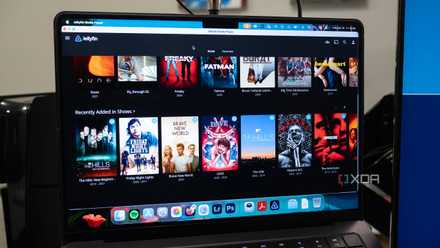
Jellyfin is 90% of Plex, and the missing 10% doesn't matter to me
Free and open source over greedy subscriptions
Jellyfin became my new media home
It's everything Plex was (and more)
Switching from Plex to Jellyfin was quite the move. I had been a Plex user for years, and now it was time to part ways and start anew. Some highlights that enticed me were the open-source nature of the package, zero cloud dependencies, fully self-hosted, completely transparent, and entirely focused on media we owned. It simply exists to stream my media, and that's precisely what I needed from a streaming media platform. It also helps that Jellyfin is seriously good, largely because of its solid foundations, which stem from Emby.
Although it started as a fork of Emby, Jellyfin has come a long way with its separate development path. The server is lightweight enough to run on just about anything, the UI is clean and easy for everyone to navigate through, and features keep being added over time. Hardware acceleration is also free, which helps compared to some other offerings, though this matters less for our hardware at home, as nearly all clients directly stream the stored media.
I have a soft spot for Jellyfin, but it can sometimes feel like a homebrew project that's still catching up in certain areas. Native clients aren't the best, and we have to rely on third-party offerings for the best experience. There were a few other minor issues, such as platime not correctly syncing between devices and some updates causing issues here and there, but it's largely been flawless. The server continues to hum away and receive requests without fail.
So, because it's effectively based on Emby, I decided to try out the media streaming platform.
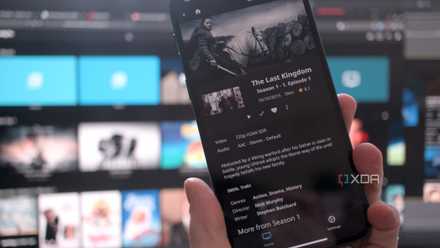
How I replaced all these streaming services with one self-hosted app
Cutting the online streaming cord with this one free self-hosted app.
Emby is much better than I thought
It's definitely up there with Jellyfin
I'll be honest, I knew Jellyfin was forked from Emby, but I always pegged Emby closer to Plex when comparing the three. It's more similar to Plex in some areas, including the closed-source nature, paid premium features, and a smaller community. What Emby was, instead, was a server package that felt like Jellyfin but with some Plex polish. It was very much an in-between but without an aggressive push toward third-party streaming.
Once my NAS media folders were imported to the container, Emby immediately started cataloging everything. I actually found metadata to be much better on Emby than Jellyfin. It seemed to pick up a few albums and other things that Jellyfin failed to fetch. Clients were also better, and I didn't find myself needing to use any third-party solutions to get something working reliably. Jellyfin's aren't terrible, but even the Android TV one has a few minor issues.
What would normally be a mark down for me would be the paid tier. I enjoy donating to projects I use regularly, but I'm trying to save as much money as possible through self-hosting, and paying for software to run feels like it goes against this mantra. I don't mind hardware transcoding being behind a paywall since it's a resource-intensive function that takes time to develop and improve. The same goes for mobile sync and advanced DVR. You don't have to pay for Emby, and I certainly didn't to get the most out of it.

I built an Emby media server on a Raspberry Pi Zero 2W and here's how it went
Convert your power-conserving SBC like the Pi Zero 2W can double up as an Emby client for a measly $15 and digitize your media collection.
I haven't completely abandoned Jellyfin; in fact, I'll continue switching between the two as time passes to see which really works best for the entire household. The thing that really entices me back to Jellyfin is the complete control over everything. This is something that Plex and Emby couldn't offer. If Jellyfin were to cease development, it could be forked for continued community contributions. I really like Emby and can completely understand why it has a following.
But for now, I enjoy my media server working for me with the least friction. Unfortunately, my spouse simply cannot get on with Jellyfin's official apps, especially on mobile. Emby isn't perfect, and there are some things that I would like to see added to it that Jellyfin does better, but it's definitely worth checking out if you're tired of either alternative.