
Gamers are always trying to squeeze out the most performance from their hardware, especially in competitive titles. Every frame and every extra millisecond of latency can make the difference, and even in titles where it's not as serious, nobody is going to complain about extra FPS. DLSS is great at providing extra frames at the slight cost of visual fidelity, and for most games, this is a net positive, but it's not necessarily the "future" of PC gaming. It's already here, and it's good. The real future of gaming is asynchronous reprojection, a technology that promises much lower latency and a smooth experience regardless of framerate.
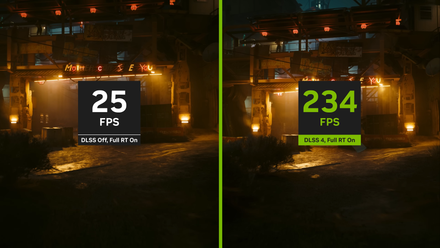
Nvidia's DLSS 4 multi frame generation works best when it doesn't make sense to use it
If you want to use Nvidia's new multi frame generation, keep in mind that there are very specific times where it can actually make a difference.
What is asynchronous reprojection?
Decoupling framerate from user inputs
At its core, asynchronous reprojection is a GPU rendering technology that generates synthetic frame data to maintain smooth motion on a display. Most of its development was necessitated by VR gaming, where the smoothness of the experience trumps essentially everything else. Instead of requiring a GPU to hit 90 frames per second to drive a 90Hz display, reprojection allows the system to render fewer frames—say 45 FPS—and fill in the gaps with predicted frames derived from motion data and prior renders.
This might sound a lot like what an AI upscaler like DLSS does, but the key difference is that it decouples the render rate from the display refresh rate. The GPU doesn’t need to match the panel’s refresh cadence perfectly, but instead, a compositor or runtime layer ensures the display is continuously fed smooth motion, even if the underlying render cadence fluctuates. In plain English, this means your input is always smooth, even if your GPU can't fully maintain the required framerate.
This demo made by Comrade Stinger is a great illustration of what asynchronous reprojection actually looks like.
DLSS is Nvidia's Achilles heel — here's why
It's great for gamers, but DLSS can only hurt Nvidia in the long run.
It's very impressive in VR, but hasn't taken strides in conventional PC gaming
Nvidia's Reflex 2 is the closest thing we have right now
If you want great examples of asynchronous reprojection in action, the best place to find them is in VR gaming. Essentially all VR platforms, whether it be from Meta or from Valve, implement this rendering technology to great effect, but we don't see it in conventional PC gaming.
The experience of a VR game suffers greatly if there's even one dropped frame, unlike in a normal PC gaming setup, where lower framerates can be suboptimal, but can still provide an adequate gaming experience. Technologies like variable refresh rate can also assist with this to a degree, and this is probably why we haven't seen asynchronous reprojection in any meaningful sense outside of VR.
Nvidia's Reflex 2 technology is the closest we've come to asynchronous reprojection in conventional games, and it's only supported by a handful of them. There have been a few demos showcasing this technology, with one notable example being done by a community modder PureDark, who reverse-engineered it via exposed game files.
This is showcasing what Nvidia is calling "Frame Warp", which takes the freshest mouse input it can and reprojects the most up-to-date frame by filling in the gaps that exist between it and the last "true" frame sent to the display. The result is a fair amount of tearing and artifacting, especially around the edges of the screen where there is a lot of filling-in to do, but the demo is just a proof of concept.
While the numbers are very dependent on a number of other variables, the difference in input latency can be absolutely massive.
5 reasons high FPS doesn't guarantee a great gaming experience
A lot of other factors are at play
We've already reached peak upscaling
How much better can DLSS realistically get?
Upscaling technologies like DLSS and FSR have come a long way, even in just the last year alone. DLSS is obviously still the industry standard, with version 4.5 bringing significant improvements, but FSR and XeSS aren't terribly far behind. I would be comfortable in saying that those upscalers are the "present" of PC rendering tech, and will only become more ubiquitous as time goes on. They're not really the "future" anymore, especially when you look at a best-case-scenario for them, which is probably something like using DLSS 4.5 at 4K with an acceptable base framerate.

You may not like them, but AI upscalers are currently saving PC gaming
DLSS is playing a large part in why old hardware is still capable right now
There's no guarantee asynchronous reprojection will actually make it to all games
FPS games are prime candidates, the rest not so much
This is extremely applicable to competitive shooters specifically, where latency is a key performance metric players would like to keep as low as possible. There's virtually no guarantee that asynchronous reprojection will make it to all games, not just because it's not entirely necessary for all of them, but because it's pretty technically complex. Support for this tech currently needs to be enabled by developers, and if it's not properly implemented, it probably won't work well whatsoever.

7 ways Nvidia's DLSS 4 is making the future of gaming happen today
DLSS 4 shows upscaling is the future of gaming.
The next frontier of rendering
As a gamer, I'm sold on the concept of having buttery smooth inputs at all times, regardless of my input latency. If they can sort out most of the issues with artifacting at the peripheries, I can see myself turning this on in every game possible. DLSS and other upscalers might've made resolutions like 1440p and 4K more attainable for more users, but asynchronous reprojection could make smooth gameplay attainable for all, regardless of resolution.