
For the last three years that I've owned my gaming rig, I've always been happy to get the most out of my 1440p machine. Buying a new 4K mini-LED TV, however, has changed that: it has planted in me the idea that maybe the console doesn't have to be the only thing plugged into it. The PS5 Pro is great, sure, but a PC, even one built around a three-year-old GPU, still offers better image controls, more flexibility, and far more room to experiment.
The only real roadblock, however, was confidence. Dropping the internal resolution to anything south of 70% has always been a strict no-no for me, and at 1440p, it has also been doable. Now, however, DLSS 4.5 just changed the game (pun fully intended). Not only do games look better at lower upscaling modes like Balanced and Performance, but the obvious trade-offs have all but disappeared.
Nvidia's 6x frame generation proves that we've reached the hardware ceiling for GPUs
There's only so much VRAM to go around.
My RTX 4070 Ti was never meant to be a 4K card
I've been perfectly happy with my 1440p display
The RTX 4070 Ti is three years old, which, in GPU years, is basically middle-aged at this point. From day one, the 70-class cards have always occupied a very specific, very comfortable lane: excellent 1440p performance, high refresh rates, and just enough headroom to crank settings without constantly staring at a frame-time graph. Heck, they're even capable of jetting out 4K games, provided those games aren't the latest AAA games, but coming out of your nostalgia library. I bought into that reality fully, and never once pretended that this was a "4K card."
As such, for the last three years, my experience has been pretty consistent and predictable. I used native 1440p or DLSS Quality, used Frame Generation only where it made sense, and almost never dropped below High or Very High presets. More importantly, I had a hard line with DLSS: Quality or nothing. The Balanced and Performance resolutions always came with ghosting, trailing, and instability in fine details that my eyes picked up immediately. At 1440p especially, those compromises stood out, and I refused to make them.
That's why this shift matters. My RTX 4070 Ti hasn't become more powerful all of a sudden. What's changed, though, is how effectively it's using its power, and for the first time, the card is escaping the rigid 1440p box it was always confined to.
DLSS 4.5 just got my PC attached to a 4K TV
I'm afraid I might not be able to go back
I didn't buy a QD mini-LED TV with a 144 Hz panel with PC gaming as my primary goal. My PS5 Pro already covers that side of the equation nicely, and yet, curiosity got the better of me, and the only reason I even entertained the idea of hooking up my PC was DLSS 4.5. Before this update, going below DLSS Quality at 4K simply wasn't an option I respected. Balanced was a compromise, Performance has always been a last resort, and Ultra-Performance was territory I never even considered touching. All of these felt like downgrades I'd immediately notice from the couch.
DLSS 4.5 completely changes that equation. Balanced doesn't feel like a fallback, because it's so significantly improved — the image quality is sharper, edges shimmer way less, and on a 4K 55" panel, everything looks shockingly clean. Even DLSS Performance now holds up in motion in a way that would have genuinely been unthinkable a year ago. Paired with the 40-series' Frame Generation (2x), I'm now seeing a consistent 60–90 FPS at 4K using High presets, without the image breaking apart under scrutiny.
That's the real breakthrough here. I'm no longer forcing my PC onto the TV "just for testing." It's now a genuinely valid, enjoyable way to play, and that's something DLSS simply couldn't promise before.
DLSS 4.5 is expensive, but it’s the best thing to happen to my aging RTX PC
The upside is remarkable, but the cost isn't equal for all.
DLSS 4.5's Balanced and Performance presets are legitimately impressive
Plus, it's still better than FSR on the PlayStation 5
On my 1440p display, running Cyberpunk 2077 completely maxed out with Path Tracing and Ray Reconstruction, helped by Frame Generation, I got a steady 91 FPS with DLSS Quality. This is what I played and finished the game with DLSS 4.0. Bumping things up to 4K, the exact same graphics and upscaling settings gave me nothing more than 45 FPS.
Now, however, things have changed. With DLSS Balanced looking better than it ever has, Cyberpunk 2077 delivers an impressive 80 FPS on 4K, and if I were to drop to DLSS Performance, the image quality still looks impressive, and the frame rate goes even higher.
|
Cyberpunk 2077 |
|||
|
Resolution |
Graphics Preset |
DLSS Mode |
Avg. FPS |
|
1440p |
Maxed out + Path Tracing |
DLSS Quality (4.0) |
91 |
|
4K |
Maxed out + Path Tracing |
DLSS Quality (4.0) |
46 |
|
4K |
Maxed out + RT Psycho |
DLSS Balanced (4.5) |
80 |
|
4K |
Maxed out + RT Psycho |
DLSS Performance (4.5) |
99 |
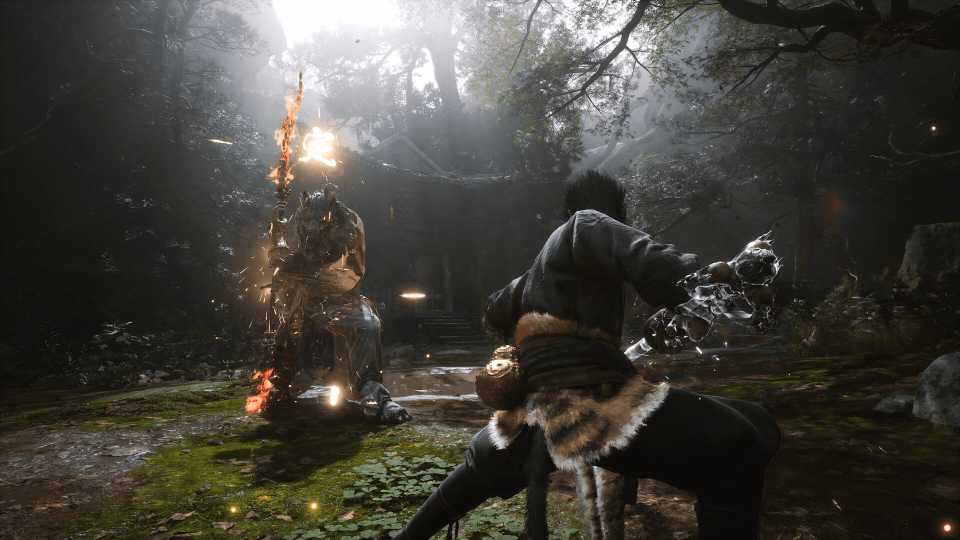
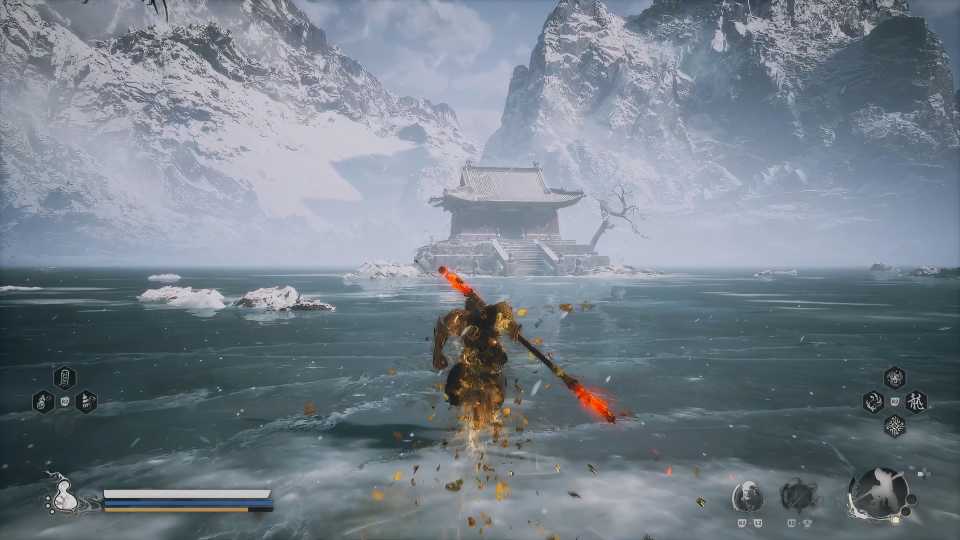
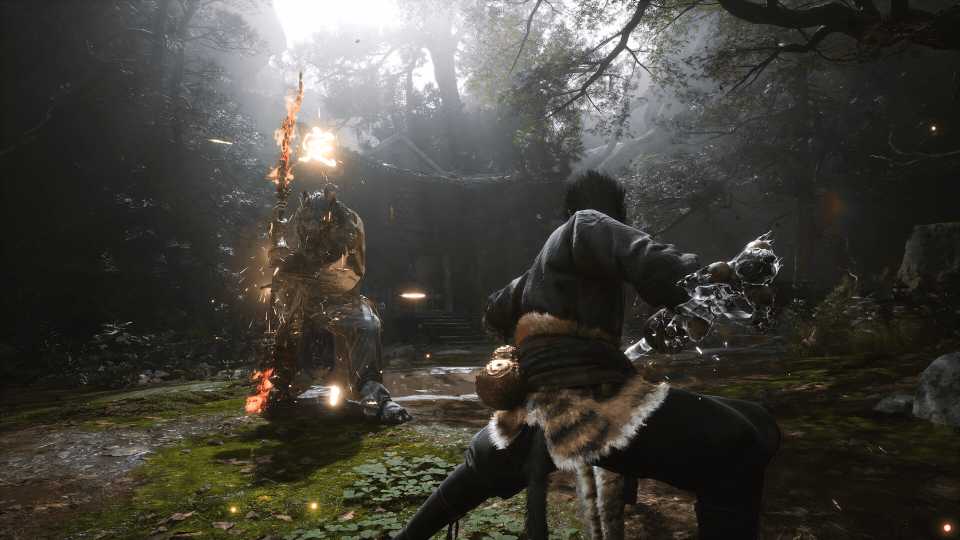
I missed out on playing Elden Ring on a 4K display, but Black Myth: Wukong is the current soulslike title I've been contending with over the weekends. Now, it does suffer from Unreal Engine 5's shimmering and less-than-impressive optimization, but with the right DLSS preset, the game does look good. Playing it maxed out at the Cinematic preset is not something even my 1440p display handles well, either, so the comparison here was between the Very High and High presets.
|
Black Myth: Wukong |
|||
|
Resolution |
Graphics Preset |
DLSS Mode |
Avg. FPS |
|
1440p |
Very High + Path Tracing High |
DLSS Quality (4.0) |
86 |
|
4K |
Very High + Path Tracing High |
DLSS Quality (4.0) |
42 |
|
4K |
High + Path Tracing Medium |
DLSS Balanced (4.5) |
75 |
|
4K |
High + Path Tracing Medium |
DLSS Performance (4.5) |
89 |
Lastly, rounding up the testing was The Witcher 3: Wild Hunt. The next-gen update has been a wonder for those still in love with the game, and with over 400 hours logged into the game, I now have one more reason to replay the entire thing from start to finish: a new 4K view.
|
The Witcher 3: Wild Hunt |
|||
|
Resolution |
Graphics Preset |
DLSS Mode |
Avg. FPS |
|
1440p |
RT Ultra |
DLSS Quality (4.0) |
102 |
|
4K |
RT Ultra |
DLSS Quality (4.0) |
58 |
|
4K |
RT Ultra |
DLSS Balanced (4.5) |
69 |
|
4K |
RT |
DLSS Balanced (4.5) |
78 |
|
4K |
RT |
DLSS Performance (4.5) |
91 |
All games tested above were run with DLSS Frame Generation turned on. On an RTX 40-series card, the frame generation scale is 2x.
-
👁 Placeholder Image
OpenCritic Reviews - Top Critic Avg: 82/100 Critics Rec: 81%

- Released
- August 20, 2024
- ESRB
- M For Mature 17+ // Blood, Violence
- Developer(s)
- Game Science
- Publisher(s)
- Game Science








WHERE TO PLAY


Black Myth: Wukong is an action RPG rooted in Chinese mythology and based on Journey to the West, one of the Four Great Classical Novels of Chinese literature.
You shall set out as the Destined One to venture into the challenges and marvels ahead, to uncover the obscured truth beneath the veil of a glorious legend from the past.
As the Destined One, you shall encounter powerful foes and worthy rivals throughout your journey. Fearlessly engage them in epic battles where surrender is not an option.
Aside from mastering various staff techniques, you can also freely combine different spells, abilities, weapons, and equipment to find the winning strategy that best suits your combat style.
- Engine
- Unreal Engine 5
- Genre(s)
- Action RPG
A lower graphics preset at 4K still looks better
I'm no longer getting caught up in graphics tuning
There's a strange obsession in PC gaming with never touching the graphics preset slider. I've been pretty guilty of this, too. Dropping from Very High to the High graphics preset is almost treated like a failure state, as if the game suddenly becomes ugly the moment a checkbox flips. Real-world experience, however, tells a very different story, especially at 4K. The jump in resolution does far more for perceived image quality than one step on a preset ladder ever could.
On a large mini-LED display, that difference is significantly amplified. Higher pixel density, stronger contrast, better local dimming, and sheer screen size — all of these factors have done more heavy lifting than ultra-quality shadows or marginally denser foliage. Texture clarity, fine detail, and scene cohesion benefit far more from 4K output than they do from pushing a preset one notch higher at 1440p.
The end result is simple and remarkably enjoyable: my games look cleaner, richer, and more cinematic, even at High settings, while being rendered at a 50% internal resolution. Once I actually sit back and play, that trade-off stops feeling like a compromise immediately.

5 reasons 1440p is still the best resolution for PC gaming
Gaming at 1440p makes for a gorgeous image without overly taxing your PC.
Image reconstruction with DLSS 4.5 is confident, not corrective
The confidence scales to the output resolution, too
What stands out most with DLSS 4.5 is not the raw performance, but how little the image feels like it's being fixed in real time. Earlier versions always carried a subtle sense of correction: thin geometry shimmering, foliage breaking apart mid-pan, fine detail smearing just enough to remind you this wasn't native. That's largely gone now. It hasn't disappeared, but now, the edges hold, motion stays coherent, and complex scenes have stopped collapsing into soft noise when the camera moves quickly.
The biggest win here is the temporal stability. Ghosting and trailing — two things that made me swear off Balanced and Performance entirely — are no longer persistent distractions. Reconstruction feels deliberate and confident instead of seeming reactive. At 4K especially, DLSS 4.5 just looks good instead of coming off as trying to convince you that it does. That psychological shift matters significantly when you're sitting in front of the TV with the controller in your hands and can't remember if you're somehow still playing at DLSS Quality because the picture looks that darn good.
I have an RTX 50-series GPU, and I've barely touched DLSS 4
I've intentionally ignored quadrupling my frame rate, and for a good reason.
DLSS 4.5 has given me the confidence to push 4K for the next five years
DLSS 4.5 has removed the long-standing visual penalties that used to make certain choices feel irresponsible.
Gaming in 4K on my TV with the same GPU that has been pushing 1440p for three years has reinforced for me that modern PC gaming is no longer about brute force alone. Now, it's about trusting reconstruction, smarter scaling, and knowing where compromises actually matter and where they don't. It isn't like my RTX 4070 Ti magically turned into a flagship GPU, it's that it didn't need to.
What DLSS 4.5 has done is remove the long-standing visual penalties that used to make certain choices feel irresponsible. Once you experience that shift, it's hard to go back to thinking in rigid resolutions ever again.