|
VOOZH | about |
|
VOOZH | about |
As blockchain technology grows in popularity, many new platforms are emerging at a fast pace as the industry expands. One example is Harmony, which allows data to be transferred seamlessly between blockchain networks. Harmony is attracting many developers and users because it charges fewer gas fees than Ethereum, and has an effective proof of stake (PoS) model that eliminates stake centralization.
👁 ImageOn the other hand, there are more popular options like the Ethereum blockchain, which has been operational for over six years, boasts a large network size, and is good for rapid deployment.
These blockchain platforms have their own limitations and benefits depending on their use case when working with decentralized applications. In this article, you will learn the difference between the Ethereum blockchain and the Harmony blockchain by analyzing their use cases and PoS models.
Blockchain platforms provide the infrastructure that allows users to access existing transaction ledgers, NFT marketplaces, and smart contracts.
Blockchain platforms have different use cases in terms of how blocks are mined and how their PoS consensus is modeled.
Ethereum is an open source project created by the Russian developer Vitalik Buterin. It offers smart contract functionality, which makes it great for decentralized finance applications and global payments.
Let’s discuss some of the use cases for the Ethereum blockchain.
Decentralized finance (DeFi) is a financial system that operates without the intervention of financial institutions and intermediaries, while providing financial services and operations on the blockchain.
DeFi uses blockchain platforms such as Ethereum to offer and automate its services. In this case, Ethereum smart contracts are used to automate financial tasks when a certain condition is met.
DeFi applications are open source and prevent risks that come with centralized finance, such as fraud and forgery. Blockchain is unalterable and offers transparency to users, features that prevent fraud from occurring.
Immutability and transparency means a blockchain is unalterable and its transaction records visible to all users. Transparency and immutability are some of the Ethereum properties that have made it suitable for healthcare use cases.
Immutability ensures that medical transaction history is not altered and transparency ensures that medical data is available to stakeholders around the world, so data won’t be secretly edited without other stakeholders seeing. Therefore, the Ethereum blockchain is used by health institutions for medical data management and to track drug supply.
Ethereum has completely revolutionized the payment industry with its smart contract feature. Using smart contracts, you can buy digital products directly from the producer. Once the conditions stated in a smart contract are met, the smart contract will initiate the payment process without the need for a financial institute to initiate and validate payment transactions.
Ethereum also offers protection against fraud, as blockchain transaction history cannot be altered.
Harmony was founded by Stephen Tse in 2018 and launched in May 2019. Harmony aims to remove limitations such as high energy consumption and high gas fees that are common in previous blockchain platforms such as Ethereum.
Harmony removes these limitations by charging lower gas fees, and has already implemented a new PoS called the effective proof of stake, or EPoS. Ethereum is still using the PoS model, which is slow and consumes more energy.
Harmony also enables you to send data between different blockchains, and offers fungible tokens and non-fungible assets.
Harmony’s success is driven by charging low fees and reducing latency. High Ethereum gas fees are one of the factors that prevent usage, especially for beginners and people with less cryptocurrency.
The use cases for Harmony are many. Firstly, Harmony can be used to send data from one blockchain to another, this feature allows developers to send and receive assets between blockchain networks. It also offers fungible tokens which can be used to store people’s medical records.
Just like Ethereum, Harmony can be used for building decentralized applications because of its speed when it comes to making transactions. Harmony allows a wide range of devices to participate in its consensus building to strengthen decentralization.
Finally, Harmony offers scalability, because it promotes sharding. Sharding involves splitting Harmony network nodes into portions, which enables Harmony to be easily scaled. This makes Harmony suitable for building decentralized applications.
PoS is a consensus mechanism in which users are selected to validate block and suggest blocks that should be validated. This consensus requires users who want to validate blocks to stake their cryptocurrency, which will be taken if the validator violates the rules. Validators will be rewarded with crypto when when they successfully validate blocks.
Stake centralization has been a major problem in the Ethereum blockchain, because it leads to top miners getting many blocks to validate, while other validators get fewer. To eliminate stake centralization, Harmony has created the EPoS consensus, which removes voting power centralization by creating an evenly distributed stake, and supports automatic stake compounding.
This new consensus algorithm also improves security and scalability. These innovative approaches solve problems commonly found while working with Ethereum.
Validators are chosen using the following factors:
Top validators will be penalized if they put a lot of stake on one node.
There are only 320 spots in the first stage of staking. Those who join earlier will get more rewards. Efficient validators can expect a reward of 441M ONE annually.
Ethereum’s PoS model is being introduced in Ethereum 2.0, which is being rolled out in phases. The first phase was released in December 2020, and the PoS model will be released in 2022.
Ethereum’s PoS model selects validators to check the validity and credibility of blocks they did not create. Any user who wants to be a validator will have to put forward a stake of 32ETH. These validators are selected randomly as they are not competing. This is a benefit, because you will not need a lot of computational power when competing for blocks to mine.
Failing to validate blocks will lead to one losing a portion of their stake, or their full stake if they do any illegal activities. To get rewarded you have to suggest blocks and validate blocks that you have been given.
When building a DApp, there are only two tasks that differentiate a decentralized application development procedure from a typical web application development procedure. These tasks are:
A smart contract is the core of a decentralized application. A smart contract is what makes decentralized applications different from web applications. You can use Solidity and Vyper to create and implement your decentralized application’s smart contracts.
For your application to be able to read and access a blockchain, it has to connect to a blockchain node. To connect to a node you can use a client-facing API.
To connect to an Ethereum network, you can use the Infura API to communicate with the blockchain and to carry out transactions without the need of maintaining a node. Libraries such as Web3J and Ethers.js enable you to create Ethereum wallets, send ETH, and check your wallet balance.
Unfortunately, Harmony does not have as many integrations and libraries as Ethereum. But there is Pyhmy, which gives you a platform for interacting and querying the Harmony blockchain.
Ethereum is one of the earliest blockchain platforms, so finding tutorials for building DApps with Ethereum is easy when compared to searching for tutorials for building DApps with Harmony.
Harmony’s goal is to eliminate problems that come with old blockchain platforms such as Ethereum and Bitcoin. It eliminates:
It goes further by improving security and allowing data to be passed between blockchain platforms. But, it is still new in the cryptocurrency market. It does not have abundant documentation and client-facing APIs, which are essential for building decentralized applications.
Ethereum, however, is now releasing 2.0, which promises to improve Ethereum’s scalability and transaction speed. These features are already being exhibited by Harmony’s current version.
Ethereum has been performing well in the DeFi sector and it has been tested and proven to be secure many times, which makes it trustworthy to use for building your decentralized finance applications.
If you are a developer who wants to build decentralized social networks, Ethereum is the best blockchain platform you should choose for this use case. Ethereum has many boilerplates and tools such as Moralis you can use to make the process of building decentralized social networks easy.
Ethereum has a big network size, which makes it the best blockchain platform for selling and buying NFTs, as there are many potential customers. In addition, many people are more familiar with Ethereum than Harmony. People will always choose whatever product they are familiar with before deeply introspecting and analyzing the market.
If your’e looking forward to mining blockchain. It would be wise to choose Harmony over Ethereum. Harmony’s EPoS model makes it easy for crypto investors who are beginners to prosper, as it prevents top miners from getting all block validation opportunities. Harmony also charges fewer gas fees.
Harmony is technologically advanced when compared to Ethereum, but is not well tested and proven, as it is new. But its rapid innovation makes it a better platform for building decentralized applications when compared to Ethereum.
Client-side issues that impact users’ ability to activate and transact in your apps can drastically affect your bottom line. If you’re interested in monitoring UX issues, automatically surfacing JavaScript errors, and tracking slow network requests and component load time, try LogRocket.
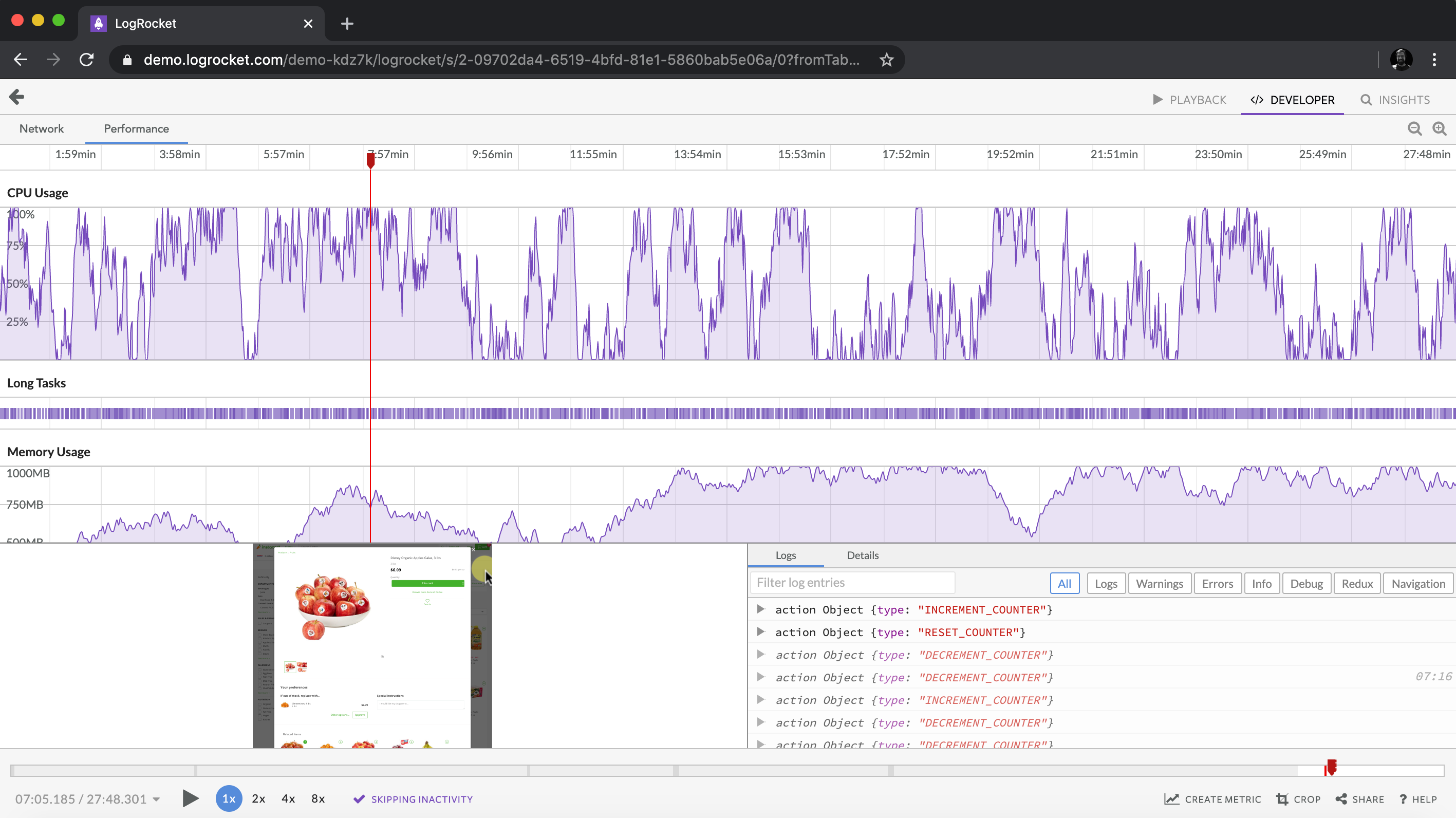
👁 LogRocket Dashboard Free Trial BannerLogRocket lets you replay user sessions, eliminating guesswork around why bugs happen by showing exactly what users experienced. It captures console logs, errors, network requests, and pixel-perfect DOM recordings — compatible with all frameworks.
LogRocket's Galileo AI watches sessions for you, instantly identifying and explaining user struggles with automated monitoring of your entire product experience.
Modernize how you debug web and mobile apps — start monitoring for free.
Explore why npm dependencies are a major supply chain security risk and how to protect JavaScript apps from compromised packages and transitive threats.
Enabled React Compiler v1.0 on a production Next.js app. Here’s every warning, breakage, and silent opt-out I documented — and what actually worked.
We built the same app in TanStack Start RSC and Next.js RSC. TanStack shipped 40% less JS and built 4x faster — but Next.js is still the safer production bet.
From RSC vulnerabilities and the Vercel breach to TypeScript 7.0 Beta and AI agents — the nine frontend storylines that defined H1 2026, ranked.
Hey there, want to help make our blog better?
Join LogRocket’s Content Advisory Board. You’ll help inform the type of content we create and get access to exclusive meetups, social accreditation, and swag.
Sign up now