| 👁 } | |
| Feature type | Catena |
|---|---|
| Coordinates | 15°24′N 352°54′W / 15.40°N 352.90°W / 15.40; -352.90 |
| Length | 103.80 kilometres (64.50 mi)[2] |
| Eponym | Nanshe |


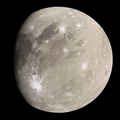
Nanshe Catena is a crater chain on Ganymede, the largest moon of planet Jupiter. The crater chain is 103.8 kilometres (64.5 mi) long [2] and about 50 kilometres (31 mi) wide, and it is composed of around seven individual ray craters that are closely overlapping each other, forming a line or chain.[1]
Naming
[edit]Nanshe Catena is named after the goddess of spring water and aquatic animals from Mesopotamian mythology. According to legend, Nanshe was the daughter of Enki, the god of wisdom. After Enki completed his task of helping bringing order to the cosmos, he assigned Nanshe the divine duty of taking care of the fishes of the rivers and sea. Nanshe is also associated with the interpretation of dreams and soothsaying.[3]
The name for Nanshe Catena was chosen in line with the rule set by the International Astronomical Union (IAU) that stipulates that craters and crater chains on Ganymede should be named after deities and heroes from Ancient Middle Eastern mythologies, including Mesopotamian mythology.[4]
The IAU approved the name for Nanshe Catena in 1997.[2]
Location
[edit]

Nanshe Catena is located at the eastern end of Phrygia Sulcus, a bright, grooved terrain on Ganymede[5] to the northeast of a dark, ancient region called Barnard Regio.[6]
Only two craters in Nanshe Catena's vicinity have names: the bright ray crater Diment to the north, and the strained, dome crater Isimu to the southwest.[1]
Nanshe Catena is situated in the northwest corner of the Misharu quadrangle (or section) of Ganymede (designated Jg10).[1]
Because Ganymede is in synchronous rotation as it orbit around Jupiter, one hemisphere of the moon is always facing its parent planet, while the opposite hemisphere never does. Nanshe Catena is located on the Jupiter-facing hemisphere of Ganymede, which means that an observer standing at Nanshe Catena will always see Jupiter in the sky almost directly overhead at all times.[a]
Morphology and Age
[edit]Nanshe Catena is roughly capsule-like in shape. The bright rays extending from the craters of the catena indicate that it was formed recently in terms of geologic timescale. While the exact age of the crater is unknown, it probably formed within the past few hundred million years or so.[1]
Exploration
[edit]Nanshe Catena was imaged in close-up only by Voyager 1 during its flyby of Ganymede in March 1979. It was able to image Nanshe Catena at a medium resolution of 1,000 metres (3,300 ft) per pixel.[1]


Galileo was only able to photograph Nanshe Catena from great distances, such as during its distant flyby of Ganymede in September 1997.[8] No high-resolution images from Galileo are available in its image galleries.


In June 2021, the Juno spacecraft flew by Ganymede during its 34th perijove (i.e. closest approach to Jupiter during orbit). It was able to image Nanshe Catena at high resolution. Juno also may have imaged a new crater to the southeast of Nanshe Catena.[9]
Future Missions
[edit]The European Space Agency's (ESA) Jupiter Icy Moons Explorer (Juice) will arrive at Jupiter in July 2031.[10] Juice is expected to settle into a low orbit around Ganymede at a distance of just 500 kilometres (310 mi) in July 2034 after spending three and a half years orbiting Jupiter.[11] Juice will provide the first high-resolution images of the bright catena.


Notes
[edit]References
[edit]- ^ a b c d e f Schenk, Paul, ed. (2012). Atlas of the Galilean Satellites. Cambridge University Press. pp. 131, 151, 154. doi:10.1017/CBO9780511676468. ISBN 9780511676468.
- ^ a b c "GANYMEDE – Nanshe Catena". USGS. 2016. Retrieved 2026-01-18.
- ^ "Nanshe Mesopotamian deity". Britannica. 2026. Retrieved 2026-01-18.
- ^ "Categories (Themes) for Naming Features on Planets and Satellites". USGS. 2026. Retrieved 2026-01-18.
- ^ "GANYMEDE – Phrygia Sulcus". USGS. 2016. Retrieved 2026-01-19.
- ^ "GANYMEDE – Barnard Regio". USGS. 2016. Retrieved 2026-01-19.
- ^ "Discussion of Chapter 6". Open University. Retrieved 2026-01-17.
- ^ a b "OPUS ID: go-ssi-c0413627100". SETI. 2026. Retrieved 2026-01-19.
- ^ "A New Crater?". NASA/JPLSWRI/Alain Mir. 2021. Retrieved 2026-01-19.
- ^ "Juice Jupiter Icy Moons Explorer". ESA. 2023. Retrieved 2026-01-18.
- ^ "Juice's journey and Jupiter system tour". ESA. 2022. Retrieved 2026-01-18.