| 👁 Image A close-up of a chaotic section of Uruk Sulcus, where older and newer terrains are mixing and merging, imaged by the Galileo space probe on September 7 1997. | |
| Feature type | Sulcus |
|---|---|
| Coordinates | 0°48′N 160°18′W / 0.8°N 160.3°W / 0.8; -160.3[1] |
| Length | 2,200 km (1,400 mi) |
| Eponym | Uruk |


Uruk Sulcus is a bright region of grooved terrain on Jupiter's largest moon moon Ganymede. Its length is approximately 2,200 km (1,400 mi)[1] and is thought to be younger than the darker material in nearby Galileo Regio and similar regions elsewhere on the moon.
Naming
[edit]The feature is named after Uruk, a Mesopotamian city that, in myth and literature, was ruled by the legendary Gilgamesh,[2]—the protagonist of the Epic of Gilgamesh, one of the oldest surviving literatures in history.[3] The name was adopted by the International Astronomical Union (IAU) in accordance with the theme that surface features and craters on Ganymede should be named after deities, heroes and places from Ancient Middle Eastern mythology, such as Mesopotamian mythology.[4] The sulcus's name was approved by the IAU in 1979.[1]
Geography
[edit]

Uruk Sulcus is located between two dark regions on Ganymede—Marius Regio to the southwest, and Galileo Regio to the northeast. The sulcus forms the boundary between the two.[5]
Uruk Sulcus begins between the vicinity where two other sulci, Nippur Sulcus and Masha Sulcus, meet each other, running from the northwest to the southeast[5] before terminating at the point between the craters Ninsum and Gad.[1][6]
A handful of craters within the sulcus have been given names by the IAU such as Khensu and El, which are beside each other, and En zu and Mot.[7]
The Uruk quadrangle of Ganymede (designated Jg8) is named after this sulcus. Most of Uruk Sulcus is located within this quadrangle, but officially, a small portion of its eastern part belongs to the Memphis Facula quadrangle (designated Jg7), and a very small portion of its northwesternmost parts crosses over into the Philus quadrangle (designated Jg4).[8]
Geology and Characteristics
[edit]

Like many bright regions on Ganymede, Uruk Sulcus is a bright-terrain feature characterized by multiple sets of ridges and grooves. These younger, sinuous, trending grooves clearly cut across older, darker terrains such as the nearby Galileo and Marius Regiones, apparently disrupting or destroying them in the process. This process, in which older terrain is erased or overlain by newer, fresher terrain through tectonic activity, is widespread across the moon’s surface and plays a major role in shaping its overall appearance.[9][10] Fresh, clean reflects a lot of sunlight,[11] making them brighter than older regions with ice that have been contaminated by dark materials accumulated over the eons.


Bright terrains on Ganymede such as Uruk Sulcus are analogous to the dark Lunar maria on the Earth's Moon in terms of age, as both are considered the youngest parts of their respective moons’ surfaces. The dark basaltic lava flows that formed the younger regions of the Moon’s surface are instead represented or replaced by bright water ice on Ganymede. Dark terrains on Ganymede, in turn, are analogous to the bright Lunar highlands, which are older than the Lunar maria.[13]
Attempts to construct a three-dimensional map of the grooves and troughs of Uruk Sulcus have shown that bright, icy material is exposed along their ridge crests, while darker material has accumulated in the lower-lying areas.[12]
Exploration and Observation
[edit]

As of 2025, a total two spacecraft were able to explore Uruk Sulcus—Voyager 2 and the Galileo spacecraft
Voyager 2 made a brief flyby of Ganymede in July 1979. It was able to take medium resolution photographs of Uruk Sulcus, but since it was only a brief flyby, it was not able to fly close to the sulcus to take closeup photographs.


Uruk Sulcus was observed in detail when the Galileo orbiter conducted two close flybys with Ganymede on 27 June and 6 September 1996. The encounter allowed stereo images to be acquired, though 30% of the Galileo images were lost on both passes due to onboard data processing and transmission limitations.[15]: 304 During its other encounters with Ganymede, the images sent back by Galileo was able to see details as small as 74 m (243 ft) across.[16] As of 2025, Galileo's close-up images of the Uruk are the best available images of the sulcus.


In 2021, Uruk Sulcus was once again the subject of 3D geographic mapping. The said study is currently waiting for more data from the European Space Agency's (ESA) upcoming Jupiter Icy Moons Explorer (Juice) mission.[17]
Future Mission
[edit]ESA's Juice mission is expected to reach the Jovian system in July 2031,[18] and it will later start closely orbiting Ganymede around the year 2034 at a distance of as low as 500 kilometres (310 mi).[19] It is expected to send high resolution images of Uruk Sulcus, outperforming even the best close-up images of Galileo.
Gallery
[edit]-
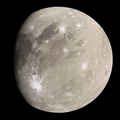
A mosaic image of Ganymede showing Uruk Sulcus, taken by Voyager 2 in July 1979.
-
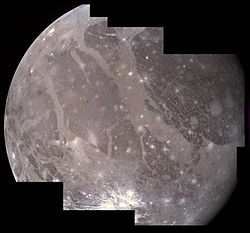
👁 A comparative image of Uruk Sulcus, showing Galileo's higher-resolution images superimposed on Voyager 2's lower-resolution images of the same region, which revealed details of its parallel ridges and troughs. The Galileo version was taken in September 1997.[16]A comparative image of Uruk Sulcus, showing Galileo's higher-resolution images superimposed on Voyager 2's lower-resolution images of the same region, which revealed details of its parallel ridges and troughs. The Galileo version was taken in September 1997.[16]


![👁 A comparative image of Uruk Sulcus, showing Galileo's higher-resolution images superimposed on Voyager 2's lower-resolution images of the same region, which revealed details of its parallel ridges and troughs. The Galileo version was taken in September 1997.[16]](https://upload.wikimedia.org/wikipedia/commons/thumb/0/00/PIA00493_Uruk_Sulcus.jpg/250px-PIA00493_Uruk_Sulcus.jpg)

![👁 An image of between Uruk Sulcus, taken by the Galileo spacecraft in June 1996.[20][21][22] The dark crater in the image is En-zu.[23]](https://upload.wikimedia.org/wikipedia/commons/thumb/b/b4/Galileo_Regio_and_Uruk.jpg/250px-Galileo_Regio_and_Uruk.jpg)
See also
[edit]


References
[edit]- ^ a b c d "GANYMEDE – Uruk Sulcus". USGS. 2016. Retrieved 2025-12-18.
- ^ "Uruk". World History Encyclopedia. 2025. Retrieved 2025-12-18.
- ^ "Epic of Gilgamesh". Britannica. 2025. Retrieved 2025-12-18.
- ^ "Categories (Themes) for Naming Features on Planets and Satellites". USGS. 2025. Retrieved 2025-12-23.
- ^ a b "Ganymede Geologic Map of the Uruk Sulcus Quadrangle". USGS. 1988. Retrieved 2025-12-18.
- ^ "Geologic map of the Memphis Facula Quadrangle (Jg-7) of Ganymede". USGS. 1992. Retrieved 2025-12-18.
- ^ "Global Geologic Map of Ganymede" (PDF). USGS. 2014. Retrieved 2025-12-18.
- ^ Ganymede Map Images Archived 2007-11-19 at the Wayback Machine
- ^ "Geology and mapping of dark terrain on Ganymede and implications for grooved terrain formation". NASA. 2000. Retrieved 2025-12-04.
- ^ "Ganymede: Bright and Dark Terrain". AGU Publications. 2000. Retrieved 2025-12-03.
- ^ "Why is the Arctic So Sensitive to Climate Change and Why Do We Care?". NOAA. 2008. Retrieved 2025-12-18.
- ^ a b "Perspective View of Bright Ridges in Uruk Sulcus". NASA. 1998. Retrieved 2025-12-18.
- ^ "Ganymede Dark Terrain at High Resolution". NASA/JPL. 2000. Retrieved 2025-12-05.
- ^ "Detail of Ganymede's Uruk Sulcus Region as Viewed by Galileo and Voyager". NASA/JPL. 1997. Retrieved 2025-12-21.
- ^ Giese, B.; Oberst, J.; Roatsch, T.; Neukum, G.; Head, J. W.; Pappalardo, R. T. (September 1998). "The Local Topography of Uruk Sulcus and Galileo Regio Obtained from Stereo Images". Icarus. 135 (1): 303–316. Bibcode:1998Icar..135..303G. doi:10.1006/icar.1998.5967.
- ^ a b "Uruk Sulcus Mosaic – Galileo over Voyager Data". NASA. 1997. Retrieved 2025-12-18.
- ^ "3D geological model of Uruk Sulcus on Ganymede: modeling approach and first insights". Adsabs Harvard. 2021. Retrieved 2025-12-18.
- ^ "Juice Jupiter Icy Moons Explorer". ESA. 2023. Retrieved 2025-12-21.
- ^ "Juice's journey and Jupiter system tour". ESA. 2022. Retrieved 2025-12-21.
- ^ "Ganymede - Mixture of Terrains and Large Impact Crater in Uruk Sulcus Region". NASA. 1999. Retrieved 2025-12-06.
- ^ "Mixture of Terrains and Large Impact Crater". Solarviews. 1997.
- ^ "Ganymede - Galileo Regio". Solarviews. 1997.
- ^ Atlas of the Galilean Satellites; Schenk, Paul; Cambridge University Press; Page 140