The springbok or springbuck (Antidorcas marsupialis) is an antelope found mainly in south and southwest Africa. The sole living member of the genusAntidorcas, this bovid was first described by the German zoologist Eberhard August Wilhelm von Zimmermann in 1780. Three subspecies are identified. A slender, long-legged antelope, the springbok reaches 71 to 86 cm (28 to 34 in) at the shoulder and weighs between 27 and 42 kg (60 and 93 lb). Both sexes have a pair of black, 35 to 50 cm (14 to 20 in) long horns that curve backwards. The springbok is characterised by a white face, a dark stripe running from the eyes to the mouth, a light brown coat marked by a reddish-brown stripe that runs from the upper foreleg to the buttocks across the flanks like the Thomson's gazelle, and a white rump flap.
Active mainly at dawn and dusk, springbok form harems (mixed-sex herds). In earlier times, springbok of the Kalahari Desert and Karoo migrated in large numbers across the countryside, a practice known as trekbokking. A feature, peculiar but not unique, to the springbok is pronking, in which the springbok performs multiple leaps into the air, up to 2 m (6 ft 7 in) above the ground, in a stiff-legged posture, with the back bowed and the white flap lifted. Primarily a browser, the springbok feeds on shrubs and succulents; this antelope can live without drinking water for years, meeting its requirements through eating succulent vegetation. Breeding takes place year-round, and peaks in the rainy season, when forage is most abundant. A single calf is born after a five- to six-month-long pregnancy; weaning occurs at nearly six months of age, and the calf leaves its mother a few months later. (Full article...)
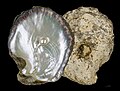
The maxima clam (Tridacna maxima) is a species of bivalve found throughout the Indo-Pacific. It is found on the surface of reefs or sand, or partly embedded in coral (as with this specimen), in the oceans surrounding east Africa, India, China, Australia, Southeast Asia and the islands of the Pacific. This clam is much sought after in the aquarium trade, as its often striking coloration—the result of crystalline pigment—mimics that of the true giant clam.
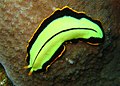
Platyhelminthes (from Ancient Greek πλατύ platy'flat' and ἕλμινς helmins'parasitic worm') is a phylum of relatively simple bilaterian, unsegmented, soft-bodied invertebrates commonly called flatworms or flat worms. Being acoelomates (having no body cavity), and having no specialised circulatory and respiratoryorgans, they are restricted to having flattened shapes that allow oxygen and nutrients to pass through their bodies by diffusion. The digestive cavity has only one opening for both ingestion (intake of nutrients) and egestion (removal of undigested wastes); as a result, the food can not be processed continuously. (Full article...)
Eutropis macularia, the bronze grass skink, is a species of lizard in the skink family, Scincidae, native to South and Southeast Asia. It lives in both deciduous and evergreen forests, in plantations, in grasslands, and in rocky areas with scattered trees. The species is active in both the day and the night, feeding on insects and other invertebrates. This bronze grass skink was photographed on a tree trunk on the island of Don Det in Laos.
The golden toad (Bufo periglenes) is an extinct species of true toad that was once abundant in a small region of high-altitude cloud-covered tropical forests, about 30 km2 (12 sq mi) in area, above the city of Monteverde, Costa Rica. The last reported sighting of a golden toad was on 15 May 1989. Its sudden extinction may have been caused by chytrid fungus and extensive habitat loss.
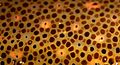
Plate 5 from Ernst Haeckel's Kunstformen der Natur, showing a variety of calcareous sponges, a class of about 400 marine sponges that are found mostly in shallow tropical waters worldwide. Calcareous sponges vary from radially symmetrical vase-shaped body types to colonies made up of a meshwork of thin tubes, or irregular massive forms. The skeleton has either a mesh or honeycomb structure.
Representative dinosaurs of the Hadrosauroideasuperfamily. The familyHadrosauridae contains the dinosaurs commonly known as "duck-billed" dinosaurs. They were ubiquitous herbivores during the Cretaceous period, and prey to theropoda such as Tyrannosaurus. The individual drawings represent typical genera. All these groups were alive in the late Cretaceous, and are generally known only from a single fossil site. Animals are shown to scale.
Brittle stars, serpent stars, or ophiuroids (from Latin ophiurus'brittle star'; from Ancient Greekὄφις (óphis)'serpent' and οὐρά (ourá)'tail'; referring to the serpent-like arms of the brittle star) are echinoderms in the class Ophiuroidea, closely related to starfish. They crawl across the sea floor using their flexible arms for locomotion. The ophiuroids generally have five long, slender, whip-like arms which may reach up to 60 cm (24 in) in length on the largest specimens. (Full article...)
The eastern grey kangaroo (Macropus giganteus) is a marsupial found in the eastern third of Australia, with a population of several million. The eastern grey kangaroo is the second largest living marsupial and native land mammal in Australia, with adult males weighing around 50 to 66 kg (110 to 146 lb) and females weighing around 17 to 40 kg (37 to 88 lb). Like all kangaroos, it is mainly nocturnal and crepuscular, and is mostly seen early in the morning, or as the light starts to fade in the evening. In the middle of the day, kangaroos rest in the cover of the woodlands and graze there. Kangaroos are the only large mammals to hop on two legs as their primary means of locomotion. This multiple exposure photograph shows an eastern grey kangaroo hopping in Mount Annan, New South Wales.
The leopard shark (Triakis semifasciata) is a species of hound shark found along the Pacific coast of North America from the U.S. state of Oregon to Mazatlán in Mexico. Typically measuring 1.2–1.5 m (3.9–4.9 ft) long, this slender-bodied shark is characterized by black saddle-like markings and large spots over its back.
The coconut octopus (Amphioctopus marginatus) is a medium-sized cephalopod found in tropical waters of the western Pacific Ocean. It commonly preys upon shrimp, crabs, and clams, and displays unusual behaviour, including bipedal walking and gathering and using coconut shells and seashells for shelter.
Bryozoa (also known as the Polyzoa, Ectoprocta or commonly as moss animals) are a phylum of simple, aquaticinvertebrate animals, nearly all living in sedentary colonies. Typically about 0.5 millimetres (1⁄64 in) long, they have a special feeding structure called a lophophore, a "crown" of tentacles used for filter feeding. The bryozoans are classified as the marine bryozoans (Stenolaemata), freshwater bryozoans (Phylactolaemata), and mostly-marine bryozoans (Gymnolaemata), a few members of which prefer brackish water. Most marine bryozoans live in tropical waters, but a few are found in oceanic trenches and polar waters. 5,869living species of bryozoa are known. Originally all of the crown group Bryozoa were colonial, but as an adaptation to a mesopsammal (interstitial spaces in marine sand) life or to deep-sea habitats, secondarily solitary forms have since evolved. Solitary species have been described in four genera: Aethozooides, Aethozoon, Franzenella, and Monobryozoon, the latter having a statocyst-like organ with a supposed excretory function. (Full article...)
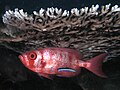
The Atlantic spadefish is a species of marine fish endemic to the shallow waters off the coast of the southeastern United States and in the Caribbean Sea. They are similar in appearance to fresh waterangelfish, but much larger, reaching up to three feet (0.9 m) in length. Due to their reputation as strong fighters, they are popular game fish, especially during the summer months when they are most active.
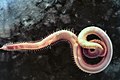
A cross section of a post-clitellum segment of an annelid (ringed worm); almost all segments of an annelid contain the same set of organs and parts, a pattern called metamerism. Annelids have no lungs, but rather exchange carbon dioxide and oxygen directly through the moist skin when blood reaches the extremely fine capillaries of the body walls; a dry worm cannot breathe and will die of suffocation. The worm's red blood, which does not consist of platelets or red cells but mostly of a liquid containing suspended hemoglobin, makes a circuit up and down the animal in its closed circulatory systems.
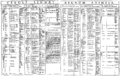
The book begins with a brief account of the physical causes of animal coloration. The second chapter gives an overview of the book, describing the various uses of colour in terms of the advantages it can bring through natural selection. The next seven chapters describe camouflage, both in predators and in prey. Methods of camouflage covered include background matching, resemblance to specific objects such as bird droppings, self-decoration with materials from the environment, and the seasonal colour change of arctic animals. Two chapters cover warning colours, including both Batesian mimicry, where the mimic is edible, and Müllerian mimicry, where distasteful species mimic each other. A chapter then looks at how animals combine multiple methods of defence, for instance in the puss moth. Two chapters examine coloration related to sexual selection. Finally Poulton summarizes the subject with a fold-out table including a set of Greek derived words that he invented, of which "aposematic" and "cryptic" survive in biological usage. (Full article...)
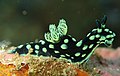
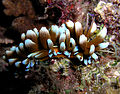
...that six new species of marine slugs in the genus Phyllodesmium(Sp. kabiranum pictured) have been described in the last two years?
...that Maui's dolphin is the most endangered species of dolphin in the world, with only about 110 left?
...that the land snail Euglandina rosea is a significant threat to Hawaiian freshwater snail known as Newcomb's snail (Erinna newcombi), because the predatory Euglandina is able to hunt Erinna under water?
...that the body of the "X-ray fish" (Pristella maxillaris ) is so transparent that it is possible to see its backbone?
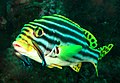
Image 15A brilliantly-coloured oriental sweetlips fish (Plectorhinchus vittatus) waits while two boldly-patterned cleaner wrasse (Labroides dimidiatus) pick parasites from its skin. The spotted tail and fin pattern of the sweetlips signals sexual maturity; the behaviour and pattern of the cleaner fish signal their availability for cleaning service, rather than as prey. (from Animal coloration)
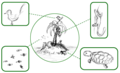
Image 31Idealised nephrozoan body plan. With an elongated body and a direction of movement the animal has head and tail ends. Sense organs and mouth form the basis of the head. Opposed circular and longitudinal muscles enable peristaltic motion. (from Animal)
Image 32The bilaterian gut develops in two ways. In many protostomes, the blastopore develops into the mouth, while in deuterostomes it becomes the anus. (from Animal)
Image 39A praying mantis in deimatic or threat pose displays conspicuous patches of colour to startle potential predators. This is not warning coloration as the insect is palatable. (from Animal coloration)
Image 40The microscopic cave snail Zospeum tholussum, found at depths of 743 to 1,392 m (2,438 to 4,567 ft) in the Lukina Jama–Trojama cave system of Croatia, is completely blind with a translucent shell (from Fauna)
The following table lists estimated numbers of described extant species for the animal groups with the largest numbers of species,[1] along with their principal habitats (terrestrial, fresh water,[2] and marine),[3] and free-living or parasitic ways of life.[4] Species estimates shown here are based on numbers described scientifically; much larger estimates have been calculated based on various means of prediction, and these can vary wildly. For instance, around 25,000–27,000 species of nematodes have been described, while published estimates of the total number of nematode species include 10,000–20,000; 500,000; 10 million; and 100 million.[5] Using patterns within the taxonomic hierarchy, the total number of animal species—including those not yet described—was calculated to be about 7.77 million in 2011.[6][7][a]
^The application of DNA barcoding to taxonomy further complicates this; a 2016 barcoding analysis estimated a total count of nearly 100,000 insect species for Canada alone, and extrapolated that the global insect fauna must be in excess of 10 million species, of which nearly 2 million are in a single fly family known as gall midges (Cecidomyiidae).[8]
^Stork, Nigel E. (January 2018). "How Many Species of Insects and Other Terrestrial Arthropods Are There on Earth?". Annual Review of Entomology. 63 (1): 31–45. doi:10.1146/annurev-ento-020117-043348. PMID28938083. S2CID23755007. Stork notes that 1m insects have been named, making much larger predicted estimates.
^ abcdNicol, David (June 1969). "The Number of Living Species of Molluscs". Systematic Zoology. 18 (2): 251–254. doi:10.2307/2412618. JSTOR2412618.
^Sluys, R. (1999). "Global diversity of land planarians (Platyhelminthes, Tricladida, Terricola): a new indicator-taxon in biodiversity and conservation studies". Biodiversity and Conservation. 8 (12): 1663–1681. doi:10.1023/A:1008994925673. S2CID38784755.


_on_a_tree_trunk.jpg)


_Mount_Annan_composite_of_6.jpg)



_on_Bohadschia_argus_(Sea_cucumber).jpg)












.png)


.jpg)








_Naggar,_Himachal_Pradesh,_2013_(cropped).JPG)




.jpg)




.jpg)