|
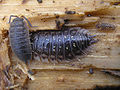
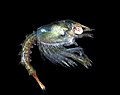
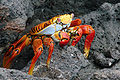
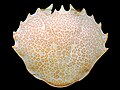
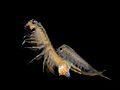
Crustaceans (from Latin word "crustacea" meaning: "those with shells" or "crusted ones") are mandibulate arthropods that are traditionally a part of the paraphyletic subphylum Crustacea (/krəˈsteɪʃə/). Crustaceans are mainly aquatic, including decapods (shrimps, prawns, crabs, lobsters, and crayfish), seed shrimps, branchiopods, fish lice, krill, remipedes, isopods, barnacles, copepods, opossum shrimps, amphipods and mantis shrimp. It is now well accepted that hexapods (insects and entognathans) are cladistically crustaceans, with the two groups now combined in the monophyletic clade Pancrustacea. The three classes Cephalocarida, Branchiopoda, and Remipedia are more closely related to the hexapods than they are to any other crustaceans (oligostracans and multicrustaceans). The 67,000 described species range in size from Stygotantulus stocki at 0.1 mm (0.004 in), to the Japanese spider crab with a leg span of up to 3.8 m (12.5 ft) and a mass of 20 kg (44 lb). Like other arthropods, crustaceans have an exoskeleton, which they moult to grow. They are distinguished from other groups of arthropods, such as insects, myriapods and chelicerates, by the possession of biramous (two-parted) limbs, and by their larval forms, such as the nauplius stage of branchiopods and copepods. Most crustaceans are free-living aquatic animals, but some are terrestrial (e.g. woodlice, sandhoppers), some are parasitic (e.g. Rhizocephala, fish lice, tongue worms) and some are sessile (e.g. barnacles). The group has an extensive fossil record, reaching back to the Cambrian. More than 7.9 million tons of crustaceans per year are harvested by fishery or farming for human consumption, consisting mostly of shrimp and prawns. Krill and copepods are not as widely fished, but may be the animals with the greatest biomass on the planet, and form a vital part of the food chain. The scientific study of crustaceans is known as carcinology (alternatively, malacostracology, crustaceology or crustalogy), and a scientist who works in carcinology is a carcinologist. (Full article...) Selected articleCrayfish are freshwater crustaceans belonging to the infraorder Astacidea, which also contains lobsters. Taxonomically, they are members of the superfamilies Astacoidea and Parastacoidea. They breathe through feather-like gills. Some species are found in brooks and streams, where fresh water is running, while others thrive in swamps, ditches, and paddy fields. Most crayfish cannot tolerate polluted water, although some species, such as Procambarus clarkii, are hardier. Crayfish feed on animals and plants, either living or decomposing, and detritus. The term "crayfish" is applied to saltwater species in some countries. (Full article...) Did you know?
Selected biography
Charles Chilton (1860–1929) was a New Zealand zoologist, the first rector to be appointed in Australasia, and the first person to be awarded a D.Sc. degree in New Zealand.
Chilton was born on September 27, 1860 at Little Marstone, Pencombe (near Leominster, Herefordshire, England) but emigrated with his family to New Zealand in 1862. They settled on a farm at East Eyreton, North Canterbury. He was troubled by his hips from an early age, and had his left leg amputated, using an artificial leg and a crutch thereafter. In 1881, he gained an M.A. with first class honours from Canterbury College, having been taught by Frederick Wollaston Hutton, who inspired him to take up biology, especially the study of crustaceans, which had been little studied in New Zealand up to that time. Chilton's first scientific publication followed that same year, when he described three new species of crustacean (two crabs and one isopod) from Lyttelton Harbour and Lake Pupuke. He surprised the scientific world later that year by describing four species of amphipod and isopod from groundwaters at the family farm in Eyreton. He went on to discover the isopod Phreatoicus typicus in the same location, the first example ever described of the suborder Phreatoicidea, the "earliest derived isopod[s]". Charles Chilton became rector of Christchurch University College in 1921, the first time such a post had been granted in Australia or New Zealand. Chilton died on October 25, 1929 of a sudden attack of pneumonia, before he could collect his life's work into a single monograph. He had published 130 papers on crustaceans, mostly amphipods, isopods and decapods, from all around the world, but especially from New Zealand, subterranean and sub-Antarctic waters. Selected image
Perisesarma bidens is a semiterrestrial crab from tropical Asia. General imagesThe following are images from various crustacean-related articles on Wikipedia.
Crustacean lists
SubcategoriesRelated portalsWikiProjectsAssociated WikimediaThe following Wikimedia Foundation sister projects provide more on this subject:
Discover Wikipedia using portals
|
 |
VOOZH | about |





_-_Oberer_Brauner_Jura_-_Bissingen_unter_Teck.jpg)