


Insects (from Latin insectum) are hexapod invertebrates of the class Insecta. They are the largest group within the arthropod phylum. Insects have a chitinous exoskeleton, a three-part body (head, thorax and abdomen), three pairs of jointed legs, compound eyes, and a pair of antennae. Insects are the most diverse group of animals, with more than a million described species; they represent more than half of all animal species. (Full article...)
Selected article - show another
.jpg)

Myrmecia nigriceps, also known as the black-headed bull ant, is a species of ant endemic to Australia. A member of the genus Myrmecia in the subfamily Myrmeciinae, it was first described by Austrian entomologist Gustav Mayr in 1862. These ants are large, varying from 19 to 23 millimetres (0.75 to 0.91 in) in length. However, colonies contain workers that are much smaller, usually half the size of normal workers. The queens are the largest while the males are the smallest, which can be easily identified due to their small mandibles.
Mainly nocturnal M. nigriceps is found in hot hilly areas and woodland, nesting underground in mounds. The ant's diet consists of sweet liquids from flowering plants and invertebrate prey, which are fed to the carnivorous larvae. Spiders are known to eat these ants, and echidnas consume the larvae and pupae. Like other Myrmecia species, M. nigriceps ants possess a powerful and painful sting, and the venom is capable of inducing allergic reactions in sensitive people. (Full article...)
Did you know - load new batch
- ... that offspring of Gargaphia solani almost always fall victim to predation without the protection of their mother?
- ... that the brilliantly-coloured blue and black neon cuckoo bee of Australia is a parasite of the blue banded bee?
- ... that fossil specimens of the extinct scorpionfly family Dinopanorpidae, which includes Dinopanorpa and Dinokanaga, sometimes have preserved dark with light to clear color patterning?
- ... that Ororaphidia and Styporaphidia are the oldest snakeflies known from China, dating from the Middle Jurassic?
- ... that the Australian cicada Psaltoda plaga is commonly known as the "black prince"?
List articles


Related portals


General images - load new batch
-
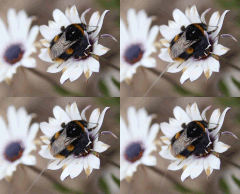
👁 Image 1Bumblebee defecating. Note the contraction of the anus, which provides internal pressure. (from Insect morphology)Bumblebee defecating. Note the contraction of the anus, which provides internal pressure. (from Insect morphology)
-
👁 Image 2A tau emerald (Hemicordulia tau) dragonfly has flight muscles attached directly to its wings. (from Insect flight)A tau emerald (Hemicordulia tau) dragonfly has flight muscles attached directly to its wings. (from Insect flight)
-
Diagram of a typical insect leg (from Insect morphology)
-
👁 Image 5Stylized diagram of insect digestive tract showing malpighian tubule, from an insect of the order Orthoptera. (from Insect morphology)Stylized diagram of insect digestive tract showing malpighian tubule, from an insect of the order Orthoptera. (from Insect morphology)
-
👁 Image 6Indian moon moth (Actias selene) with some of the spiracles identified (from Respiratory system of insects)Indian moon moth (Actias selene) with some of the spiracles identified (from Respiratory system of insects)
-
👁 Image 7Variety of male structures in Phlebotominae (Diptera, Psychodidae) (from Insect reproductive system)Variety of male structures in Phlebotominae (Diptera, Psychodidae) (from Insect reproductive system)
-
👁 Image 8 Insect morphology Legend of body parts Tagmata: A – Head, B – Thorax, C – Abdomen. antenna ocelli (lower) ocelli (upper) compound eye brain (cerebral ganglia) prothorax dorsal blood vessel tracheal tubes (trunk with spiracle) mesothorax metathorax forewing hindwing mid-gut (stomach) dorsal tube (heart) ovary hind-gut (intestine, rectum & anus) anus oviduct nerve cord (abdominal ganglia) Malpighian tubes tarsal pads claws tarsus tibia femur trochanter fore-gut (crop, gizzard) thoracic ganglion coxa salivary gland subesophageal ganglion mouthparts (from Insect morphology)Insect morphology
Legend of body parts
Tagmata: A – Head, B – Thorax, C – Abdomen.(from Insect morphology)- antenna
- ocelli (lower)
- ocelli (upper)
- compound eye
- brain (cerebral ganglia)
- prothorax
- dorsal blood vessel
- tracheal tubes (trunk with spiracle)
- mesothorax
- metathorax
- forewing
- hindwing
- mid-gut (stomach)
- dorsal tube (heart)
- ovary
- hind-gut (intestine, rectum & anus)
- anus
- oviduct
- nerve cord (abdominal ganglia)
- Malpighian tubes
- tarsal pads
- claws
- tarsus
- tibia
- femur
- trochanter
- fore-gut (crop, gizzard)
- thoracic ganglion
- coxa
- salivary gland
- subesophageal ganglion
- mouthparts
-
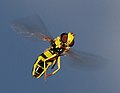
Hoverfly (Philhelius pedissequum) has indirect flight musculature. (from Insect flight)
-
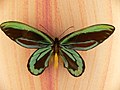
👁 Image 10Queen Alexandra's birdwing (Ornithoptera alexandrae) of Papua New Guinea (from Insect biodiversity)Queen Alexandra's birdwing (Ornithoptera alexandrae) of Papua New Guinea (from Insect biodiversity)
-
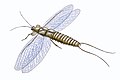
👁 Image 11Mazothairos, a Carboniferous member of the now extinct order Palaeodictyoptera. (from Evolution of insects)Mazothairos, a Carboniferous member of the now extinct order Palaeodictyoptera. (from Evolution of insects)
-
👁 Image 12Evolution has produced astonishing variety of appendages in insects, such as these antennae. (from Evolution of insects)Evolution has produced astonishing variety of appendages in insects, such as these antennae. (from Evolution of insects)
-
👁 Image 13Generalized arthropod biramous limb. Trueman proposed that an endite and an exite fused to form a wing. (from Insect flight)Generalized arthropod biramous limb. Trueman proposed that an endite and an exite fused to form a wing. (from Insect flight)
-
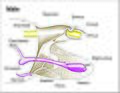
Male genitalia of Lepidoptera (from Insect reproductive system)
-
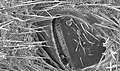
👁 Image 15Scanning electron micrograph of a cricket spiracle valve (from Respiratory system of insects)Scanning electron micrograph of a cricket spiracle valve (from Respiratory system of insects)
-
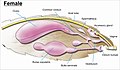
The female genitalia of Lepidoptera (from Insect reproductive system)
-
Direct flight: muscles attached to wings. Large insects only (from Insect flight)
-
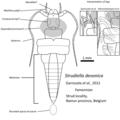
Reconstruction of Strudiella devonica as a possible hexapod (from Evolution of insects)
-
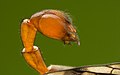
👁 Image 20The abdominal terminus of male scorpionflies is enlarged into a "genital bulb", as seen in Panorpa communis (from Insect morphology)The abdominal terminus of male scorpionflies is enlarged into a "genital bulb", as seen in Panorpa communis (from Insect morphology)
-
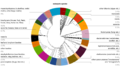
👁 Image 21A pie chart of described eukaryote species, showing just over half of these to be insects (from Insect biodiversity)A pie chart of described eukaryote species, showing just over half of these to be insects (from Insect biodiversity)
-
👁 Image 22Mandibles of Rhyniognatha hirsti, it may be one of the oldest insects, but also possible to be a myriapod. (from Evolution of insects)Mandibles of Rhyniognatha hirsti, it may be one of the oldest insects, but also possible to be a myriapod. (from Evolution of insects)
-
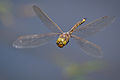
👁 Image 23The Odonata (dragonflies and damselflies) have direct flight musculature. (from Insect flight)The Odonata (dragonflies and damselflies) have direct flight musculature. (from Insect flight)
-
Frenulo-retinacular wing coupling in male and female moths (from Insect flight)
-
Mayfly nymph with paired abdominal gills (from Insect flight)
-
Cross-section of wing vein (from Insect morphology)



.jpg)


.png)


.jpg)














.JPG)


Selected image - show another


| 👁 Image Credit: Noodle snacks |

Abantiades latipennis (Lepidoptera: Hepialidae) is one of fourteen species in the Australian genus Abantiades. It thrives in regrowth forests that were previously clearfelled; the phytophagous larvae of A. latipennis feed primarily on the root systems of two species of tree, Eucalyptus obliqua (messmate stringybark) and Eucalyptus regnans (mountain ash).
Topics


Subcategories


WikiProjects


Main WikiProject:
Related projects:
- WikiProject Arthropods
- WikiProject Spiders
- WikiProject Animals
- WikiProject Tree of Life
- WikiProject Biology
Daughter projects:
Tasks
|
👁 Image |
Here are some tasks awaiting attention:
|


Associated Wikimedia
The following Wikimedia Foundation sister projects provide more on this subject:
-
Commons
Free media repository -
Wikibooks
Free textbooks and manuals -
Wikidata
Free knowledge base -
Wikinews
Free-content news -
Wikiquote
Collection of quotations -
Wikisource
Free-content library -
Wikiversity
Free learning tools -
Wiktionary
Dictionary and thesaurus


- Portals with triaged subpages from June 2018
- All portals with triaged subpages
- Portals with no named maintainer
- Random portal component with 31–40 available subpages
- Random portal component with 11–15 available image subpages
- Redirect targets of redirected portals with existing subpages
- Portals needing placement of incoming links