IntroductionThe Catholic Church (Latin: Ecclesia Catholica), commonly called the Roman Catholic Church, is the largest Christian church, with an estimated 1.28 to 1.41 billion baptized members worldwide as of 2026. It consists of 24 autonomous (sui iuris) churches—the Latin Church and 23 Eastern Catholic Churches—organized into nearly 3,500 dioceses and eparchies governed by bishops. Throughout history, the church has had a large role in the development of Western civilization. Catholic communities are present worldwide through missions, immigration, and conversions. The majority of Catholics live in the Global South, reflecting rapid demographic growth in Africa, Asia, and Latin America, as well as secularization in parts of Europe and North America. Catholic doctrine is rooted in the Nicene Creed and holds that the church is the "one, holy, catholic and apostolic Church" founded by Jesus Christ. It teaches that bishops are the successors of the apostles and that the pope is the successor of Saint Peter, entrusted with a unique pastoral role. The pope serves as the head of the church; the Diocese of Rome forms his local jurisdiction, while the Holy See serves as the church’s central governing authority through the Roman Curia. Apostolic teaching is understood to be transmitted through Scripture and sacred tradition, interpreted by the magisterium, the church's teaching authority. Catholic liturgical life includes the Roman Rite, other rites of the Latin Church, and the liturgical traditions of the Eastern Catholic Churches. Religious orders, monastic communities, and lay movements contribute to a wide range of theological and devotional expressions within Catholicism globally. Among the church's seven sacraments, the Eucharist is seen as the source and summit of the Christian life and is celebrated in the Mass. Catholics believe that through consecration by a priest, the bread and wine become the body and blood of Christ. The Virgin Mary is venerated as the Mother of God and honored through dogmas such as the Immaculate Conception, perpetual virginity, and Assumption, including devotional practices. Catholic social teaching emphasizes care for the poor, the sick, and the marginalized. The church operates tens of thousands of educational, medical, and charitable institutions worldwide, becoming the largest non-governmental provider of education and health care. (Full article...) Selected article
The Knights of Columbus is the world's largest Roman Catholic fraternal service organization. Founded in the United States in 1882, it is named in honor of Christopher Columbus and dedicated to the principles of Charity, Unity, Fraternity, and Patriotism. There are more than 1.7 million members in 14,000 councils, with nearly 200 councils on college campuses. Membership is limited to "practical Catholic" men aged 18 or older. Councils have been chartered in the United States, Canada, Mexico, the Caribbean, Central America, the Philippines, Guam, Saipan, and most recently in Poland. The Knights' official junior organization, the Columbian Squires, has over 5,000 Circles. All the Order's ceremonials and business meetings are restricted to members though all other events are open to the public. A promise not to reveal any details of the ceremonials except to an equally qualified Knight is required to ensure their impact and meaning for new members; an additional clause subordinates the promise to that Knight's civil and religious duties.
Selected image
Credit: Diliff St. Vitus Cathedral (Czech: Katedrála svatého Víta) is a Roman Catholic cathedral in Prague, Czech Republic, and the seat of the Archbishop of Prague. The full name of the cathedral is St. Vitus, St. Wenceslas and St. Adalbert Cathedral. Located within Prague Castle and containing the tombs of many Bohemian kings, this cathedral is an excellent example of Gothic architecture and is the biggest and most important church in the country. Selected biography
Henry de Lichton (de Lychtone, Leighton) (d. 1440), was a medieval Scottish prelate and diplomat, who, serving as Bishop of Moray (1414–1422) and Bishop of Aberdeen (1422–1440), became a significant patron of the church, a cathedral builder and a writer. He also served King James I of Scotland as a diplomat in England, France and Italy. He was born in the diocese of Brechin (probably Angus) somewhere between 1369 and 1379 to Henry and Janet Lichton. He was exceptionally well educated for his time, attending the University of Orléans and possibly the University of St Andrews, earning licentiates in civil law and canon law, a bachelorate in canon law and a doctorate in canon law, all achieved between 1394 and 1415; he attained an additional doctorate — in civil law — by 1436. Lichton followed an ecclesiastical career simultaneously with his studies. The first notice of this career comes in 1392, when he was vicar of Markinch in Fife, a vicariate of St Andrews Cathedral Priory.
Did you know...
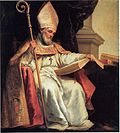
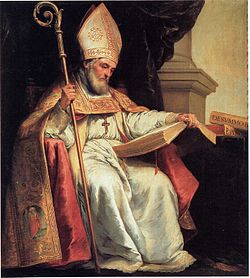
Related portalsFeast Day of April 4
Selected quote
News
SubcategoriesTopics
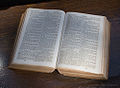
The Holy Bible:
Particular churches (grouped by liturgical rite):
Things you can do
External resourcesWikiProjectsAssociated WikimediaThe following Wikimedia Foundation sister projects provide more on this subject:
Discover Wikipedia using portals |
 |
VOOZH | about |


.jpg)








.jpg)


.svg)

.svg)