


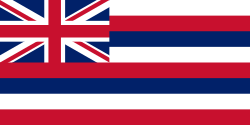
Hawaii (/həˈwaɪ.i/ ⓘ hə-WY-ee; Hawaiian: Hawaiʻi [həˈvɐjʔi,həˈwɐjʔi]) is an island state of the United States, in the Pacific Ocean about 2,000 miles (3,200 km) southwest of the U.S. mainland. One of the two non-contiguous U.S. states (along with Alaska), it is the only state not on the North American mainland, the only state that is an archipelago, the only state south of the Tropic of Cancer, one of only two states, along with Florida, with regions that have a tropical climate, and one of the two U.S. states, along with Texas, that were internationally recognized sovereign countries before becoming U.S. states. Hawaii consists of 137 volcanic islands that make up almost the entire Hawaiian archipelago (the exception is Midway Atoll). Spanning 1,500 miles (2,400 km), the state is physiographically and ethnologically part of the Polynesian subregion of Oceania. Hawaii's ocean coastline is consequently the fourth-longest in the U.S., at about 750 miles (1,210 km). The eight main islands, from northwest to southeast, are Niʻihau, Kauaʻi, Oʻahu, Molokaʻi, Lānaʻi, Kahoʻolawe, Maui, and Hawaiʻi, after which the state is named; the last is often called the "Big Island" or "Hawaiʻi Island" to avoid confusion with the state or archipelago. The uninhabited Northwestern Hawaiian Islands make up most of the Papahānaumokuākea Marine National Monument, the largest protected area in the U.S. and the fourth-largest in the world. Of the 50 U.S. states, Hawaii is the eighth-smallest in land area and the 11th-least populous; but with 1.4 million residents, it ranks 13th in population density. Two-thirds of Hawaii residents live on Oʻahu, home to the state's capital and largest city, Honolulu. Hawaii is one of the most demographically diverse U.S. states, owing to its location in the central Pacific and over two centuries of migration. As one of nine majority-minority states, it has the only Asian American plurality, the largest Buddhist community, and largest proportion of multiracial people in the U.S. Consequently, Hawaii is a unique melting pot of North American and East Asian cultures, in addition to its indigenous Hawaiian heritage. Settled by Polynesians sometime between 1000 and 1200 CE, Hawaii was home to numerous independent chiefdoms. In 1778, British explorer James Cook was the first known non-Polynesian to arrive at the archipelago; early British influence is reflected in the state flag, which bears a Union Jack. An influx of European and American explorers, traders, and whalers soon arrived, leading to the decimation of the once-isolated indigenous community through the introduction of diseases such as syphilis, tuberculosis, smallpox, and measles; the native Hawaiian population declined from between 300,000 and one million to less than 40,000 by 1890. Hawaii became a unified, internationally recognized kingdom in 1810, remaining independent until American and European businessmen overthrew the monarchy in 1893; this led to annexation by the U.S. in 1898. As a strategically valuable U.S. territory, Hawaii was attacked by Japan on December 7, 1941, which brought it global and historical significance, and contributed to America's entry into World War II. Hawaii is the most recent state to join the union, on August 21, 1959. In 1993, the U.S. government formally apologized for its role in the overthrow of Hawaii's government, which had spurred the Hawaiian sovereignty movement and has led to ongoing efforts to obtain redress for the indigenous population. (Full article...) 👁 Image |



- Pages using the Phonos extension
- Portals with triaged subpages from October 2020
- All portals with triaged subpages
- Portals with no named maintainer
- Pages including recorded pronunciations
- Pages with Hawaiian IPA
- Random portal component with 31–40 available image subpages
- Random portal component with more available subpages than specified max
- Random portal component with 16–20 available subpages
- Random portal component with 6–10 available subpages