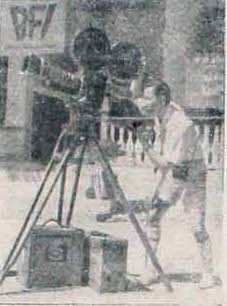
Terang Boelan (Indonesian pronunciation:[t̪əˌraŋˈbulan]; Indonesian for "Full Moon", Terang Bulan in the Enhanced Spelling System) is a 1937 film from the Dutch East Indies (now Indonesia). Written by Saeroen, directed by Albert Balink, and starring Rd Mochtar, Roekiah and Eddie T. Effendi, Terang Boelan follows two lovers who elope after one is almost forced to marry an opium smuggler. The film was shot in the Indies and Singapore, and was partially inspired by the 1936 Hollywood film The Jungle Princess. It was aimed at native audiences and included keroncong music, which was popular at the time, and several actors from Balink's previous work Pareh (1936). Terang Boelan was a commercial success in both the Indies and abroad, earning 200,000 Straits dollars in British Malaya. This success revived the faltering domestic film industry and inspired films aimed at Malay audiences in Malaya, creating a formula of songs, beautiful scenery and romance that was followed for decades afterwards. The Indonesian film historian Misbach Yusa Biran described it as a turning point in the history of Indonesian cinema for its catalytic effect on the industry's growth. Like many Indonesian films of the era, Terang Boelan has been lost since at least the 1970s. (Full article...)
Djadoeg Djajakusuma ([dʒaˈdʊʔdʒajakuˈsuma]; 1 August 1918 – 28 October 1987) was an Indonesian film director and promoter of traditional art forms. Born to a nobleman and his wife in Temanggung, Central Java, Djajakusuma became interested in the arts at a young age, choosing to pursue a career in theatre. During the Japanese occupation from 1943 to 1945 he was a translator and actor, and in the four-year national revolution which followed he worked for the military's educational division, several news agencies, and in drama.
In 1951, Djajakusuma joined the National Film Corporation (Perfini) at the invitation of Usmar Ismail. After making his directorial debut with Embun, Djajakusuma released a further eleven films with the company before leaving in 1964. He then returned to traditional Indonesian theatre, including wayang. Although he continued to direct movies independently of Perfini, most of his energies were dedicated to promoting traditional art forms and teaching cinematography. After over a decade of poor health and high blood pressure, Djajakusuma collapsed during a ceremony and died. He was buried in Karet Bivak Cemetery. (Full article...)
Drama dari Krakatau ([ˈdramadaˈrikraˈkatau]; Drama of Krakatoa) is a 1929 vernacular Malay novel written by Kwee Tek Hoay. Inspired by Edward Bulwer-Lytton's 1834 novel The Last Days of Pompeii and the 1883 eruption of Krakatoa, the sixteen-chapter book centres on two families in 1920s West Java that are unknowingly tied together by siblings who were separated in 1883. The brother becomes a political figure, while the sister marries a Baduy priest-king. Ultimately, these families are reunited by the wedding of their children, after which the priest sacrifices himself to calm a stirring Krakatoa.
First published as a serial in Kwee's magazine Panorama between 7 April and 22 December 1928, Drama dari Krakatau was written over a period of two months after the author was asked to prepare a "sensational" story for a film. Before the final instalment had been published, the novel had already been adapted for the stage. Although Kwee was known as a realist and researched the volcano before writing, Drama dari Krakatau is replete with mysticism. Thematic analyses have focused on the depiction of indigenous cultures by Kwee (himself ethnic Chinese), as well as geography and nationalism. As with other works of Chinese Malay literature, the book is not considered part of the Indonesian literary canon. (Full article...)
The 1740 Batavia massacre (Dutch: Chinezenmoord, lit.'Murder of the Chinese'; Indonesian: Geger Pacinan, lit.'Chinatown tumult') was a massacre and pogrom of ethnic Chinese residents of the port city of Batavia (present-day Jakarta) in the Dutch East Indies. It was carried out by Dutch soldiers of the Dutch East India Company and allied members of other Batavian ethnic groups. The violence in the city lasted from 9 October 1740, until 22 October, with minor skirmishes outside the walls continuing late into November that year. Historians have estimated that at least 10,000 ethnic Chinese were massacred; just 600 to 3,000 are believed to have survived.
In September 1740, as unrest rose among the Chinese population, spurred by government repression and declining sugar prices, Governor-GeneralAdriaan Valckenier declared that any uprising would be met with deadly force. On 7 October, hundreds of ethnic Chinese, many of them sugar mill workers, killed 50 Dutch soldiers, leading Dutch troops to confiscate all weapons from the Chinese populace and to place the Chinese under a curfew. Two days later, rumors of Chinese atrocities led other Batavian ethnic groups to burn Chinese houses along Besar River and Dutch soldiers to fire cannons at Chinese homes in revenge. The violence soon spread throughout Batavia, killing more Chinese. Although Valckenier declared an amnesty on 11 October, gangs of irregulars continued to hunt down and kill Chinese until 22 October, when the governor-general called more forcefully for a cessation of hostilities. Outside the city walls, clashes continued between Dutch troops and rioting sugar mill workers. After several weeks of minor skirmishes, Dutch-led troops assaulted Chinese strongholds in sugar mills throughout the area. (Full article...)
Written over a period of several years and influenced by European literature, Siti Akbari differs from earlier syairs in its use of suspense and emphasis on prose rather than form. It also incorporates European realist views to expand upon the genre, although it maintains several of the hallmarks of traditional syairs. Critical views have emphasised various aspects of its story, finding in the work an increased empathy for women's thoughts and feelings, a call for a unifying language in the Dutch East Indies (now Indonesia), and a polemic regarding the relation between tradition and modernity. (Full article...)
Harta Berdarah ([harˈtabərˈdarah]; Indonesian for Bloody Treasure) is a 1940 action film from the Dutch East Indies (now Indonesia). Set in the Middle Ages, the film stars R Sukran and Hadidjah as a pirate and a princess who fall in love. Union Films, the country's first indigenous film production house, produced the film with Rd Ariffien and R Hu as directors. It was written by Saeroen, one of the country's most prolific screenwriters.The film, which stars Zonder and Soelastri, tells of a young man who convinces a stingy hadji to be more charitable and, in the process, falls in love with the man's daughter.
Released during Eid al-Fitr, Harta Berdarah was advertised as a "magnificent Indonesian action hit" and used Zonder's silat skills and Soelastri's fame as a keroncong singer to draw audiences. Reviews for the work were positive, with praise focused on its acting and story. Although Harta Berdarah was screened as late as 1944, as with most contemporary productions it is now likely lost. (Full article...)
Tjioeng Wanara (Indonesian pronunciation:[ˌtʃiʊŋwaˈnara]; Perfected Spelling: Ciung Wanara) is a 1941 film from the Dutch East Indies (modern-day Indonesia) directed and produced by Jo Eng Sek. Starring R Sukran, Elly Joenara and AB Djoenaedi, it featured more than 500 people in supporting roles. The film follows a young prince named Tjioeng Wanara who must reclaim his throne from the cruel King of Galuh; it is adapted from the Sundanese legend of the same name.
The second production by Star Film, Tjioeng Wanara was released 18 August 1941. It was advertised heavily, emphasising the fact that the scholar Poerbatjaraka had served as the historical adviser and that the film was based on Balai Pustaka's version of the legend. It premiered to commercial success, but received mixed reviews. This black-and-white production, which was screened until at least 1948, is now thought lost. (Full article...)
The colony's first directors, L. Heuveldorp and George Krugers, were of European or mixed descent. They were followed by ethnic Chinese soon after, when Nelson Wong made his debut in 1928 with Lily van Java; other Chinese directors included Lie Tek Swie (1929), Wong's brothers Joshua and Othniel (1930), and The Teng Chun (1931). Ethnic Chinese directors dominated the colony's cinema for the remainder of its existence. The first native director, Bachtiar Effendi, made his debut in 1932 with the talkie Njai Dasima; another native director would not appear until Andjar Asmara and Rd Ariffien made their debuts in 1940. (Full article...)
👁 A poster with Malay-language text, reading Loetoeng Kasaroeng in large letters; an image is also visible. Film poster for Loetoeng Kasaroeng, the first locally produced film released in the Dutch East Indies A total of 112 fictional films are known to have been produced in the Dutch East Indies (modern-day Indonesia) between 1926 and the colony's dissolution in 1949. The earliest motion pictures, imported from abroad, were shown in late 1900, and by the early 1920s imported serials and fictional films were being shown, often with localised names. Dutch companies were also producing documentary films about the Indies to be shown in the Netherlands. The first reports of fictional film production in the Indies date from 1923, although the work in question was not completed. The first locally produced film, Loetoeng Kasaroeng, was directed by L. Heuveldorp and released on 31 December 1926.
Between 1926 and 1933 numerous other local productions were released. Although Dutchmen like Heuveldorp and George Krugers continued to be active in the industry, the majority of filmmakers and producers were ethnic Chinese. The Tan brothers (Khoen Yauw and Khoen Hian) and The Teng Chun were major producers during this period, while the Wong brothers (Nelson, Othniel, and Joshua) were among the more prominent directors. During the mid-1930s, production dropped as a result of the Great Depression. The release of Albert Balink's commercially and critically successful Terang Boelan (Full Moon) in 1937 led to renewed interest in filmmaking, and 1941 saw thirty locally produced films. This rate of production declined after the Japanese occupation beginning in early 1942, closing all but one film studio; this resulted in several films which had begun production in 1941 being released several years later. The majority of films produced during the occupation were short propaganda pieces. Following the Proclamation of Indonesian Independence in 1945 and during the ensuing revolution several films were made, by both pro-Dutch and pro-Indonesian backers; the Dutch formally recognised Indonesia's sovereignty on 27 December 1949, leaving the Dutch East Indies defunct. (Full article...)
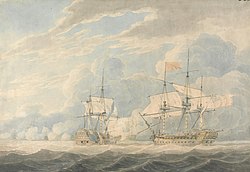
The Battle of Camperdown was an important naval action of the French Revolutionary Wars, fought off Camperduin on the North Holland coast on 11 October 1797 between a Royal Navy fleet under Admiral Adam Duncan and a Batavian Navy fleet under Vice-Admiral Jan Willem de Winter. France had overrun the Dutch Republic two years earlier, which was replaced by the Batavian Republic. In early 1797, the Batavian Navy was ordered to sail to Brest and unite with the French Atlantic Fleet in preparation for an invasion of Ireland. Shortly afterwards, the British navy was paralysed by the Spithead and Nore mutinies, in which the navy's sailors refused to take their ships to sea until they were awarded better pay and conditions. For two months[citation needed] the English Channel was undefended, but the Batavian navy failed to take the opportunity to sail from their harbour in the Texel as their preparations were not complete; furthermore, a small squadron of loyal ships under Duncan convinced de Winter that the British navy was at sea by sending nonsensical signals to fictitious ships over the horizon.
By October 1797, the plan to invade Ireland had been abandoned and the British North Sea Fleet was again at full strength. During a brief period replenishing supplies at Yarmouth, news reached Duncan on 10 October that de Winter had set sail with his fleeton a raiding cruise[citation needed] and he returned to the Dutch coast, intercepting the Batavian fleet on its way back to the Texel. The Batavians formed a line of battle in shallow coastal waters to meet Duncan's attack, which was conducted in a confused mass, the British fleet separating into two groups that struck the vanguard and rear of the Batavian fleet, overwhelming each in turn and capturing eleven ships, including de Winter's flagship Vrijheid. On the return journey, three of the captured ships were lost, and none of the surviving prizes were ever suitable for active service again[citation needed]. Both sides suffered heavy casualties during the battle as each fleet had been trained to aim at the hulls of their opponents, maximising the damage to personnel. (Full article...)
Since 1 January 2023, there are 342 regular municipalities (Dutch: gemeenten[ɣəˈmeːntə(n)]ⓘ; sing.gemeente[xəˈmeːntə]ⓘ) and three special municipalities (Dutch: bijzondere gemeenten[biˈzɔndərə-]) in the Netherlands. The latter is the status of three of the six island territories that make up the Dutch Caribbean. Municipalities are the second-level administrative division, or public bodies (Dutch: openbare lichamen), in the Netherlands and are subdivisions of their respective provinces. Their duties are delegated to them by the central government and they are ruled by a municipal council that is elected every four years. Municipal mergers have reduced the total number of municipalities by two-thirds since the first official boundaries were created in the mid 19th century. Municipalities themselves are informally subdivided into districts and neighbourhoods for administrative and statistical purposes.
These municipalities come in a wide range of sizes, Westervoort is the smallest with a land area of 7.01 km2 (2.71 sq mi) and Súdwest-Fryslân the largest with a land area of 522.7 km2 (201.8 sq mi). Schiermonnikoog is both the least populated, with 972 people, and the least densely populated municipality at 23/km2 (60/sq mi). Amsterdam has the highest population with 931,298 residents as of January 2024, whereas The Hague is the most densely populated with a density of 6,868/km2 (17,790/sq mi). (Full article...)
This page is a list of films that received the Golden Film since its introduction in 2001 by the Netherlands Film Festival and the Netherlands Film Fund. In 2001 and 2002, films from the Netherlands received the award once they had sold 75,000 tickets. From 2003 to date, the Golden Film is awarded to films from the Netherlands once they have sold 100,000 tickets. This page shows, for both audience criteria, which films received the Golden Film and how soon they received it after their releases.
In the following tables, the 'year' column contains the years in which the films received the Golden Film, the '#' column contains the number of the Golden Film, the 'film title' column contains the titles of the receiving films, the 'film release' column contains the dates on which the films were first released in the cinemas, and the 'Golden Film' column contains the days when the Netherlands Film Festival and the Netherlands Film Fund announced that the receiving films reached the audience criterion of the Golden Film. (Full article...)
The Amsterdam Tournament (Dutch: Amsterdam Toernooi) was a pre-season association football competition, held in Amsterdam, Netherlands. The competition was hosted by Eredivisie club Ajax at the Amsterdam Arena. It was inaugurated in 1975 as the Amsterdam 700 Tournament to celebrate 700 years of history in the city. It was held annually each summer until 1992, when the last edition of the original tournament was played. It returned in 1999 with the backing of the International Event Partnership (IEP). Four teams participate in the competition, played in a league format since 1986.
Since its return, the tournament has used an unusual point scoring system. As with most league competitions, three points are awarded for a win, one for a draw and zero for a loss. An additional point, however, is awarded for each goal scored. The system is designed to reward teams that adopt a more attacking style of play. Each entrant plays two matches, with the winner being the club that finishes at the top of the table. The original competition was held at Amsterdam's Olympic Stadium, where Ajax played its international games until 1996. The Amsterdam Arena, now named the Johan Cruyff Arena, has played host to the event since the return until 2009. (Full article...)
Twenty-two people are recorded as having produced fictional films in the Dutch East Indies between 1926, when L. Heuveldorp released Loetoeng Kasaroeng, the colony's first domestically produced film, and 1949, when the Dutch formally recognised Indonesia's sovereignty after a four-year revolution, leaving the Dutch East Indies defunct. Altogether, they are credited for 93 of all known films produced in the Indies, and four of them remained active after independence. All were men; the first female film producer in Indonesia, Ratna Asmara, produced her first film in 1953.
The colony's first producer, Heuveldorp, was of European descent. He was followed in 1928 by the ethnic Chinese businessmen Tjan Tjoen Lian and Liem Goan Lian, who began work on Lily van Java but soon pulled out, to be replaced by David Wong. By 1930 Chinese producers had dominated the industry. The most active of these, The Teng Chun, made his debut in 1931 with Boenga Roos dari Tjikembang; he would go on to produce another 27 films before independence. No native Indonesian film producers are recorded from this period, although several productions were credited only to companies. (Full article...)
Van Dijk started as a speed skater and undertook cycling as part of cross-training in summer. She excelled at both, competing nationally at junior level. After becoming a national cycling champion for the fifth time in 2007, she quit speed skating and became a full-time cyclist. Along with her world title successes, Van Dijk has also twice been European track champion, twice European time trial champion and has won five world cup races. In 2012 she competed in three disciplines at the 2012 Olympic Games in London, where she helped Marianne Vos win the gold medal in the road race, finished eighth in the time trial and sixth in the team pursuit.
A juvenile pied avocet (Recurvirostra avosetta) near Oosterend, Texel Island, the Netherlands. While adults are black and white, juveniles of this species have more greyish and sepia tones.
Clitocybe nebularis, commonly known as the clouded agaric or the cloud funnel, is a common gilled fungus that grows both in conifer-dominated forests and broad-leaved woodland in Europe and North America. This C. nebularis mushroom was photographed growing among fallen beech leaves in Famberhorst nature reserve, the Netherlands.
Helleborus orientalis, also known as the Lenten rose, is a perennial flowering plant and a species of hellebore in the buttercup family, Ranunculaceae, native to Greece and Turkey. Jean-Baptiste Lamarck described the species in 1789, giving it its current name of Helleborus orientalis ("Hellébore du Levant"). The species name is derived from the Latin oriens ('east'). The common name derives from the plant's flowering during Lent. Within the genus Helleborus, it has been classified in the section Helleborastrum, and is closely related to the other eight species in the section. These species are all highly variable and hybridise with each other freely.
This picture shows an H. orientalis flower from the Netherlands, showing swollen seedpods.
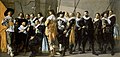
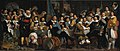
De Magere Compagnie (completed 1637), which depicts a company of schutterij, a voluntary city guard or citizen militia in the medieval and early modernNetherlands. Frans Hals was commissioned to create this, but he was unable to complete it after three years, and the company hired Pieter Codde to finish it. Group portraits such as this of schutterij were known as schuttersstuk, and were popular among the guards themselves.
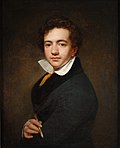
A self-portrait of Louis-Marie Autissier (1772–1830), a French-born Belgian portrait miniature painter. He is considered the founder of the Belgian school of miniature painting in the nineteenth century. Born at Vannes, in Brittany, he joined the French Revolutionary Army at Rennes in 1791. On leaving the army in 1795, Autissier went to Paris and trained his art by studying paintings at the Louvre. In 1796 he settled in Brussels, but continued to divide his time between Belgium, the Netherlands, and France. Although he enjoyed great success in his career, serving as court painter to Louis Napoleon, French King of the Netherlands, and later to Willem I, Autissier died penniless.
This painting, though long thought to be a self-portrait, is now attributed to Friedrich Carl Albert Schreuel, a German artist whom Saleh knew during his time in Europe.
The rupiah is the national currency of Indonesia. Introduced in 1946 by Indonesian nationalists fighting for independence, the currency replaced a version of the Netherlands Indies gulden which had been introduced during the Japanese occupation in World War II. In its early years the rupiah was used in conjunction with other currencies, including a new version of the gulden introduced by the Dutch. Since 1950, it has had a lengthy history of inflation and revaluation. As of August 2018[update] '"`UNIQ--nowiki-0000002B-QINU`"' , the currency—which is issued and controlled by the Bank of Indonesia—is trading for more than 14,600 rupiah to the United States dollar.
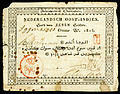
A banknote for one Netherlands Indies gulden. This note was issued in 1815 as part of the first Dutch government-issued paper money in the Netherlands Indies. However, in 1818 the issuing bank—De Bank Courant en Bank van Leening—was dissolved due to a lack of capital, and six months later, this first series of notes was declared worthless.
Photograph credit: Tati Photo Studio; restored by Chris Woodrich
Baby Huwae (22 November 1939 – 5 June 1989) was an Indonesian model, film actress and singer. Born in Rotterdam, Netherlands, she moved to Indonesia, where she took up modelling, by the 1950s. She entered the film industry in 1958, and gained popularity following the success of Asrama Dara. Over the next few years, Huwae acted in a further five films and established a girl group, the Baby Dolls, with several actresses who had appeared in her second film. She made a guest appearance in one more film in 1971 after a ten-year hiatus.
Richèl Hogenkamp (born 16 April 1992) is a professional tennis player from the Netherlands. Her highest WTA singles ranking is 94, which she reached on 24 July 2017. On the ITF Women's World Tennis Tour, she has won 16 singles and 14 doubles titles. This photograph depicts Hogenkamp competing at the 2015 Madrid Open.
Engraver: George J. Verbeck, after Thérèse van Duyl Schwarze Restoration: Lise Broer
A 1901 etching of Queen Wilhelmina of the Netherlands, based on an 1898 painting of her in her coronation robe. Having assumed the throne at the age of ten after the death of her father, King William III, Wilhemina ruled for fifty-eight years (1890–1948), longer than any other Dutch monarch. In 1948 she abdicated in favor of her daughter Juliana, thereafter making few public appearances until the country was devastated by the North Sea flood of 1953.
... that Dutch soldier Gerrit van der Waals escaped from a German POW camp, aided Jews and anti-Nazi resistance, then was arrested by the Soviets and died in their custody?
... that Dutch rabbi Meijer de Hond, who grew up in poverty, was known as the Volksrebbe ('people's rabbi') for his popularity among the Jewish poor of Amsterdam?





.jpg)






_tussen_afgevallen_beukenblad_(d.j.b.)_01.jpg)





,_processed,_obverse%2Breverse.jpg)
![👁 Image 9 Indonesian rupiah Banknotes: Bank of Indonesia The rupiah is the national currency of Indonesia. Introduced in 1946 by Indonesian nationalists fighting for independence, the currency replaced a version of the Netherlands Indies gulden which had been introduced during the Japanese occupation in World War II. In its early years the rupiah was used in conjunction with other currencies, including a new version of the gulden introduced by the Dutch. Since 1950, it has had a lengthy history of inflation and revaluation. As of August 2018[update] '"`UNIQ--nowiki-0000002B-QINU`"' , the currency—which is issued and controlled by the Bank of Indonesia—is trading for more than 14,600 rupiah to the United States dollar. This note, denominated 20,000 rupiah, is from a 2011 revision of an earlier series. It depicts Oto Iskandar di Nata, a National Hero of Indonesia, on its obverse, and Sundanese tea farmers on its reverse. See other denominations: Rp 1,000, Rp 2,000, Rp 5,000, Rp 10,000, Rp 50,000, Rp 100,000 More selected pictures](https://upload.wikimedia.org/wikipedia/commons/thumb/0/0c/20000_rupiah_bill%2C_2011_revision_%282013_date%29%2C_processed%2C_obverse%2Breverse.jpg/120px-20000_rupiah_bill%2C_2011_revision_%282013_date%29%2C_processed%2C_obverse%2Breverse.jpg)
-1-Dutch_Administration-1_Gulden_(1815).jpg)







,_koning_der_Nederlanden,_Nicolaas_Pieneman,_1856_-_Rijksmuseum.jpg)


.svg)






-Vincent-van-Gogh-Met.jpg)


_-_Google_Art_Project_-_edited.jpg)


.jpg)










.jpg)


.jpg)


_-_Google_Art_Project.jpg)


_-_Google_Art_Project.jpg)


_-_Google_Art_Project.jpg)





.jpg)


.jpg)


_-_Google_Art_Project.jpg)


_%E2%80%93_cropped.jpg)







.jpg)


_card_money.jpg)
.jpg)

.jpg)

.jpg)

.jpg)

.jpg)
.jpg)

.jpg)








.jpg)

.jpg)




(Jan_Abrahamsz._Beerstraten).jpg)


,_Queen_of_Hungary.jpg)


.jpg)




.jpg)