"Endless" is a song recorded by Romanian singer Inna for her second studio album, I Am the Club Rocker (2011). The song was released on 25 November 2011 as the fourth single from the album. It was written and produced by Play & Win members Sebastian Barac, Radu Bolfea and Marcel Botezan. A flamenco-influenced mid-tempoclub-ballad, "Endless" features an acoustic and Spanish guitar in its instrumentation.
Music critics gave favorable reviews of the track, pointing it out as a highlight on I Am the Club Rocker. At the 2011 Balkan Music Awards, the song won in the Best Song in the Balkans from Romania in 2011 category. To promote "Endless", an accompanying music video was shot by Alex Herron and uploaded onto Inna's YouTube channel on 24 November 2011 to positive response. It was connected to the International Day for the Elimination of Violence against Women, which is observed on 25 November. The singer had also launched a foundation against domestic violence simultaneously with the video's release. She further promoted the recording through various live performances. Commercially, "Endless" reached the top ten in Romania and Slovakia. (Full article...)
"Me Gusta" (English: "I Like") is a song recorded by Romanian singer Inna. Written by Inna and produced by David Ciente, the track was released for digital download and streaming on 14 February 2018 by Roton and Empire Music Management. "Me Gusta" is a Spanish language song, featuring an electronic production and beat drops. A reviewer noted an Asian sound. Lyrically, Inna admires a man's presence and dance abilities.
Music critics were positive towards "Me Gusta", praising its production and catchiness, and predicting its commercial success. An accompanying music video for the song was uploaded onto Inna's official YouTube channel on 13 February 2018 to positive response. Shot by Barna Nemethi, it shows Inna performing to the track on streets of Bucharest and Barcelona. Prior to the single's release, Inna sang "Me Gusta" on Romanian radio station Radio ZU. Commercially, it peaked at number 89 in Romania. (Full article...)
Elena Alexandra Apostoleanu (born 16 October 1986), known professionally as Inna (stylized in all caps), is a Romanian singer. Born in Mangalia and raised in Neptun, she studied political science at Ovidius University before meeting the Romanian trio Play & Win and pursuing a music career. She adopted the stage name "Alessandra" and a pop-rock style in 2008; later that year, she changed her stage name to "Inna" and began releasing EDM, house and popcorn music. "Hot" (2008), her debut single, was a commercial success worldwide and topped the Romanian and Billboard'sHot Dance Airplay chart, among others. Her debut studio album of the same name followed in August 2009 and was certified Gold and Platinum. It featured several other successful singles in Europe, including "Amazing" (2009), the singer's second number-one single in Romania.
The Count of the Székelys (Hungarian: székelyispán, Latin: comes Sicolorum) was the leader of the Hungarian-speaking Székelys in Transylvania, in the medieval Kingdom of Hungary. First mentioned in royal charters of the 13th century, the counts were the highest-ranking royal officials in Székely Land. From around 1320 to the second half of the 15th century, the counts' jurisdiction included four Transylvanian Saxon districts, in addition to the seven Székely seats (or administrative units).
The counts also held important castles outside the territories under their administration, including their seat at Görgény (now Gurghiu in Romania). They were the supreme commanders of the Székely troops; their military campaigns against Bulgaria and the Golden Horde were mentioned in royal charters and medieval chronicles. The counts presided over the general assemblies of both the individual Székely seats and the entire Székely community. They also heard appeals of the decisions of the supreme court of Székely Land. (Full article...)
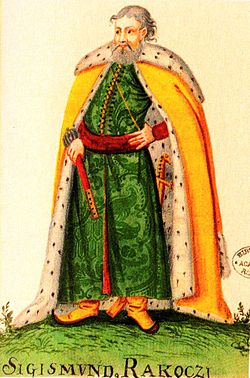
👁 Image Sigismund Rákóczi (Hungarian: Rákóczi Zsigmond, pronounced[ˈraːkoːtsiˈʒiɡmond]; 1544 – 5December 1608) was Prince of Transylvania from 1607 to 1608. He was the son of János Rákóczi, a lesser nobleman with estates in Upper Hungary. Sigismund began a military career as the sword-bearer of the wealthy Gábor Perényi in Sárospatak. After Perényi died in 1567, Sigismund served in the royal fortresses of Eger and Szendrő. The royal chamber mortgaged him several estates to compensate him for unpaid salaries. He received Szerencs in 1580, which enabled him to engage in the lucrative Tokaji wine trade. He took possession of the large estates of András Mágóchy's minor sons as their guardian, and the second husband of their mother Judit Alaghy, in 1587.
Sigismund was made the captain of the important stronghold of Eger on 29 June 1588. Rudolph I, King of Hungary, granted him the title of baron on 28 August. Sigismund rose to fame after he routed the united forces of three Ottoman beys (captains) near Szikszó on 8 October. He also helped the Calvinist pastor, Gáspár Károli, publish the Hungarian translation of the Bible (the so-called Vizsoly Bible). He renounced the captaincy in 1590 or 1591 because the royal treasury had not provided enough funds to finance the management of the fortress. Sigismund was a successful commander of the royal army during the first decade of the Long Turkish War, which broke out in 1593. (Full article...)
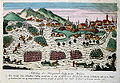
The Catholic and Eastern Orthodox churches had coexisted in the southern and eastern territories of the medieval Kingdom of Hungary for centuries. However, ideas that the Catholic Church regarded as heresy were not tolerated: the Hungarian Hussites were expelled from the country in the 1430s and the 1523 Diet of Hungary passed a decree that ordered the persecution of Lutherans. The latter decree was in practice ignored during the civil war that followed the Ottoman victory against the Hungarian army in the Battle of Mohács in 1526. After the Ottomans occupied the central regions of the medieval kingdom in 1541, they allowed the infant John Sigismund to rule the lands to the east of the river Tisza under the regency of his mother, Isabella Jagiellon. In the early 1540s the Diets acknowledged the right of the Three Nations to freely regulate their internal affairs. The Saxons regarded religion as an internal affair and ordered the introduction of the Lutheran Reformation in their settlements in 1544–1545. The Diet sanctioned the coexistence of the Catholic and Lutheran denominations only in 1557. (Full article...)
"Miami" is a song recorded by Romanian producer and disc jockey Manuel Riva featuring guest vocals from Romanian singer Alexandra Stan. It released on 6 March 2018 by Roton and Forward Music Agency. Riva produced the song, and wrote it with Cristian Sorin Ochiu. He worked on the track during the songwriting camp Tabăra Internaţională de Muzică TIC (International Music Camp TIC) held in Romania in 2017. A Latin-inspired track, "Miami" lyrically talks about freedom and emotional expression.
A music critic from CelebMix gave a positive review of the song, praising the lyrics, production and Stan's vocal delivery. Commercially, "Miami" experienced moderate success on record charts, reaching the top ten on the Romanian Airplay 100, in Bulgaria, and on Billboard'sDance Club Songs component chart, as well as number 44 on the Hot Dance/Electronic Songs ranking also compiled by the same publication. It was aided by a music video released onto Roton's official YouTube channel on 16 March 2018. Shot by Bogdan Păun in the United States, it shows two male and female characters dancing and interacting with a masked man. "Miami" was used as the anthem for the 2018 Neversea Festival. (Full article...)
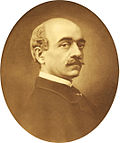
👁 Image Mateiu Ion Caragiale (Romanian:[maˈtejiˈonkaraˈdʒjale]; 25 March [O.S. 12 March] 1885 – 17 January 1936), also credited as Matei or Matheiu, or in the antiquated version Mateiŭ, was a Romanian poet and prose writer, best known for his novel Craii de Curtea-Veche, which portrays the milieu of boyar descendants before and after World War I. Caragiale's style, associated with Symbolism, the Decadent movement of the fin de siècle, and early modernism, was an original element in the Romanian literature of the interwar period. In other late contributions, Caragiale pioneered detective fiction locally, but there is disagreement over whether his work in the field produced a complete narrative or just fragments. The scarcity of writings he left is contrasted by their critical acclaim and a large, mostly posthumous, following, commonly known as mateists.
Left humerus of the holotype specimen in ventral (A) and distal (B) view
Hatzegopteryx ("Hațeg basin wing") is a genus of azhdarchidpterosaur found in the late Maastrichtian deposits of the Densuș-Ciula Formation, an outcropping in Transylvania, Romania. It is known only from the type species, Hatzegopteryx thambema, named by paleontologists Eric Buffetaut, Dan Grigorescu, and Zoltan Csiki in 2002 based on parts of the skull and humerus. Additional specimens, including a neck vertebra, were later placed in the genus, representing a range of sizes. The largest of these remains indicate it was among the biggest pterosaurs, with an estimated wingspan of 10 to 12 m (33 to 39 ft).
Unusually among giant azhdarchids, Hatzegopteryx had a very wide skull bearing large muscular attachments, bones with a spongy internal texture instead of being hollow, and a short, robust, and heavily muscled neck measuring 1.5 m (5 ft) long, which was about half the length of other azhdarchids with comparable wingspans and was capable of withstanding strong bending forces. Hatzegopteryx inhabited Hațeg Island, an island situated in the Cretaceous subtropics within the prehistoric Tethys Sea. In the absence of large theropods, Hatzegopteryx was likely the apex predator of Hațeg Island, tackling proportionally larger prey (including dwarf titanosaurs and iguanodontians) than other azhdarchids. (Full article...)
"De la capăt" (Romanian for 'From the beginning'; cfr. "da capo") is a song recorded by Romanian group Voltaj for their tenth studio album X (2016). It was made available as a single for digital download on 31 October 2014 by Cat Music and Voltz Media. A Romanian song, two other versions were released eventually—"De la capăt (All Over Again)" in Romanian and English, and "All Over Again" fully in English. "De la capăt (All Over Again)" was written by band members Călin Goia, Gabriel Constantin and Adrian Cristescu with Silviu Marian Păduraru and Victor Răzvan Alstani, while music was composed by the aforementioned alongside Monica-Ana Stevens and Andrei-Mădalin Leonte. "De la capăt" has been described as an indie pop rock and soft rock song, and is a manifesto raising awareness for children whose parents have left them behind to work abroad.
"De la capăt (All Over Again)" represented Romania in the 2015 Eurovision Song Contest in Vienna, Austria after winning the pre-selection show Selecția Națională. The country went on to reach 15th place in a field of 26, scoring a total of 35 points. During Voltaj's minimalistic and mostly black-and-white show, the stage was scattered with multiple suitcases while excerpts from the music video were shown on the background LED screen. "De la capăt" received mixed reviews from music critics, with praise for the song's message and lyrics, as well as for band soloist Goia's vocal delivery. Observers have compared the track to "I Could Sing of Your Love Forever" (1995) by Delirious?. It won in the Best Pop Rock Song category at the 2015 Radio România Actualități Awards. (Full article...)
Glad (Bulgarian: Глад, Hungarian: Galád, Romanian: Glad, Serbian: Глад) was the ruler of Banat (in present-day Romania and Serbia) at the time of the Hungarian conquest of the Carpathian Basin around 900 AD, according to the Gesta Hungarorum. The Gesta, which was written by an author known in modern scholarship as Anonymus in the second half of the 12th century or in the early 13th century, is the earliest extant Hungarian chronicle. The Gesta did not refer to the enemies of the conquering Hungarians (or Magyars), who had been mentioned in earlier annals and chronicles, but wrote of a dozen persons, including Glad, who are unknown from other primary sources of the Hungarian Conquest. Therefore, modern historians debate whether Glad was an actual enemy of the conquerors or only a "fictitious person" made up by Anonymus. In Romanian historiography, based on the mention by Anonymus some 300 years later, Glad is described as one of the three Romanian dukes who ruled a historical region of present-day Romania in the early 10th century.
According to the Gesta, Glad came from Vidin in Bulgaria. He occupied Banat with the assistance of "Cumans" before the arrival of the Magyars. Anonymus wrote that Cumans, Bulgarians, and Vlachs (or Romanians), supported Glad against the invading Magyars, but the latter annihilated their united army in a battle near the Timiș River. The Gesta presents Ahtum, who ruled Banat in the early 11th century, according to the longer version of the Life of St Gerard, as Glad's descendant. (Full article...)
"Zaleilah" represented Romania in the 2012 Eurovision Song Contest in Baku, Azerbaijan, after winning the pre-selection show Selecția Națională. The country reached 12th place in a field of 26, scoring a total of 71 points. Mandinga's show featured the band members performing choreography and accompanying Ionescu, with pyrotechnics and fireworks also being used. The song received mixed reviews from music critics. While it was praised for its catchiness and dance nature, some viewed it as mediocre and unoriginal. "Zaleilah" received a nomination in the Best Song category at the 2011 Romanian Music Awards. (Full article...)
NMS Mărășești was one of four Vifor-classdestroyers ordered by Romania shortly before the beginning of the First World War from Italy. All four sister ships were requisitioned when Italy joined the war in 1915. Originally named Vârtej by the Romanians, she was renamed Nibbio and classified as a scout cruiser in Italian service. Not completed until mid-1918, the ship took part in the Adriatic campaign of World War I but engaged Austro-Hungarian Navy ships in the Adriatic Sea only once before the war ended in November 1918. She was renamed Mărășești when she was re-purchased by the Romanians in 1920.
"Playing with Fire" is a song recorded by Romanian singer Paula Seling and Romanian-Norwegian performer Ovidiu Cernăuțeanu for their 2010 collaborative album of the same name. It was released as a CD single in 2010 by TVR, TMC and AXR labels. Partly influenced by opera music, the track was written by Ovi and produced by Simen M. Eriksrud. The lyrics of "Playing with Fire" portray a fight between a male and a female, with a reviewer speculating that it revolved around arson.
The track represented Romania in the 2010 Eurovision Song Contest in Oslo, Norway after winning the pre-selection show Selecția Națională. Seling and Ovi's win sparked controversy after it was speculated that Eriksrud was one of the writers of "Playing with Fire", which was not permitted by the rules of the national selection as he is not of Romanian origin. The accusations were denied and it was later confirmed that Eriksrud only produced the track. In Oslo, the singers qualified for the Grand Final, where they finished third with 162 points. This remains Romania's best result in the contest alongside 2005's "Let Me Try" by Luminița Anghel and Sistem. Onstage, Seling and Ovi played a double piano wearing a black catsuit and black clothing, respectively, accompanied by four background vocalists. (Full article...)
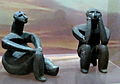
Their extensive and well-preserved remains present a picture of a vigorous and innovative ancient civilization. Today, treasure-hunters sometimes search the area, as Romania lacks legislation in this domain (see Archaeological looting in Romania). (Full article...)
Brassaï (French:[bʁasaj]; pseudonym of Gyula Halász, Hungarian:[ˈɟulɒˈhɒlaːs]; 9 September 1899 – 8 July 1984) was a Hungarian–French photographer, sculptor, medalist, writer, and filmmaker who rose to international fame in France in the 20th century. He was one of the numerous Hungarian artists who flourished in Paris beginning between the world wars.
In the early 21st century, the discovery of more than 200 letters and hundreds of drawings and other items from the period 1940 to 1984 has provided scholars with material for understanding his later life and career. (Full article...)
... that scholar Axinte Frunză wanted Romania to join the Central Powers in 1916, espousing "a vision that was profoundly anti-statist (with hints of anarchism), populist, and virulently anti-Russian"?
... that a bride's farewell can be sung in Romanian traditional music as a lament – sometimes also played instrumentally as "the bride's sorrow"?
... that Matei Donici, a general in the Imperial Russian Army, secretly wrote poetry with Romanian-nationalist and anti-Russian messages?
... that Romanian adventure novelist N. D. Popescu-Popnedea "generate[d] laughter" with his deposition at a political assassin's trial?
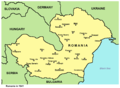
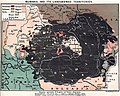
Image 4Ethnic map of Greater Romania according to the 1930 census. Sizeable ethnic minorities put Romania at odds with Hungary, Bulgaria, and the Soviet Union throughout the interwar period. (from History of Romania)
Image 211941 stamp depicting a Romanian and a German soldier in reference to the two countries' common participation in Operation Barbarossa, the text below reads the holy war against Bolshevism (from History of Romania)
Image 36Romania after the territorial losses of 1940. The recovery of Bessarabia and Northern Bukovina was the catalyst for Romania's entry into the war on Germany's side. (from History of Romania)
Image 52Romania has seen its largest waves of protests against judicial reform ordinances of the PSD-ALDE coalition during the 2017–2019 Romanian protests (from History of Romania)
Image 57The upper map shows Dacia’s territory at the beginning of Burebista’s rule, while the lower map depicts its territory at the end of his reign. (from History of Romania)
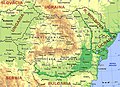
Image 81Map depicting the Dacian Kingdom, including its annexed territories and areas of approximate influence including Pannonia and Bohemia. (from History of Romania)
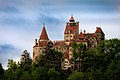
Image 89Bran Castle (German: Törzburg, Hungarian: Törcsvár) built in 1377, is commonly known as Dracula's Castle and is situated in the center of present-day Romania. In addition to its unique architecture, the castle is famous because of persistent myths that it was once the home of Vlad III Dracula. (from History of Romania)
Image 91The Principalities of Moldavia and Wallachia in 1786, Italian map by G. Pittori, since the geographer Giovanni Antonio Rizzi Zannoni (from History of Romania)
This is a list of recognized content, updated weekly by JL-Bot (talk·contribs) (typically on Saturdays). There is no need to edit the list yourself. If an article is missing from the list, make sure it is tagged (e.g. {{WikiProject Romania}}) or categorized correctly and wait for the next update. See WP:RECOG for configuration options.









.jpg)


.svg)


.jpg)













.svg)



.jpg)













.svg)















.png)





.JPG)

.jpg)












.jpg)










_female_underside_Dobruja.jpg)

_in_flight_Danube_delta_2.jpg)


_R%C3%A1k%C3%B3czi_(1593-1648)_-_Rembrandt_van_Rijn_%26_Jan_Gillisz._van_Vliet.jpg)

_Danube_delta.jpg)


_form_prorsa_underside_Piatra_Craiului.jpg)

.jpg)

.jpg)

.jpg)

_female_with_bee_prey_Babadag.jpg)


,_figurino_di_Adolf_Hohenstein_per_La_Wally_(1892)_-_Archivio_Storico_Ricordi_ICON004639_-_Restoration.jpg)