|
VOOZH | about |
|
VOOZH | about |
In this article, we explore the Bag of Words (BoW) model, a fundamental approach in natural language processing. BoW simplifies text by counting word occurrences, disregarding their order. We delve into its principles, applications, and optimization strategies, highlighting its significance in NLP tasks like text classification.
“Language is a wonderful medium of communication”.You and I would have understood that sentence in a fraction of a second. But machines simply cannot process text data in raw form. They need us to break down the text into a numerical format that’s easily readable by the machine (the idea behind Natural Language Processing!).
This is where the concepts of Bag-of-Words (BoW) and TF-IDF come into play. Both BoW and TF-IDF are techniques that help us convert text sentences into numeric vectors.
I’ll be discussing both Bag-of-Words and TF-IDF in this article. We’ll use an intuitive and general example to understand each concept in detail.
New to Natural Language Processing (NLP)? We’ve got the perfect courses for you to get started:
The Bag of Words (BoW) model is the simplest form of text representation in numbers. Like the term itself, we can represent a sentence as a bag of words vector (a string of numbers).
Let’s recall the three types of movie reviews we saw earlier:
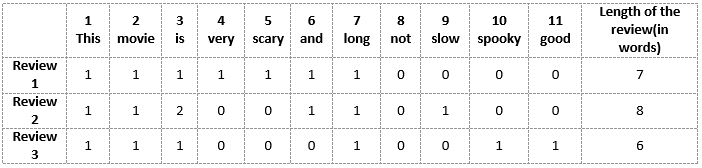
We will first build a vocabulary from all the unique words in the above three reviews. The vocabulary consists of these 11 words: ‘This’, ‘movie’, ‘is’, ‘very’, ‘scary’, ‘and’, ‘long’, ‘not’, ‘slow’, ‘spooky’, ‘good’.
We can now take each of these words and mark their occurrence in the three movie reviews above with 1s and 0s. This will give us 3 vectors for 3 reviews:
Vector-of-Review1: [1 1 1 1 1 1 1 0 0 0 0]
Vector-of-Review2: [1 1 2 0 0 1 1 0 1 0 0]
Vector-of-Review3: [1 1 1 0 0 0 1 0 0 1 1]
And that’s the core idea behind a Bag of Words (BoW) model.
In the above example, we can have vectors of length 11. However, we start facing issues of Bag of Words when we come across new sentences:
I’ll take a popular example to explain Bag-of-Words (BoW) and TF-DF in this article.
We all love watching movies (to varying degrees). I tend to always look at the reviews of a movie before I commit to watching it. I know a lot of you do the same! So, I’ll use this example here.
Here’s a sample of reviews about a particular horror movie:
You can see that there are some contrasting reviews about the movie as well as the length and pace of the movie. Imagine looking at a thousand reviews like these. Clearly, there is a lot of interesting insights we can draw from them and build upon them to gauge how well the movie performed.
However, as we saw above, we cannot simply give these sentences to a machine learning model and ask it to tell us whether a review was positive or negative. We need to perform certain text preprocessing steps.
Bag-of-Words and TF-IDF are two examples of how to do this. Let’s understand them in detail.
Can you think of some techniques we could use to vectorize a sentence at the beginning? The basic requirements would be:
Word Embedding is one such technique where we can represent the text using vectors. The more popular forms of word embeddings are:
Now, let us see how we can represent the above movie reviews as embeddings and get them ready for a machine learning model.
Let’s first put a formal definition around TF-IDF. Here’s how Wikipedia puts it:
“Term frequency–inverse document frequency, is a numerical statistic that is intended to reflect how important a word is to a document in a collection or corpus.”
Let’s first understand Term Frequent (TF). It is a measure of how frequently a term, t, appears in a document, d:
Here, in the numerator, n is the number of times the term “t” appears in the document “d”. Thus, each document and term would have its own TF value.
We will again use the same vocabulary we had built in the Bag-of-Words model to show how to calculate the TF for Review #2:
Review 2: This movie is not scary and is slow
Here,
Similarly,
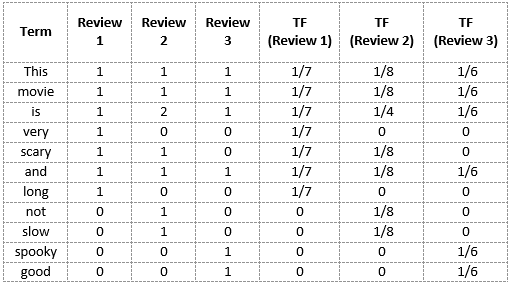
We can calculate the term frequencies for all the terms and all the reviews in this manner:
IDF is a measure of how important a term is. We need the IDF value because computing just the TF alone is not sufficient to understand the importance of words:
We can calculate the IDF values for the all the words in Review 2:
IDF(‘this’) = log(number of documents/number of documents containing the word ‘this’) = log(3/3) = log(1) = 0
Similarly,
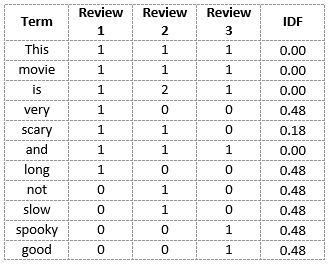
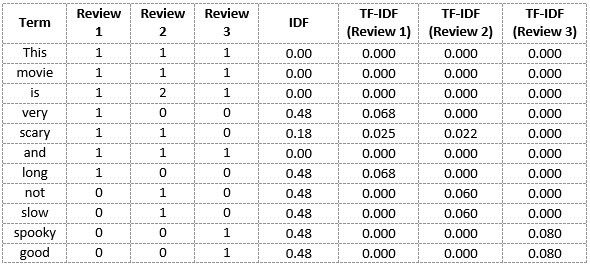
We can calculate the IDF values for each word like this. Thus, the IDF values for the entire vocabulary would be:
Hence, we see that words like “is”, “this”, “and”, etc., are reduced to 0 and have little importance; while words like “scary”, “long”, “good”, etc. are words with more importance and thus have a higher value.
We can now compute the TF-IDF score for each word in the corpus. Words with a higher score are more important, and those with a lower score are less important:
We can now calculate the TF-IDF score for every word in Review 2:
TF-IDF(‘this’, Review 2) = TF(‘this’, Review 2) * IDF(‘this’) = 1/8 * 0 = 0
Similarly,
Similarly, we can calculate the TF-IDF scores for all the words with respect to all the reviews:
We have now obtained the TF-IDF scores for our vocabulary. TF-IDF also gives larger values for less frequent words and is high when both IDF and TF values are high i.e the word is rare in all the documents combined but frequent in a single document.
Let me summarize what we’ve covered in the article:
While both Bag-of-Words and TF-IDF have been popular in their own regard, there still remained a void where understanding the context of words was concerned. Detecting the similarity between the words ‘spooky’ and ‘scary’, or translating our given documents into another language, requires a lot more information on the documents.
This is where Word Embedding techniques such as Word2Vec, Continuous Bag of Words (CBOW), Skipgram, etc. come in. You can find a detailed guide to such techniques here:
Associate of Data Science @ JP Morgan
GPT-4 vs. Llama 3.1 – Which Model is Better?
Llama-3.1-Storm-8B: The 8B LLM Powerhouse Surpa...
A Comprehensive Guide to Building Agentic RAG S...
Top 10 Machine Learning Algorithms in 2026
45 Questions to Test a Data Scientist on Basics...
90+ Python Interview Questions and Answers (202...
8 Easy Ways to Access ChatGPT for Free
Prompt Engineering: Definition, Examples, Tips ...
What is LangChain?
What is Retrieval-Augmented Generation (RAG)?
for the given reviews, i din't see any difference between using either bow or tf idf , if the stop word could have been removed first and I think that's how it should have been. Other observation is, Movie is also important word but tf idf was not able to consider that as important . Pl correct if am wrong
This is an excellent article. Simple to follow. It appears to be a TYPO in the below. Review 1: This movie is very scary and long Review 2: This movie is not scary and is slow Review 3: This movie is spooky and good 1-This,2-movie,3-is,4-very,5-scary,6-and,7-long,8-not,9-slow,10-spooky,11-good TYPO in long word calculation. long word available only in Review 1. But its updated in all three Vector of Reviews. Vector of Review 1: [1 1 1 1 1 1 1 0 0 0 0] Vector of Review 2: [1 1 2 0 0 1 1 0 1 0 0] Vector of Review 3: [1 1 1 0 0 0 1 0 0 1 1]
Edit
Resend OTP
Resend OTP in 45s