 |
VOOZH | about |
|
VOOZH | about |
This article was published as a part of the Data Science Blogathon
As we know data has some kind of meaning in its position. For every moment, mostly text data is getting generated in different formats like SMS, reviews, Emails, and so on. The main purpose of this article is to understand the basic idea of NLP using the library- SpaCy. So let’s go ahead.
In this article, we are going to see how to perform natural language processing tasks using a popular library named “SpaCy” simply. The Natural Language Process is a subfield of Artificial Intelligence and it is concerned with interactions between machine and human languages. NLP is the method of analyzing, understanding, and extracting meaning from human languages for computers.
SpaCy is an open-source and free library for Natural Language Processing (NLP) in Python having a lot of in-built functionalities. It’s becoming popular for processing and analyzing data in NLP. Unstructured text data is produced in a large quantity, and it is important to process and extract insights from unstructured data. To do this, we need to represent the data in a format that can be understood by machines. NLP will help us to do that.
There are also other alternatives for performing NLP tasks using NLTK, Genism, and flair libraries.
1. Chatbots: Customer service, as well as experience, are the most important things for any organization. It will help the companies to improve their products, and also keep the satisfaction of customers. But interaction with every customer manually becoming a tedious job so chatbots come into the picture as it helps companies in achieving the goal for a better experience of customers.
2. Autocorrection and Autocompletion Search: When we search on google by typing a couple of letters, it will show us related terms. And if we type a word incorrectly, nlp corrects it automatically.
Let’s begin with actual implementation:
Installation of necessary libraries on the machine:
SpaCy can be installed using the pip command. We can use a virtual environment to avoid depending on system-wide packages. Let see:
python3 -m venv envsource ./env/bin/activate
pip install spacyWe need to download the language model and data by using the following command:
python -m spacy download en_core_web_smNow we will use spacy and give a string and text file as input and also load the model. Here ‘nlp’ is an object of our model so we are going to use it for further coding also:
import spacy
nlp = spacy.load('en_core_web_sm')
Now we will perform sentence detection i.e extraction of sentences.
about_text = ('I am a Python developer currently'
 ' working for a London-based Fintech'
 ' company. I am interested in learning'
 ' Natural Language Processing.')
about_doc = nlp(about_text)
sentences = list(about_doc.sents)
len(sentences)
for sentence in sentences:
print (sentence)
Out: 'I am a Python developer currently working for a
London-based Fintech company.'
'I am interested in learning Natural Language Processing.'
Next, we will move ahead with tokenization to break text into meaningful tokens with the index also.
for token in about_doc:
 print (token, token.idx)

Out: I 0
am 4
a 10
Python 13
developer 15
currently 22
working 32
for 42
a 50
London 54
- 56
based 62
Fintech 63
.....
We can customize our tokenizations using a tokenizer function
from spacy.tokenizer import Tokenizer
custom_nlp = spacy.load('en_core_web_sm')
prefix_re = spacy.util.compile_prefix_regex(custom_nlp.Defaults.prefixes)
suffix_re = spacy.util.compile_suffix_regex(custom_nlp.Defaults.suffixes)
infix_re = re.compile(r'''[-~]''')
def customize_tokenizer(nlp):
 # Adds support to use `-` as the delimiter for tokenization
 return Tokenizer(nlp.vocab, prefix_search=prefix_re.search,
 suffix_search=suffix_re.search,
 infix_finditer=infix_re.finditer,
 token_match=None
 )


custom_nlp.tokenizer = customize_tokenizer(custom_nlp)
custom_tokenizer_about_doc = custom_nlp(about_text)
print([token.text for token in custom_tokenizer_about_doc])
Out: ['I', 'am', 'a', 'Python', 'developer', 'currently',
'working', 'for', 'a', 'London', '-', 'based', 'Fintech',
'company', '.', 'I', 'am', 'interested', 'in', 'learning',
'Natural', 'Language', 'Processing', '.']
Let us understand stopwords in SpaCy. We remove these stopwords from our text because it is not significant.
spacy_stopwords = spacy.lang.en.stop_words.STOP_WORDS
len(spacy_stopwords)
>>>326
for stop_word in list(spacy_stopwords)[:10]:
print(stop_word)Out: using
becomes
had
itself
once
often
is
herein
who
too..Let’s remove these stopwords from the given text:
for token in about_doc:
 if not token.is_stop:
 print (token)
Out: Python
developer
currently
working
London
-
based
Fintech
company
.
interested
learning
Natural
Language
Processing
.
let us understand how we can use lemmatization. Lemmatization is the process of reducing incurved forms of a word. This reduced form or formed root word is called a Lemma. Lemmatization helps us to avoid duplicate words that have similar meanings within text.
conference_help_text = ('Raj is helping organize a developer'
 'conference on Applications of Natural Language'
 ' Processing. He keeps organizing local Python meetups'
 ' and several internal talks at his workplace.')
conference_help_doc = nlp(conference_help_text)
for token in conference_help_doc:
 print (token, token.lemma_)
Raj Raj
is be
helping help
organize organize
a a
developer developer
conference conference
on on
Applications Applications
of of
Natural Natural
Language Language
Processing Processing
.....
He -PRON-
keeps keep
organizing organize
local local
Python Python
meetups meetup
and and
several several
internal internal
talks talk
at at
his -PRON-
workplace workplace
.....
Here we will see word frequency:
from collections import Counter
complete_text = ('J K is a Python developer currently'
 'working for a London-based Fintech company. He is'
 ' interested in learning Natural Language Processing.'
 ' There is a conference happening on 21 June'
 ' 2019 in London. It is titled "Applications of Natural'
 ' Language Processing". There is a helpline number '
 ' available . J is helping organize it.'
 ' He keeps organizing local Python meetups and several'
 ' internal talks at his workplace. J is also presenting'
 ' a talk. The talk will introduce the reader about "Use'
 ' cases of Natural Language Processing in Fintech".'
 ' Apart from his work, he is very passionate about music.'
 ' J is learning to play the Piano. He has enrolled '
 ' himself in the weekend batch of Great Piano Academy.'
 ' Great Piano Academy is situated in Mayfair or the City'
 ' of London and has world-class piano instructors.')

complete_doc = nlp(complete_text)
# Remove stop words and punctuation symbols
words = [token.text for token in complete_doc
 if not token.is_stop and not token.is_punct]
word_freq = Counter(words)
# 5 commonly occurring words with their frequencies
common_words = word_freq.most_common(5)
print (common_words)
Out: [('J', 4), ('London', 3), ('Natural', 3), ('Language', 3), ('Processing', 3)]# Unique words
unique_words = [word for (word, freq) in word_freq.items() if freq == 1]
print (unique_words)Out: ['K', 'currently', 'working', 'based', 'company',
'interested', 'conference', 'happening', '21', 'June',
'2019', 'titled', 'Applications', 'helpline', 'number',
'available', 'helping', 'organize',
'keeps', 'organizing', 'local', 'meetups', 'internal',
'talks', 'workplace', 'presenting', 'introduce', 'reader',
'Use', 'cases', 'Apart', 'work', 'passionate', 'music', 'play',
'enrolled', 'weekend', 'batch', 'situated', 'Mayfair', 'City',
'world', 'class', 'piano', 'instructors']Now understand the named entity recognition(NER). The Named Entity Recognition (NER) is the process of locating named entities in unstructured data and then classifying them into pre-defined categories, like person’s names, organizations, locations, percentages, and so on.
piano_text = ('Piano Academy is situated'
 ' in Mayfair or the City of London and has'
 ' world-class piano instructors.')
piano_doc = nlp(piano_text)
for ent in piano_doc.ents:
 print(ent.text, ent.start_char, ent.end_char,
 ent.label_, spacy.explain(ent.label_))
Out: Piano Academy 0 19 ORG Companies, institutions, etc.
Mayfair 35 42 GPE Countries, cities, states
the City of London 46 64 GPE Countries, citiesSpaCy is an advance and powerful library that is exploring huge popularity for NLP applications because of its speed, ease to use, it’s accuracy, etc. So finally You got to know the following points:
– Concepts of NLP are
– Implementation using SpaCy
– Understanding of customization and built-in functionalities
– Extracting meaningful insights from text
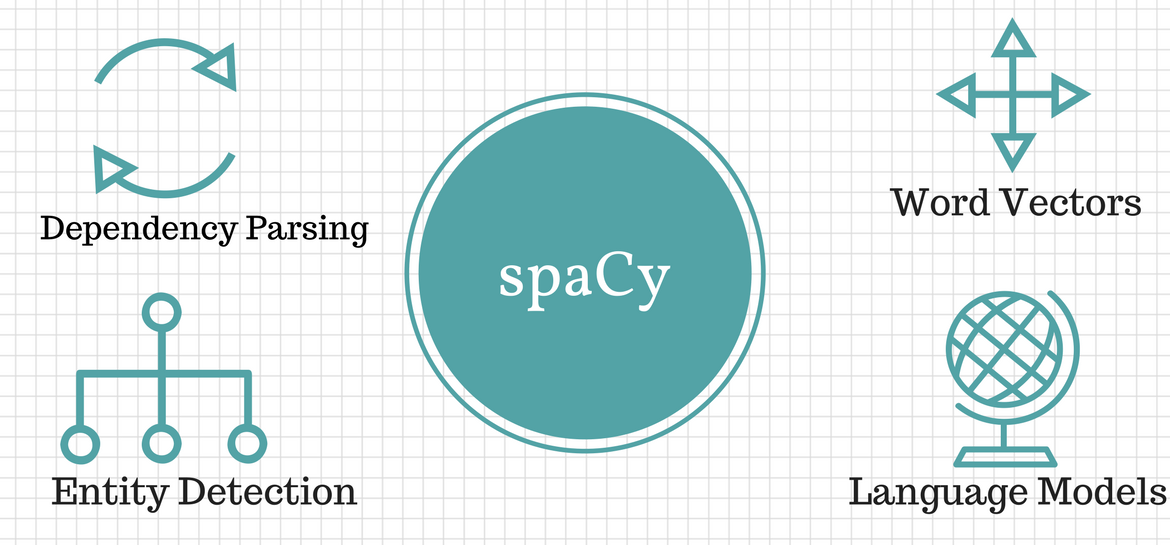
Image source- https://ruelfpepa.files.wordpress.com/2019/10/understanding.jpg
Hope you like this article. Thank You!
I am Software Engineer, data enthusiast , passionate about data and its potential to drive insights, solve problems and also seeking to learn more about machine learning, artificial intelligence fields.
GPT-4 vs. Llama 3.1 – Which Model is Better?
Llama-3.1-Storm-8B: The 8B LLM Powerhouse Surpa...
A Comprehensive Guide to Building Agentic RAG S...
Top 10 Machine Learning Algorithms in 2026
45 Questions to Test a Data Scientist on Basics...
90+ Python Interview Questions and Answers (202...
8 Easy Ways to Access ChatGPT for Free
Prompt Engineering: Definition, Examples, Tips ...
What is LangChain?
What is Retrieval-Augmented Generation (RAG)?
Edit
Resend OTP
Resend OTP in 45s

.jpg)



