|
VOOZH | about |
|
VOOZH | about |
By TAKEHIRO TOMODA/ Staff Writer
April 3, 2026 at 07:00 JST
👁 Photo/Illutration
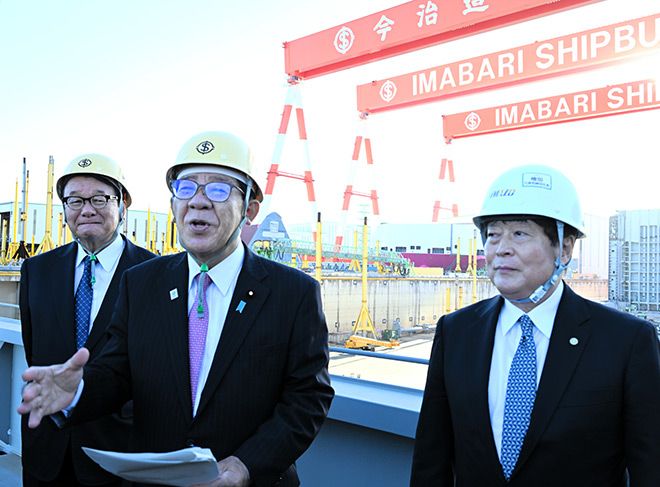
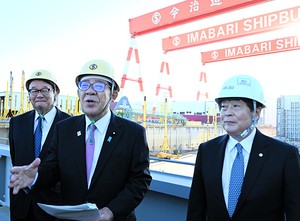
Infrastructure minister Yasushi Kaneko, center, responds to reporters after inspecting an Imabari Shipbuilding shipyard in Marugame, Kagawa Prefecture, on Nov. 22, 2025. (Asahi Shimbun file photo)
Japan aims to reclaim its position as a global titan in shipbuilding, an industry once seen as emblematic of the nation’s postwar industrial power.
After dominating the world’s oceans, Japanese shipbuilders have been in decline for years, overtaken and far outpaced by their rivals in China and South Korea.
As the Japanese industry’s outlook increasingly appeared grim, it received a much-needed boost.
On Nov. 22 last year, Yukito Higaki, president of Imabari Shipbuilding Co., repeatedly expressed his gratitude to infrastructure minister Yasushi Kaneko when he visited the company’s flagship shipyard in Marugame, Kagawa Prefecture.
“The establishment of this fund is incredibly encouraging,” Higaki said.
Just a day earlier, shipbuilding was designated a strategically important sector for economic security, along with artificial intelligence and semiconductors, in a comprehensive economic stimulus package approved by the Cabinet.
With a goal of doubling Japan’s domestic shipbuilding production by 2035, the government said it would create a state-backed fund totaling 350 billion yen ($2.2 billion) to strengthen shipbuilding capacity.
FACING GIANTS WITH LITTLE ARMOR
After leading the world in shipbuilding by construction volume, Japan from the 1990s was overtaken by South Korea and China, and the gap has widened.
Chinese shipbuilders captured more than 70 percent of global shipbuilding orders in 2024, while Japan’s share slipped below 10 percent, according to the Ministry of Land, Infrastructure, Transport and Tourism.
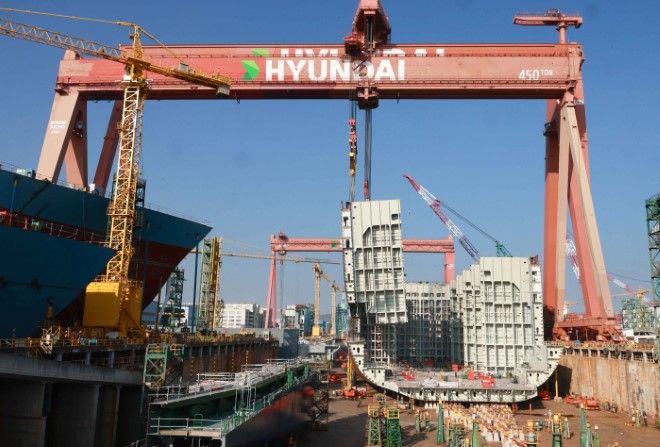
In the global market, China State Shipbuilding Corp., a state-owned conglomerate, holds an overwhelming lead by volume, followed by South Korean shipbuilders.
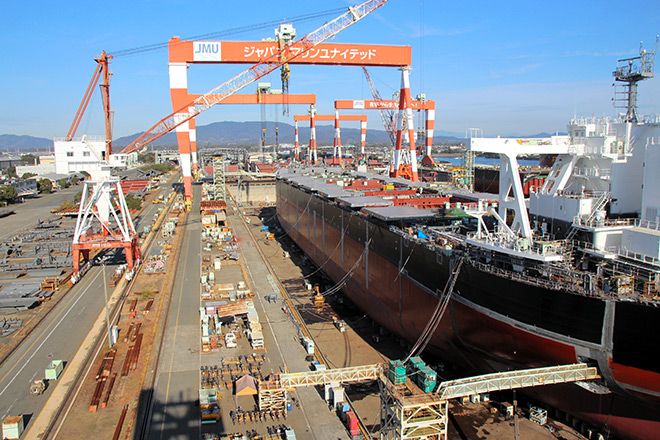
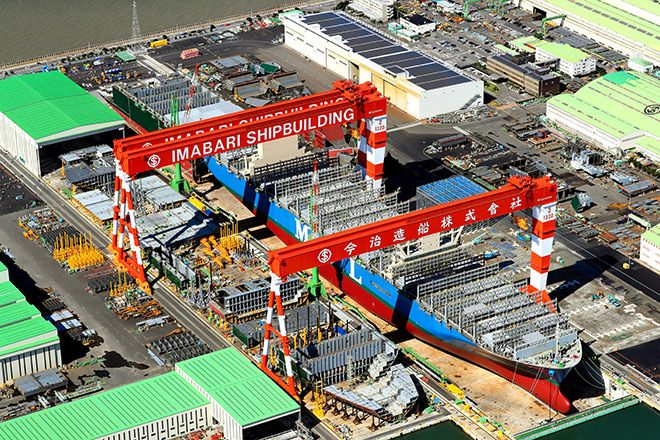
Japan’s top builder, Imabari Shipbuilding, ranks sixth unless its figures are combined with those of Japan Marine United Corp., the Yokohama-based shipbuilder that became an Imabari subsidiary in January.
Japanese industry officials believe Chinese and South Korean shipbuilders are benefitting from generous state backing.
“We are fighting giants stark naked,” a desperate executive at a Japanese shipbuilder said.
As an island nation, Japan depends on maritime shipping for more than 99 percent of its imports and exports.
“If China were to refuse all shipbuilding orders from Japan, it would inflict enormous damage on the Japanese economy,” said Hitoshi Nagasawa, chairman of major shipping company Nippon Yusen Kabushiki Kaisha (NYK Line).
Until recently, efforts to frame shipbuilding as an issue of economic security had “failed to catch the political wave,” said a lawmaker of the ruling Liberal Democratic Party.
The tide began to turn in January last year, when U.S. President Donald Trump began his second term.
In Japan’s trade talks with the Trump administration, which has repeatedly threatened trading partners with steep tariffs to extract concessions, shipbuilding emerged as a possible area for cooperation.
The decline of U.S. commercial shipbuilding capacity has become a serious security concern for Washington, contributing to delays in naval vessel construction.
As the tariff negotiations drew attention, one industry insider remarked, “Japanese politicians realized that Japan’s shipbuilding industry was actually in a shambles.”
POLITICIANS GET SERIOUS
In June that year, the Japanese political establishment began moving in earnest. The LDP’s Headquarters for the Promotion of Economic Security and Special Committee on Marine Transportation and Shipbuilding established a joint forum on shipbuilding and economic security.
At a meeting held at party headquarters on June 6, NYK Line’s Nagasawa and other industry executives warned of the sector’s worsening condition, cautioning that “amid rising geopolitical risks, we may become unable to build ships.”
Lawmakers appeared to take the message to heart, acknowledging that the issue was one of economic security and comparable to the decline of Japan’s semiconductor industry.
On June 19, the two LDP policy bodies behind the meetings compiled an emergency proposal calling for the revival of shipbuilding.
“A fund capable of enabling investments of 1 trillion yen or more should be established,” the proposal said.
According to Lower House member Keitaro Ohno who served as secretary-general of the headquarters, his original draft used wording such as “large-scale investment” without specifying an amount.
But after internal party coordination, the phrase “1 trillion yen or more” was written in explicitly.
Through the infrastructure ministry, politicians also pressed the private sector to think more boldly about investment.
Over the summer, the ministry surveyed shipbuilders, asking: “If government support were provided, when, where and how much could you invest?”
Based on the responses, the ministry later told the Japan Shipbuilding Industry Association that investment of 350 billion yen over the next 10 years appeared achievable.
‘A COMPLETELY DIFFERENT SCALE’
In October that year, the association told an LDP meeting that the private sector was prepared to shoulder 350 billion yen of the envisioned 1 trillion yen investment target.
The announcement gave fresh momentum to the push for political backing.
By November, the framework for government assistance had been finalized.
“This has become a support program of a completely different scale and quality from anything we have seen before,” a senior infrastructure ministry official said.
The shipbuilding industry is notoriously vulnerable to sharp swings between boom and bust.
One executive said current demand remains extremely strong, adding that it was difficult to imagine a collapse within the next few years.
Even so, if the market cools and orders fall sharply, the decision to commit public funds to the sector could come under scrutiny.
Industry players themselves do not appear to view the policy boost as a cure-all.
One executive, reflecting a caution widely shared within the sector, pointed out that “even at this scale, it does not come close to the financial support provided by China and South Korea” to their own shipbuilders.
That has fueled calls for a more efficient investment strategy, including narrowing support to specific categories of vessels.
In December last year, the ministry and other bodies released a public-private roadmap for supporting the industry, setting out what investments would be made and on what timetable.
Shipbuilders answer LDP’s call to revitalize critical industry
October 24, 2025South Korea’s top shipbuilder to acquire affiliate to tap U.S. demand under Trump
August 28, 2025Samsung and other South Korean firms pledge larger domestic investments after U.S. tariff deal
November 17, 2025What issues are likely to be discussed at the U.S.-South Korea summit?
August 25, 2025Japan floats plan to revive U.S. shipbuilding in talks on tariffs
May 26, 2025Government to heavily support semiconductor industry’s efforts
November 24, 2023A peek through the music industry’s curtain at the producers who harnessed social media to help their idols go global.
A series based on diplomatic documents declassified by Japan’s Foreign Ministry
Here is a collection of first-hand accounts by “hibakusha” atomic bomb survivors.
Cooking experts, chefs and others involved in the field of food introduce their special recipes intertwined with their paths in life.
A series about Japanese-Americans and their memories of World War II
Some articles on this website may contain content generated by artificial intelligence programs.
Copyright © The Asahi Shimbun Company. All rights reserved. No reproduction or republication without written permission.