|
VOOZH | about |
|
VOOZH | about |
THE ASAHI SHIMBUN
April 2, 2026 at 18:13 JST
👁 Photo/Illutration
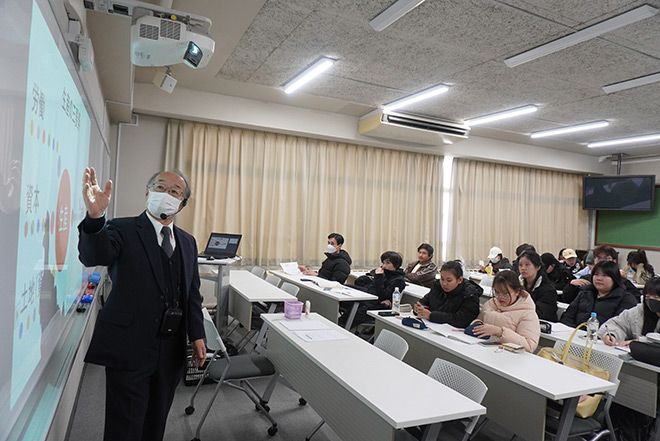
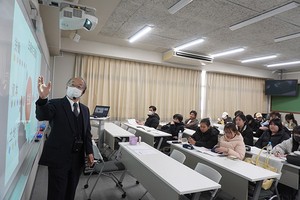
Ken Matsumura, left, teaches international students at Seigakuin University in Ageo, Saitama Prefecture, on Dec. 16. (Michiko Yoshida)
About 30 first-year international students were learning about corporations at Seigakuin University in Ageo, Saitama Prefecture, on a recent winter day.
The instructor of the “Japanese society” class was Ken Matsumura, 68, a part-time teacher who taught social studies in junior high schools for about 30 years.
When he asked, “Where can you buy shares?”
“At a stock exchange,” one student replied.
“You’re familiar with difficult terms, but that’s not correct. It’s at a securities company,” Matsumura responded and explained.
Using a junior high school civics textbook, the class covers a wide range of topics, including Japanese culture and geography, as well as the nation’s Constitution and social security system.
Each international student takes notes in a notebook given to them by the university, and after every class, Japanese-language instructors carefully review and correct the notes.
“In addition to learning the basic knowledge and values that Japanese people take for granted, we aim to help international students develop the writing and logical thinking skills needed to move on to specialized courses,” said Kayo Okamura, director of the international student center at the university.
Some universities such as Seigakuin University are expanding efforts to help international students find jobs in the country and acquire the skills needed to settle into Japanese society, as Japan grapples with a severe labor shortage.
These efforts come as higher education institutions face criticism for relying on foreign enrollees to fill shrinking student rolls.
The number of international students in Japan exceeded 330,000 in the 2024 academic year, marking a record high.
While the government aims to raise the number of international students to 400,000, universities have faced criticism for too readily admitting them to boost enrollment numbers.
PREPARING FOR LIFE IN JAPAN
International students from countries such as Nepal, China and Vietnam account for about 25 percent of Seigakuin University’s total enrollment of 1,700 students.
In the Faculty of Political Science and Economics, which is the most popular among international students, international students account for nearly half of the more than 500 students enrolled.
“Amid the declining birthrate, international students are extremely important to our university’s financial foundation,” said university President Shigeko Koike. “But we are not simply accepting them and doing nothing.”
Many international students seek to find jobs or start businesses in Japan after graduation.
In response, the university launched its own classes for international students in the 2018 academic year to help prepare them for university‑level specialized coursework.
These include the Japanese society class and “Academic Japanese,” which is designed to enhance specialized academic vocabulary.
International students at the intermediate level who have not attained the highest level (N1) of the Japanese-Language Proficiency Test are required to take these classes twice a week.
At the same time, the students study traditional subjects such as political science and economics together with Japanese students. They also join seminar groups from their second year at the university.
ROLES OF UNIVERSITIES
The effects of such education are also evident in employment outcomes.
The job placement rate for international students at the university seeking employment stands at 87 percent.
Many of these students find jobs at small and midsize companies in Saitama Prefecture, contributing to the local workforce.
“International students need to learn Japan’s social norms that may not exist in their home countries and develop specialized skills beyond language ability to settle into Japanese society and survive in the multicultural society,” Koike said, believing that universities have a major role to play in this process.
PRIVATE UNIVERSITIES FACING FINANCIAL STRAIN
Although the number of international students coming to Japan temporarily declined during the COVID-19 pandemic, it has since been increasing.
In the 2024 academic year, the total surpassed 330,000, which was an increase of 1.8 times compared with the 2014 academic year.
The government has set a target of increasing the number of international students admitted to 400,000 by 2033.
The largest number of international students is enrolled in Japanese-language educational institutions such as language schools with 107,241 students, followed by undergraduate programs at universities with 87,421 students.
Of these university students, 86 percent attend private universities.
As the declining birthrate accelerates, private universities are facing financial difficulties.
More than half are unable to fill their enrollment quotas, and about 20 percent have fewer than 80 percent of their seats filled as of the 2025 academic year.
In 2019, it came to light that approximately 1,600 international students at the Tokyo University of Social Welfare had gone missing over the previous three years.
As a result, suspicions have been raised, even in the Diet, that private universities may be too easily accepting international students to secure enrollment numbers and qualify for subsidies.
EDUCATION FOR SUCCESS IN JAPAN
However, Kenji Yamamoto, chairman of the Osaka University of Tourism, emphasizes that not all universities fit these criticisms.
At his university, international students from 16 countries and regions across Asia—mainly China and Vietnam—make up 70 percent of the total enrollment.
“It is true that international students help sustain small universities,” Yamamoto said.
That said, the university puts effort into courses such as business Japanese and classes themed around “working,” inviting outside lecturers to teach them with an eye toward international students playing active roles in Japanese society after graduation.
In addition, the university employs student support staff who can assist students in their native languages.
More than 80 percent of international students who graduated from the university in March 2025 and sought employment found jobs.
They are employed in fields such as hotels, automobile sales and the food service industry.
“By properly educating international students, we are producing human resources who can settle in as an indispensable labor force for Japanese society,” Yamamoto said.
MORE LIKELY TO STAY THAN TRAINEES
As Japan’s population continues to decline, accepting foreigners has become necessary to sustain the country.
The government has set a target of raising the domestic employment rate of international students to 60 percent.
Yamamoto said that accepting foreigners through universities is advantageous for both international students and Japanese society.
International students, he notes, come looking forward to experiencing life in Japan.
By spending several years studying while being exposed to the Japanese language and culture, they can more easily assess whether they can successfully continue living in Japan in the future.
It is also important for companies to have foreign workers stay and work long term in Japan.
Yamamoto said that “accepting them through universities makes them far more likely to settle in Japan than taking them in solely as labor through systems such as the technical intern training program.”
(This article was written by Michiko Yoshida and Chika Yamamoto.)
Universities offer ‘special track’ for students with foreign roots
August 18, 2025Online university enrolling up to 5,000 students will start in 2025
June 2, 2023Japan’s private universities fight to survive as penalties loom
October 25, 2024Universities divided over tuition hikes for foreign students
December 12, 20253 universities allowed to hike foreign students enrollment caps
February 18, 2026University in Osaka plans to start school year in the autumn
March 18, 2024A peek through the music industry’s curtain at the producers who harnessed social media to help their idols go global.
A series based on diplomatic documents declassified by Japan’s Foreign Ministry
Here is a collection of first-hand accounts by “hibakusha” atomic bomb survivors.
Cooking experts, chefs and others involved in the field of food introduce their special recipes intertwined with their paths in life.
A series about Japanese-Americans and their memories of World War II
Some articles on this website may contain content generated by artificial intelligence programs.
Copyright © The Asahi Shimbun Company. All rights reserved. No reproduction or republication without written permission.