The 10 best AI customer support chatbots in 2026


Last edited June 11, 2026
Table of Contents
- How we picked these tools
- The 10 best AI customer support chatbots in 2026
- 1. eesel AI: best for autonomous AI without ripping out your helpdesk
- 2. Zendesk: best for teams already standardized on Zendesk
- 3. Freshdesk: best for SMBs that want AI bundled in cheaply
- 4. Gorgias: best for Shopify and ecommerce brands
- 5. Tidio: best for small ecommerce and SMB teams
- 6. Minami AI: best for ecommerce brands with high post-purchase ticket volume
- 7. Ada: best for large consumer enterprises
- 8. Forethought: best for enterprises that want to keep their helpdesk
- 9. Decagon: best for high-volume, AI-native CX teams
- 10. Sierra: best for Fortune 500 and regulated brands
- What AI support chatbots actually cost
- How to choose the right one for your team
- Try eesel
How we picked these tools
We focused on tools that actually resolve support conversations on their own, not just route tickets or suggest canned replies. For each one we looked at the things a buyer actually argues about in a procurement meeting: how the AI is priced and what counts as a billable unit, whether it locks you into a specific helpdesk, what it does well, where real users say it falls short, and the security and scale story behind it.
Where a tool is something you can sign up for and try, we did, and we leaned on the product's own docs, pricing pages, and UI rather than a paraphrase of someone else's review. Where it's enterprise sales-led with no public pricing, we said so plainly instead of guessing.
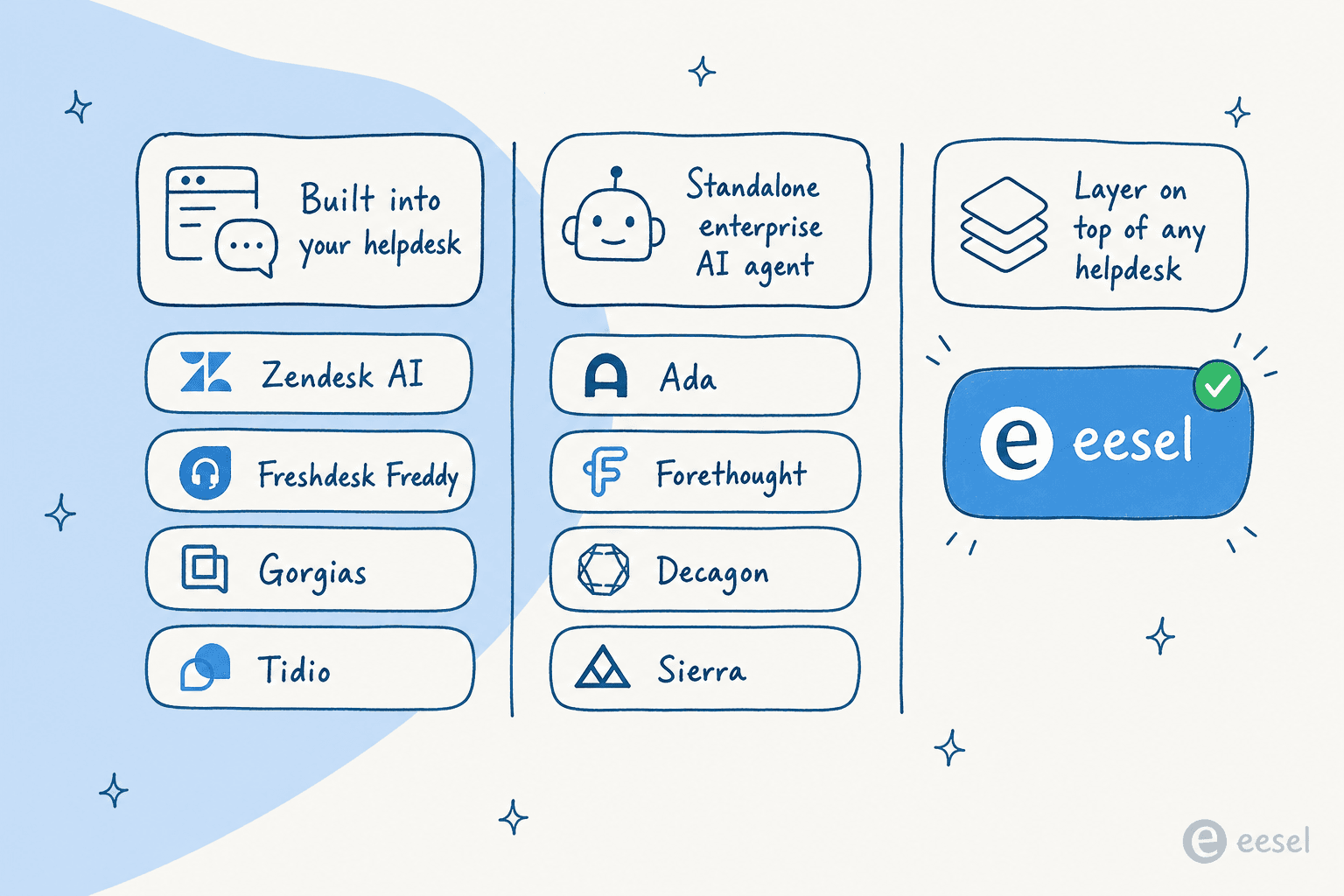
Here's the quick comparison before we get into each one.
| Tool | Best for | AI pricing model | Entry price | Native or standalone | Standout strength |
|---|---|---|---|---|---|
| eesel AI | Autonomous AI without switching helpdesks | Per task / usage | $0.40 per ticket, $50 free credit | Layers on top of any helpdesk | Self-serve, simulate on past tickets, hard spend cap |
| Zendesk | Teams already standardized on Zendesk | Per agent + per resolution | $19-$115/agent/mo + AI add-on | Native to Zendesk | Mature suite, deep reporting |
| Freshdesk | SMBs wanting AI bundled in cheaply | Per agent + per AI session | $19-$89/agent/mo | Native to Freshworks | Affordable, easy onboarding |
| Gorgias | Shopify and ecommerce brands | Per resolved conversation | $10-$900/mo by ticket volume | Native ecommerce helpdesk | Deepest Shopify integration |
| Tidio | Small ecommerce and SMB teams | Per conversation | Free, then ~$24.17/mo | Standalone + helpdesk | Lyro (Claude-powered), money-back guarantee |
| Minami AI | Ecommerce brands with high post-purchase ticket volume | Contact sales | No public pricing | Standalone ecommerce | Purpose-built post-purchase automation |
| Ada | Large consumer enterprises | Sales quote only | No public pricing (300k+ convos floor) | Standalone AI layer | Multi-LLM Reasoning Engine, AI-specific compliance |
| Forethought | Enterprises keeping their helpdesk | Sales quote (outcome-based) | No public pricing | Standalone, helpdesk-agnostic | Multi-agent system, browser agent |
| Decagon | High-volume AI-native CX teams | Sales quote by ticket volume | No public pricing | Standalone AI layer | Natural-language agent logic (AOPs) |
| Sierra | Fortune 500 / regulated brands | Outcomes-based | No public pricing | Standalone AI layer | Outcome pricing, ISO 42001, Ghostwriter |
The 10 best AI customer support chatbots in 2026
We've ordered these to move from the most broadly useful down through the helpdesk-native options to the enterprise-only platforms. Read the "best for" line on each one first, it's the fastest way to rule a tool in or out.
1. eesel AI: best for autonomous AI without ripping out your helpdesk
eesel AI takes a different angle from almost everything else on this list. Instead of being a bot you bolt onto one helpdesk, or a platform you migrate your whole support org into, it's an AI teammate that lives inside the tools you already use, Zendesk, Freshdesk, Intercom, Slack, email, Shopify, and 100+ others. You brief it in plain language, point it at your existing ticket history and docs, and it starts drafting replies, resolving tickets, and escalating the edge cases.

The two things that stand out in practice are control and transparency. You can run the agent in a simulation against thousands of your real past tickets before it ever touches a live customer, which answers the "but how accurate will it be on our tickets" question that every other vendor asks you to take on faith. And you can scope it to only handle what it's confident about, leaving everything else for a human, which is exactly the escalation behavior most support leads actually want.
It's proven at real volume too: Smava runs a fully automated Zendesk agent handling 100,000+ tickets a month in German, and Design.com handles 50,000+ tickets a month in Freshdesk across a multi-agent setup trained on 1,000+ help articles. Because you can prove the resolution rate in simulation first, the rollout is low-risk in a way the sales-led platforms can't match.
Pricing: eesel uses pure usage-based pricing with no seat fees and no platform fee on self-serve.
| Task type | Example | Price |
|---|---|---|
| Light | Dashboard question, lookup | Free |
| Regular | Support ticket or chat session | $0.40 each |
| Heavy | Blog post draft | $4.00 each |
You start with $50 of free credit and no credit card, there's a default $250/month spend cap with alerts, and a ticket is one task no matter how many back-and-forth replies it takes.
Pros:
- Keeps your existing helpdesk; no migration
- Simulate on past tickets before going live
- Transparent per-ticket pricing with a hard spend cap
- Self-serve, live in minutes rather than a sales cycle
Cons:
- It's an AI layer, not a full ticketing suite, so you do need a helpdesk underneath it
- Usage-based pricing means very high volumes need a quick cost check (though it's still seat-free)
Our take: If you already have a helpdesk and your goal is "switch on capable AI, keep control, and don't get surprised by the bill," eesel is the one we'd reach for first. It's the rare option you can fully evaluate against your own data before committing.
2. Zendesk: best for teams already standardized on Zendesk
Zendesk has repositioned itself as "the Resolution Platform," a ticketing core wrapped in an AI layer of customer-facing AI Agents, an agent-side Copilot, and Intelligent Triage. It's the safe, mature default, and it scores a solid 4.3/5 across 6,837 G2 reviews. Zendesk markets 80%+ automation rates on its AI Agents page.
The catch is cost and complexity. The AI is billed per "automated resolution" on top of per-agent seats, and reviewers consistently report $1.20-$1.50 per resolution above your committed usage, with the Copilot add-on running another $50/agent/month. There's also no graceful spending cap: Zendesk's only overage control is to pause AI entirely. The bundled "Essential" AI tier draws frequent criticism for being thin, and the AI only resolves well on top of a clean knowledge base. As one user put it bluntly in a thread on Zendesk's AI agents:
"We stopped using it because ARs are a rip off, and it's a rushed product to get into the AI hype."
u/OGShakey, r/Zendesk
Pricing:
| Plan (annual) | Price per agent/mo |
|---|---|
| Support Team | $19 |
| Suite Team | $55 |
| Suite Professional | $115 |
| Suite Enterprise + Copilot | Contact sales |
AI Agents bill per automated resolution; Copilot is a $50/agent/month add-on below the Enterprise tier.
Pros:
- Mature, full-featured suite with deep reporting
- Huge marketplace (1,800+ apps) and 80+ languages
- Strong omnichannel and routing
Cons:
- AI cost can hit 2-3x the base subscription once add-ons stack
- No soft spending cap on automated resolutions
- Admin-side AI setup is widely described as burdensome
Our take: A natural fit if you're already deep in Zendesk and have a clean knowledge base. If the per-resolution math worries you, it's worth reading our Zendesk AI pricing breakdown and considering an AI layer like eesel on top instead of the native add-ons. There's a full setup guide too, and a roundup of Zendesk AI alternatives if you're shopping around.
3. Freshdesk: best for SMBs that want AI bundled in cheaply
Freshdesk, from Freshworks, is the value-oriented helpdesk, trusted by 74,000+ businesses including Bridgestone and PepsiCo. Its AI suite, Freddy AI, splits into an autonomous Agent, a Copilot for human agents, and Insights for leadership, and Freshworks claims Freddy resolves up to 80% of queries with a sub-2-minute average resolution time.
The pricing is approachable at the seat level, and the AI gets a free on-ramp (500 Freddy AI Agent sessions on Pro and Enterprise). After that, sessions are metered at $49 per 100, so heavy automation users should model the cost carefully, because a "session" is one end-user interaction window.
Pricing:
| Plan (annual) | Price per agent/mo |
|---|---|
| Growth | $19 |
| Pro | $55 |
| Enterprise | $89 |
Freddy AI Agent: 500 free sessions on Pro/Enterprise, then $49 per 100 sessions. Freddy Copilot is a separate per-agent add-on. See our Freddy AI pricing guide for the full picture.
Pros:
- Affordable per-seat pricing
- Fast, low-friction onboarding
- Freddy is approachable for less technical teams
Cons:
- Per-session AI pricing can climb at scale
- AI is locked to the Freshworks ecosystem
- Shopify integration has a middling 3.0/5 marketplace rating
Our take: The best starting point if you want an all-in-one helpdesk with AI included and a tight budget. If you outgrow Freddy's session model or want to keep Freshdesk while running more capable AI, look at Freshdesk alternatives and our Zendesk vs Freshdesk comparison.
4. Gorgias: best for Shopify and ecommerce brands
If you sell on Shopify, Gorgias is the helpdesk built for you. It's Shopify's only Premier CX Partner, powers 40% of the top Shopify brands, and pulls order history, refunds, and product data straight into every conversation. It scores an excellent 4.6/5 across 560+ G2 reviews, and its AI chatbot handles order tracking, returns, and even revenue-driving chat campaigns. Orthofeet hit a 56% automation rate in under two months.
The recurring objection is price. Gorgias bills by ticket volume rather than seats, and the community rule of thumb is that it runs roughly 3x the cost of Zendesk for similar volumes, worth it if 40%+ of your tickets need direct Shopify actions, harder to justify if they don't. The AI Agent is a separate per-resolution add-on on top.
Pricing:
| Plan | Monthly | Tickets/mo |
|---|---|---|
| Starter | $10 | 50 |
| Basic | $60 | 300 |
| Pro | $360 | 2,000 |
| Advanced | $900 | 5,000 |
| Enterprise | Custom | Custom |
AI Agent add-on: $0.90-$1.00 per fully resolved conversation. Full breakdown in our Gorgias AI pricing guide.
Pros:
- Best-in-class Shopify integration, no exaggeration
- AI handles real ecommerce actions, not just FAQs
- Chat campaigns turn support into a revenue channel
Cons:
- Expensive relative to general-purpose helpdesks
- Pay both for ticket volume and per AI resolution
- Overkill if you're not ecommerce-first
Our take: For a Shopify brand where support is tightly tied to orders, Gorgias is hard to beat. If the pricing stings or you want AI that can sit on top of Gorgias rather than billing separately, browse Gorgias alternatives and our wider Shopify chatbot roundup.
5. Tidio: best for small ecommerce and SMB teams
Tidio bundles an AI agent, live chat, ticketing, and automation flows into one SMB-friendly package. Its AI agent, Lyro, is notable for being powered by Anthropic's Claude rather than the usual stack, and Tidio claims a market-leading 67% average resolution rate. It's trusted by 300,000+ businesses and scores 4.8/5 on the Shopify App Store across 1,300+ reviews.
The standout commercial signal is confidence in its own product: Tidio offers a money-back guarantee if Lyro resolves under 50% of conversations. It's also easy to install without engineering help. The watch-out is the layered usage model, you can end up paying per billable conversation, per Lyro conversation, and per Flows visitor, and the jump from the Growth plan to Plus ($749/mo) is steep.
Pricing:
| Plan (annual) | Price | Billable conversations |
|---|---|---|
| Free | $0 | 50 |
| Starter | $24.17/mo | 100 |
| Growth | from $49.17/mo | 250-2,000 |
| Plus | from $749/mo | Custom |
| Premium | ~$2,999/mo | Custom |
Lyro AI standalone starts at $32.50/mo; paid Lyro conversations run about $0.50 each.
Pros:
- Claude-powered AI with a money-back resolution guarantee
- Free plan and low entry price
- Easy, no-code setup
Cons:
- Stacked usage pricing is hard to predict at scale
- Big price jump between Growth and Plus
- Lower tiers are email-support only
Our take: A great low-risk starting point for small ecommerce and SMB teams, especially with that resolution guarantee. As you scale and the conversation math gets complicated, compare it against usage-based alternatives in our best AI chatbots for ecommerce guide.
6. Minami AI: best for ecommerce brands with high post-purchase ticket volume
Minami AI is an AI support agent built specifically for ecommerce, designed to handle the full post-purchase journey autonomously — order edits and cancellations, shipment tracking, lost packages, returns, exchanges, and direct courier coordination. Where most chatbots on this list handle general queries across industries, Minami goes narrow and deep on exactly the workflows that eat the most time for ecommerce support teams.
The operational scope is broader than a typical chatbot: customers can add or remove items from a paid order, and Minami manages 80%+ of courier communications and claims automatically. The returns flow includes product swap suggestions to reduce refund rates. The platform claims to have processed over 193 million real customer interactions and reports a 90%+ reduction in support costs, backed by a love-it-or-money-back guarantee. Setup is described as zero-configuration with a go-live time of minutes.
Pricing: No public pricing. Contact Minami AI directly for a quote.
Pros:
- Purpose-built for ecommerce post-purchase support — order edits, tracking, returns, courier claims
- Autonomous courier coordination handles 80%+ of claims without human involvement
- Money-back guarantee and zero-setup onboarding
Cons:
- No public pricing or self-serve trial
- Narrowly focused on post-purchase ecommerce; not suited for pre-sale or non-ecommerce support
- Contact-sales buying motion only
Our take: Minami AI is worth a close look for ecommerce teams where the bulk of tickets are post-purchase operational tasks. For teams that also need pre-sale support, internal helpdesk workflows, or a multi-channel setup beyond ecommerce, the broader platforms above cover more ground.
7. Ada: best for large consumer enterprises
Ada is a Toronto-based, enterprise-only AI platform that brands its category as "Agentic Customer Experience." Rather than living inside a helpdesk, it's a standalone AI layer that sits on top of Zendesk, Salesforce, and others. Its technical wedge is a multi-LLM Reasoning Engine, and it leans hard into AI-specific compliance (AIUC-1, zero data retention with LLM providers) that most rivals don't surface. Ada has raised ~$190M, hitting a $1.2B valuation back in its 2021 Series C.
The results it publishes are serious: Monday.com cut average handle time 42%, and IPSY reported a 943% ROI in four months. But Ada is deliberately gated, its pricing page states it's "a great fit for companies with at least 300,000 annual customer service conversations." There's no public pricing, no free trial, and no self-serve signup.
Pricing: No public pricing. Sales-led, volume-based, with a stated floor of 300,000+ annual conversations.
Pros:
- Multi-LLM orchestration rather than a single model bet
- Strong voice and omnichannel coverage
- Leading AI-specific compliance posture
Cons:
- Enterprise-only; explicitly not for SMB or mid-market
- No public pricing or self-serve trial
- You're buying a platform-plus-services engagement, not a SaaS subscription
Our take: A strong choice for large consumer brands with the volume and budget to justify it. If you're below that 300k-conversation floor, you're not the customer, and you'll get further with a self-serve tool. See Ada alternatives for options that scale down.
8. Forethought: best for enterprises that want to keep their helpdesk
Forethought is a San Francisco enterprise AI platform built as a multi-agent system, Discover (insights), Solve (the customer-facing agent), Triage, Assist (agent copilot), and Agent QA. Its strongest pitch is that it's helpdesk-agnostic: it sits on top of Zendesk, Salesforce Service Cloud, and others, so you get agentic AI without switching your stack. It's raised ~$92M and publishes a 15x average ROI and up to 98% resolution from its benchmark report.
A nice technical detail: Solve includes a Browser Agent that can operate legacy systems with no API, which matters for enterprises stuck on older internal tools. Upwork cut time-to-resolution 50% with it. Pricing is quote-only, a blend of platform fees and outcome-based costs, with a Proof of Value engagement instead of a free trial.
Pricing: No public pricing. Three tiers (Team, Professional, Enterprise) plus add-ons; "blend of platform access fees and an outcome-based pricing cost."
Pros:
- Helpdesk-agnostic; keep your current stack
- Browser Agent handles no-API legacy tools
- Clear multi-agent structure
Cons:
- No public pricing or free trial
- Mid-market-and-up focus
- Quote-based costs are hard to benchmark
Our take: The pick for a larger team committed to its current helpdesk (especially Salesforce Service Cloud) that wants agentic AI on top. For lighter-weight or self-serve options that also avoid a migration, eesel covers similar ground without the sales cycle.
9. Decagon: best for high-volume, AI-native CX teams
Decagon is one of the buzziest AI-native CX startups, founded in 2023 and reportedly valued around $1.5B after its 2025 Series C. Its differentiator is Agent Operating Procedures (AOPs), natural-language instructions that compile into executable code, so non-technical CX ops can author agent logic while engineers keep the guardrails. It runs one agent across chat, voice, email, and SMS.
The customer roster is unusually heavy for its stage, Chime, Duolingo, Hertz, Notion, and the case studies are punchy: ClassPass reported a 95% cost reduction, and Duolingo cited an 80% deflection rate after replacing a previous vendor. That switching story is Decagon's whole pitch:
"With the previous vendor, at least half my week was dedicated to maintaining their system. With Decagon, it's been a night-and-day difference."
Duolingo, via Decagon case study
Pricing: No public pricing. Sales-led, bracketed by monthly support ticket volume.
Pros:
- Natural-language agent authoring (AOPs)
- True omnichannel from one runtime, including voice
- Strong observability and QA tooling
Cons:
- No public pricing or self-serve trial
- Aimed at mid-market and enterprise volume
- Newer company, shorter track record than incumbents
Our take: Compelling if you're a high-volume team frustrated with brittle bot tooling and ready for a sales-led deployment. If you're comparing the AI-native crowd, our Decagon vs Sierra piece and ticket deflection breakdown are good next reads.
10. Sierra: best for Fortune 500 and regulated brands
Sierra is the high-end, outcomes-priced AI agent platform from Bret Taylor (former co-CEO of Salesforce and current chair of the OpenAI board) and Clay Bavor (18 years at Google). It's AI-first to the core, the agent is the product, and it's raised aggressively, reportedly hitting a ~$10B valuation in a late-2025 Series D. Its customer wall reads like a Fortune 500 list: Rocket Mortgage, SoFi, Sonos, ADT, Vanguard.
Two things set Sierra apart. First, outcomes-based pricing, you pay when the agent achieves a contracted outcome, which shifts implementation risk onto Sierra. Second, its compliance footprint: SOC 2, ISO 27001, HIPAA, and the rare ISO 42001 (AI management system) certification, which is why it lands regulated logos like FINRA and Sutter Health. Its Ghostwriter feature builds agents from SOPs and transcripts, collapsing the usual multi-week implementation.
Pricing: No public pricing. Outcomes-based, defined per use case, sales-led only.
Pros:
- Outcomes-based pricing aligns vendor incentives
- Top-tier compliance, including ISO 42001
- Deep founder and investor credibility
Cons:
- Enterprise-only; no self-serve or trial
- Outcome pricing needs careful contract definition
- Likely the most expensive option here
Our take: Built for large, often regulated enterprises that want a premium, white-glove AI agent and are happy to pay for outcomes. For everyone smaller, it's aspirational, see our Sierra review for the full picture.
What AI support chatbots actually cost
Here's the thing that trips up most buyers: these tools don't share a billable unit, so the headline number tells you almost nothing. A "$0.50 per conversation" tool and a "$1.30 per resolution" tool aren't directly comparable, and a per-seat tool can be cheap for a tiny team and brutal for a big one.
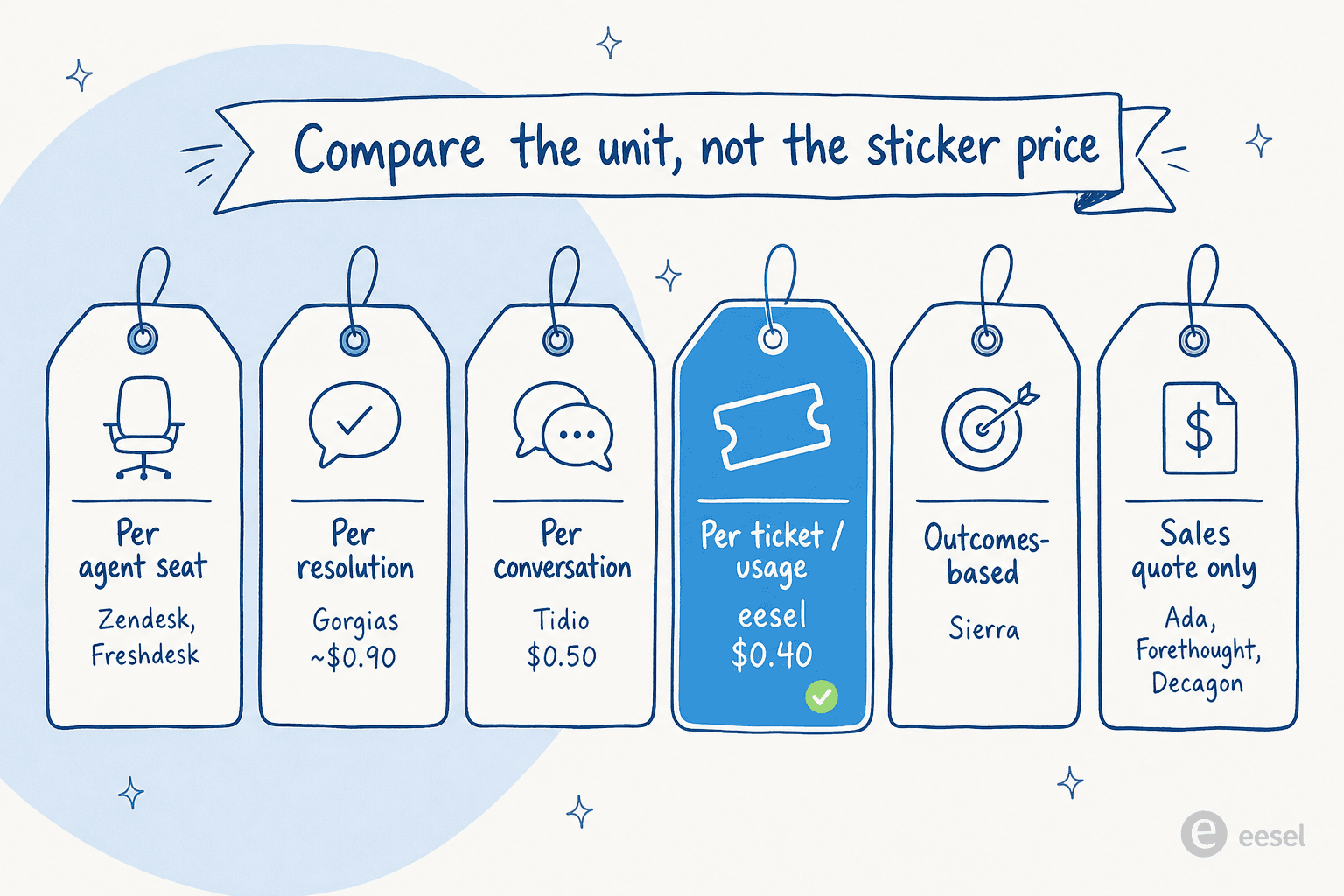
A quick worked example. Say you're a team handling 2,000 support tickets a month and you want AI to take the front line:
- Zendesk: a few Suite Professional seats (say 5 at $115) is $575/mo, plus automated resolutions at roughly $1.30 each. If AI handles even 1,200 of those tickets, that's another ~$1,560/mo, landing you north of $2,000 before the Copilot add-on.
- Gorgias: the Advanced plan ($900/mo for 5,000 tickets) plus AI Agent at ~$0.95 per resolved conversation, so ~1,200 AI resolutions adds ~$1,140, around $2,000/mo.
- eesel: 2,000 tickets at $0.40 is $800/mo, no seats, with a spend cap so it can't run away from you.
The numbers shift with your exact mix, but the pattern holds: usage-based and per-conversation models tend to win for AI-heavy support, while per-seat-plus-resolution stacks add up fast. Whatever you pick, model it on your real ticket volume, not the sticker price. Our AI vs human support cost analysis and our piece on how much AI can save in support go deeper.
How to choose the right one for your team
Strip away the marketing and the decision is mostly mechanical. Start from where you already run support and what you're optimizing for.
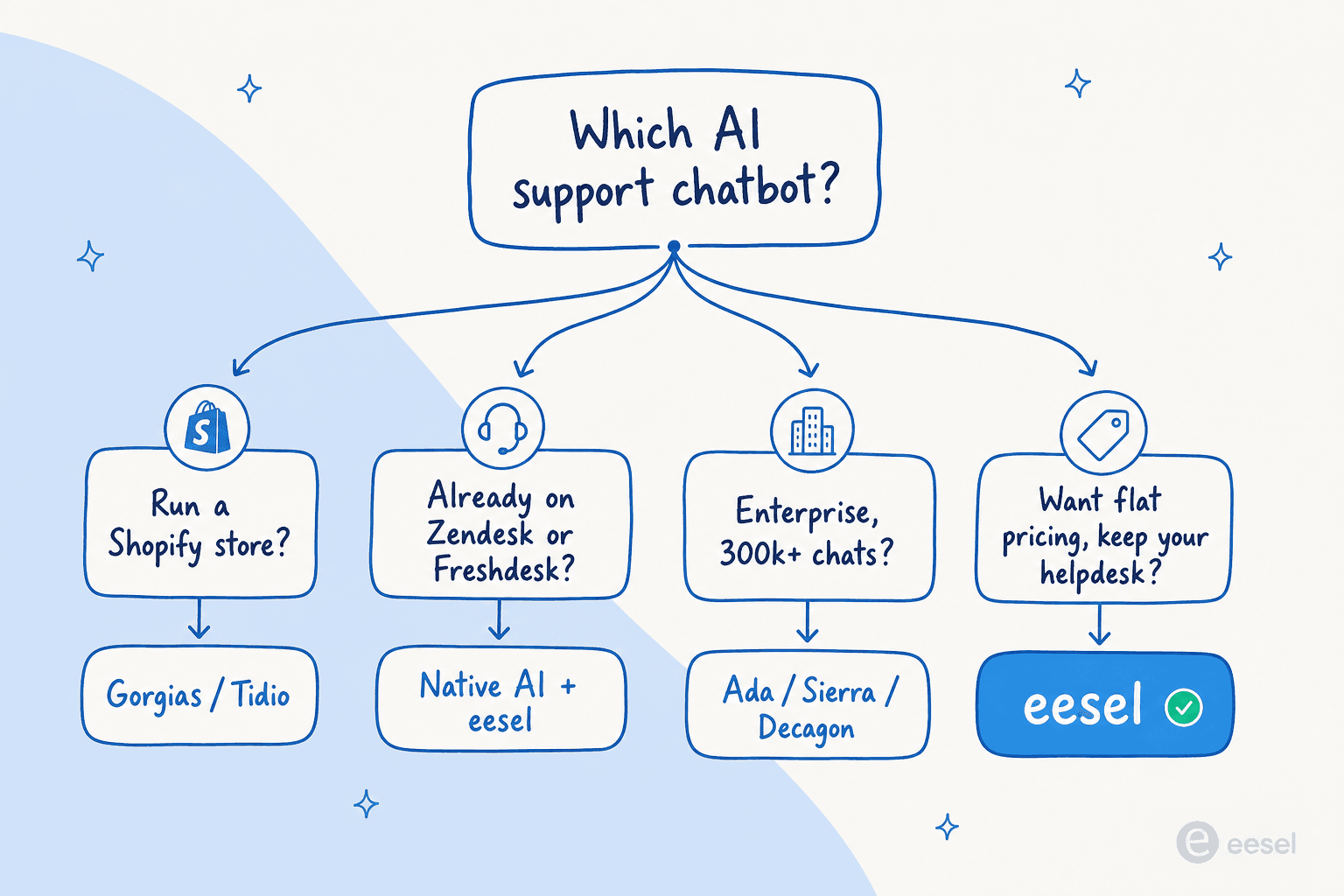
- Run a Shopify store? Start with Gorgias (action-heavy) or Tidio (budget-friendly).
- Already on Zendesk or Freshdesk? Turn on the native AI if your knowledge base is clean, or layer a tool like eesel on top for more control and predictable pricing without a migration.
- Enterprise doing 300k+ conversations a year? Ada, Sierra, and Decagon are built for that scale.
- Want capable AI, your existing helpdesk, and a bill you can predict? That's eesel's sweet spot.
The meta-advice: don't trust a resolution-rate claim until you've seen it on your tickets. The single best predictor of whether any of these tools works is the quality of your knowledge base, and the safest rollouts are the ones that let you start narrow, prove accuracy, and expand. For more on the underlying tech, see our explainers on AI agents vs rule-based chatbots and conversational AI, or the broader best customer service AI and best AI chatbot builder roundups.
Try eesel
If you've read this far and your situation is "we already have a helpdesk and we just want capable AI on top of it, without a migration, a sales cycle, or a scary bill," that's exactly what eesel AI is built for. It plugs into Zendesk, Freshdesk, Intercom, Slack, and 100+ other tools, learns from your past tickets and docs, and lets you simulate against thousands of real historical tickets before going live, so you know your resolution rate before a customer ever sees it.
Pricing is a transparent $0.40 per ticket with no seat fees and a default spend cap, and you can start with $50 of free credit and no credit card. If you want to see how it stacks up against your current setup, start free or book a demo.
Frequently Asked Questions

Share this article

Article by
Riellvriany Indriawan
Riell is a designer and writer at eesel AI with about two years of experience researching CX platforms, AI chatbots, and helpdesk software. She combines her design background with a sharp eye for how these tools actually look and feel in practice — making her comparisons unusually visual and user-focused.