The 9 best AI customer support tools in 2026


Last edited June 11, 2026
How we picked (and how to read this list)
We spent time inside each product's docs, pricing pages, and UI rather than re-reading everyone else's roundups. Where a tool was something you can actually sign up for and try, we did, and the screenshots in this post are from those sessions. For the enterprise platforms that are sales-led only, we leaned on their published case studies, security pages, and what real users say on Reddit and G2.
A few things we weighed for each tool:
- Architecture. Is the AI a feature bolted onto a helpdesk, or a standalone AI platform that sits on top of whatever helpdesk you already run? This single split explains most of the price and setup differences.
- Pricing model and total cost. Per seat, per resolution, per conversation, or per outcome. We modelled real ticket volumes, not the sticker price.
- Time to value. Days, weeks, or a quarter-long implementation.
- Channel coverage and compliance. Chat, email, voice, and the certifications regulated teams need.
- Who it is genuinely for, and just as importantly, who should skip it.
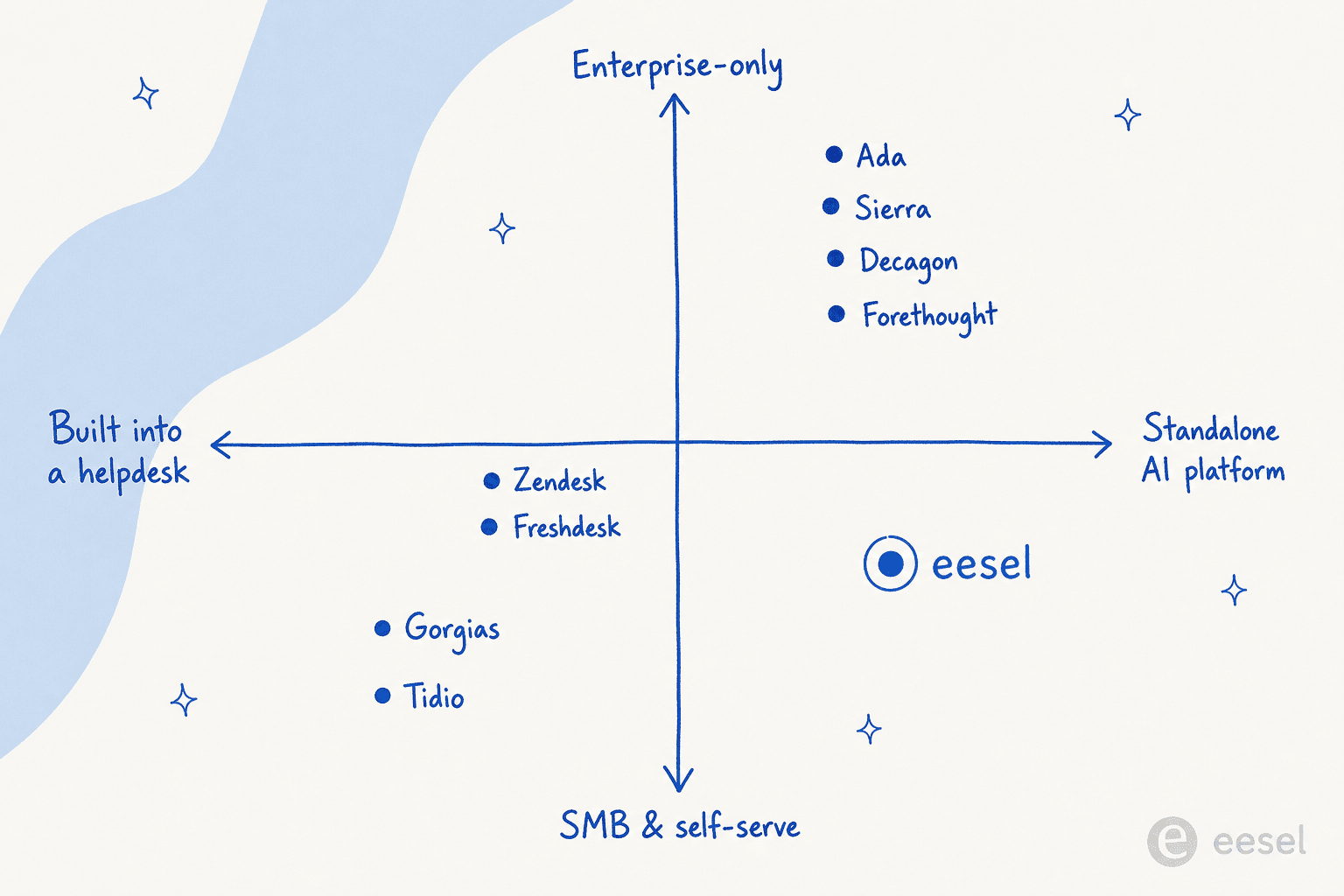
The clearest way to see where everything lands is this map. The horizontal axis is whether the AI is built into a helpdesk or a standalone platform; the vertical axis is who it serves, from self-serve SMB up to enterprise-only.
The 2026 comparison table
Here is the whole field at a glance. This is the part to screenshot.
| Tool | Best for | Type | Pricing model | Entry price | Spend cap | Free trial |
|---|---|---|---|---|---|---|
| eesel AI | Keeping your helpdesk, going live fast | Standalone AI layer | Per interaction | $0.40 / interaction, no seat fees | Yes ($250 default) | Yes ($50 credit) |
| Zendesk AI | Teams already on Zendesk | AI inside helpdesk suite | Per agent + per resolution | $19 / agent + ~$1.20–1.50 / resolution | No | Yes |
| Freshdesk Freddy | Teams already on Freshworks | AI inside helpdesk suite | Per agent + per AI session | $19 / agent; $49 / 100 sessions | No | Yes |
| Gorgias | Shopify ecommerce stores | Ecommerce helpdesk + AI | Per ticket + per resolution | $10 / mo; $0.90–1 / resolution | Plan-capped | Yes |
| Ada | Large consumer brands | Standalone AI platform | Custom (volume) | Contact sales (300k+ convos) | Custom | No |
| Sierra | Enterprise, outcome-priced | Standalone AI platform | Outcome-based | Contact sales | Custom | No |
| Decagon | AI-first high-volume CX | Standalone AI platform | Custom (volume) | Contact sales | Custom | No |
| Forethought | Keeping your helpdesk at enterprise scale | Standalone AI layer | Platform fee + outcomes | Contact sales | Custom | No (POV) |
| Tidio (Lyro) | Small ecommerce teams | SMB helpdesk + AI | Per resolved conversation | Free; $0.50 / conversation | Plan-capped | Yes |
Now the detail on each, starting with our pick.
1. eesel AI
Best for: teams that want autonomous AI support without leaving the helpdesk they already use.

Most AI support tools ask you to either adopt a whole new platform or buy an add-on locked to one vendor's suite. eesel AI takes a different route: it is an AI teammate that lives inside the tools you already run. Connect it to Zendesk, Freshdesk, Slack, Shopify, email, and 100+ others, and it reads tickets, drafts and sends replies, takes actions, and escalates the edge cases, all without you migrating anything.
The thing that makes it click in practice is onboarding. Instead of weeks of flow-building, eesel learns from your years of past tickets and help articles on day one, and you brief it in plain language the way you would a new hire ("handle the support queue this afternoon, and loop me in on anything over $500 in refunds"). One customer, Smava, runs a fully automated Zendesk agent handling 100,000+ tickets a month in German.
Key features
- Runs natively inside your existing helpdesk and chat tools, so there is no new agent interface to learn.
- Learns from historical tickets, help center, and docs automatically.
- Both an autonomous AI agent and a copilot that drafts replies for human agents.
- A simulation mode that estimates resolution rate on your real past tickets before you go live.
Pricing
eesel uses flat, usage-based pricing with no per-seat fees and no platform fee on self-serve: $0.40 per regular interaction (a ticket or a chat, no matter how many messages), free light tasks, and a free $50 credit to start. A team doing 1,000 tickets a month pays around $400. Crucially, you set a monthly spend cap (the default is $250) and agents pause when you hit it, so there is no surprise bill.
Pros and cons
- Pros: no migration, fast setup, transparent per-interaction pricing, a real spend cap, and partial rollouts (route only 200 of 1,000 tickets if you want to start small).
- Cons: it is not a standalone helpdesk, so if you do not already have a ticketing system you will need one to sit it on top of. Very large enterprises with bespoke compliance needs will want the $1,000/month enterprise tier for SSO, HIPAA, and a BAA.
Our take: eesel is the one we would reach for first if you already have a helpdesk and want AI live this week instead of next quarter. The spend cap and the no-seat-fee model make it the safest pick for teams that have been burned by per-resolution bills. Skip it only if you have no helpdesk at all, or if you are an enterprise that specifically wants a single AI-native platform to replace your stack.
2. Zendesk AI
Best for: teams already standardised on Zendesk.
Zendesk has repositioned itself as "the Resolution Platform," wrapping ticketing with AI Agents (the autonomous, customer-facing tier, derived from its Ultimate.ai acquisition), Copilot for human agents, intelligent triage, and AutoQA. It is a 2025 Gartner Magic Quadrant Leader, and it scores 4.3/5 across 6,837 G2 reviews. If you already live in Zendesk, the AI is one configuration away.
Key features
- AI Agents for autonomous resolution across messaging and email, with a dialogue flow builder and authorized actions on the Advanced tier.
- Copilot that drafts replies and executes approved actions for human agents.
- Intelligent triage to classify every ticket by intent, sentiment, and language.
Pricing
Seats run from Support Team at $19/agent/month up to Suite Professional at $115, with Copilot a $50/agent add-on. The catch is the AI billing unit, the "automated resolution," which reviewers consistently peg at around $1.20 to $1.50 each above your allowance, with no monthly cap. AI costs can easily run 2 to 3 times the base subscription.
That uncapped model is the most common complaint we found:
"From what I can see in regards to this new 'Automated Resolution' pricing model, we'll be paying about $1.50–$1.20 per resolution."
u/OGShakey and others, r/Zendesk discussion on the new AR pricing model

Pros and cons
- Pros: mature, deeply integrated if you already use Zendesk, strong omnichannel and reporting, 1,800+ marketplace apps.
- Cons: uncapped per-resolution pricing, AI quality gated by knowledge-base hygiene, and admin setup that reviewers describe as a near full-time job.
Our take: the right pick if you are already committed to Zendesk and have a clean knowledge base. If the per-resolution math worries you, look at free and cheaper Zendesk AI alternatives (including layering eesel on top of your existing Zendesk) before you sign.
3. Freshdesk Freddy AI
Best for: teams already on Freshworks who want bundled AI.
Freshdesk, from Freshworks, pairs a clean, affordable helpdesk with Freddy AI, a three-part suite: an autonomous AI Agent, a Copilot for human agents, and AI Insights for leaders. Freshworks says Freddy resolves up to 80% of queries, and the platform is trusted by 74,000+ businesses including Bridgestone and Klarna. It tends to be friendlier to less technical teams than Zendesk.
Key features
- Freddy AI Agent with 50+ prebuilt agentic workflows and a no-code studio.
- Freddy Copilot for reply suggestions, summaries, and live translation in-workspace.
- Freddy Insights for proactive alerts, root-cause analysis, and SLA-breach detection.
Pricing
Seats are Growth $19, Pro $55, and Enterprise $89 per agent/month (annual). Freddy AI Agent gives Pro and Enterprise 500 free sessions, then bills $49 per 100 additional sessions; Copilot is a per-agent add-on. A "session" is one end-user interaction over a 72-hour window.
Pros and cons
- Pros: lower entry price than Zendesk, genuinely approachable UI, strong omnichannel under one roof.
- Cons: session-based AI pricing gets expensive at volume, and the deepest AI lives behind the pricier tiers.
Our take: a solid, affordable choice if you are a Freshworks shop or want a gentler learning curve than Zendesk. If the session pricing pinches, Freddy alternatives (eesel included) can run the AI layer at a flatter rate while keeping Freshdesk as your ticketing system.
4. Gorgias
Best for: Shopify and ecommerce brands.
Gorgias is the ecommerce specialist. It is Shopify's only Premier CX Partner, powers 40% of the top Shopify brands, and pulls order history, refunds, and cancellations directly into every ticket and chat. It scores a strong 4.6/5 across 560+ G2 reviews. Its AI Agent handles order tracking, returns, and subscription edits autonomously, and it doubles as a sales channel.
Key features
- Deepest Shopify integration on the market: order data, refunds, and cancellations inside the ticket.
- AI Agent across email and chat for both pre-purchase shopping and post-purchase support.
- Proactive chat campaigns triggered by cart state or page behaviour.
Pricing
Gorgias bills by ticket volume, not seats: Starter $10 (50 tickets), Basic $60 (300), Pro $360 (2,000), Advanced $900 (5,000). The AI Agent is an add-on at $0.90 to $1.00 per fully resolved conversation. It runs roughly 3x the cost of Zendesk for similar volume, so the community's rule of thumb is sharp:
"I've been around ecommerce for 10+ years and this is honestly how I'd choose: 40%+ tickets need Shopify actions → I'd lean Gorgias. Mostly conversational support → Zendesk is fine."
u/cavalry18, r/CRM discussion on Zendesk vs Gorgias for Shopify
Pros and cons
- Pros: unmatched Shopify context, revenue attribution, AI that takes real ecommerce actions.
- Cons: premium pricing that scales with ticket volume, and overkill if your support is mostly simple conversational questions.
Our take: if you are a Shopify store where a big chunk of tickets are WISMO, refunds, and cancellations, Gorgias earns its premium. If most of your tickets are simple FAQs, you are paying for power you will not use.
5. Ada
Best for: large consumer brands with very high conversation volume.
Ada is the Toronto-based, enterprise-only AI platform that brands its category "Agentic Customer Experience." It is a standalone AI layer that sits on top of helpdesks like Zendesk and Salesforce, built around a multi-LLM "Reasoning Engine" with strong safeguards. Ada has raised around $190M, most recently a $130M Series C in 2021 at a $1.2B valuation. Customers include Monday.com (a 42% reduction in handle time) and IPSY.
Key features
- Multi-LLM orchestration via the Reasoning Engine, omnichannel including voice.
- Playbooks for multi-step SOPs and Coaching to improve the agent from reviewed conversations.
- AIUC-1 AI-specific compliance plus zero data retention with LLM providers, a rare combination.
Pricing
No public pricing. Ada states on its own site that it is a fit for companies with at least 300,000 annual customer service conversations, so this is firmly enterprise, sales-led, and almost certainly volume-based.
Pros and cons
- Pros: genuine enterprise scale, leading AI-specific compliance, strong autonomous voice.
- Cons: no SMB or mid-market option, no public pricing, and you own the AI layer separately from your helpdesk.
Our take: a serious choice for big consumer brands resolving hundreds of thousands of conversations a year. Everyone smaller should look at Ada alternatives, since you cannot even get a quote below the volume floor.
6. Sierra
Best for: enterprises that want outcome-based pricing and top-tier founders.
Sierra is the AI-agent platform from Bret Taylor (former co-CEO of Salesforce, chair of the OpenAI board) and Clay Bavor (18 years at Google). That pedigree shows up in its logo wall of regulated-industry names like Rocket Mortgage, SoFi, and Vanguard. Sierra reportedly raised $350M at a roughly $10B valuation in late 2025.
Key features
- "Ghostwriter," an agent that builds agents from SOPs, transcripts, or plain-English goals, collapsing the usual multi-week implementation.
- Both a code-first Agent SDK and a no-code Agent Studio.
- ISO 42001 (AI management) certification on top of SOC 2, HIPAA, and GDPR, plus deployment through ChatGPT.
Pricing
Sierra champions outcome-based pricing: you pay for resolved outcomes rather than seats or messages. There is no public rate card and no self-serve signup.
Pros and cons
- Pros: outcome pricing shifts risk onto the vendor, exceptional enterprise credibility, strong compliance footprint.
- Cons: enterprise-only, opaque pricing, and outcomes have to be carefully defined per contract.
Our take: a standout for Fortune 500 and regulated teams that want a partner accountable to results. Read the Sierra reviews and a Sierra vs Zendesk comparison before committing, because outcome pricing only works in your favour when the outcomes are defined tightly.
7. Decagon
Best for: AI-first companies replacing brittle bot tooling.

Decagon, founded in 2023, has become a CX-AI unicorn (reportedly ~$1.5B after a $131M Series C in 2025) on the back of a brand-heavy roster: Chime, Duolingo, Hertz, ClassPass, Figma. Its technical wedge is Agent Operating Procedures (AOPs), natural-language instructions that compile into executable code, so CX operators can author agent logic while engineers keep the guardrails.
Key features
- AOPs: natural-language agent logic that compiles to code, instead of decision trees.
- One agent runtime across chat, voice, email, SMS, and custom API surfaces.
- Observability and QA tooling (Watchtower, Duet) that traces every model call.
Pricing
Sales-led and volume-bracketed, with no public pricing; the demo form brackets prospects by monthly ticket volume. The clearest pitch is the customer who replaced a previous vendor:
"With the previous vendor, at least half my week was dedicated to maintaining their system. With Decagon, it's been a night-and-day difference."
Duolingo, Decagon case study
Pros and cons
- Pros: genuinely AI-native, strong omnichannel parity (voice included), and authoring that non-engineers can maintain.
- Cons: no public pricing, aimed at mid-market and up, and a younger company than the incumbents.
Our take: a strong option if you are an AI-first brand frustrated by a legacy bot and willing to run a sales process. If you are comparing it head-to-head, our Decagon vs Zendesk AI breakdown is the place to start.
8. Forethought
Best for: enterprises that want agentic AI but refuse to switch helpdesks.
Forethought, founded in 2017 by Deon Nicholas, markets a coordinated multi-agent system (Discover, Solve, Triage, Assist, and Agent QA) that sits on top of any helpdesk. It has raised around $92M and claims a 15x average ROI and up to 98% resolution. Upwork reported a 50% reduction in time to resolution with it.
Key features
- Solve handles customer conversations end to end, including a Browser Agent that operates legacy systems with no API.
- Triage classifies and routes tickets; Assist is the agent-side copilot.
- Agent QA scores 100% of interactions instead of a manual sample.
Pricing
Quote-only, described as a blend of platform-access fees plus outcome-based pricing. There is no free trial, but Forethought runs a Proof of Value on your own data.
Pros and cons
- Pros: helpdesk-agnostic, so you keep your existing stack; explicit action-taking; strong ticket triage.
- Cons: enterprise pricing with no transparency, and a heavier sales and onboarding cycle than the self-serve tools.
Our take: the enterprise pick when you are committed to Salesforce Service Cloud or a legacy Zendesk and do not want a vendor's AI lock-in. For smaller teams that like the "keep your helpdesk" idea, eesel delivers the same architecture with transparent pricing; see the best Forethought competitor for the comparison.
9. Tidio (Lyro)
Best for: small ecommerce teams that want AI without complexity.
Tidio is the SMB-friendly option, combining live chat, a help desk, and Lyro, an AI agent powered by Anthropic's Claude. Tidio claims a 67% average resolution rate (which it bills as the market's highest), serves 300,000+ businesses, and scores 4.6/5 across 1,879 reviews. It is genuinely easy to set up with no engineering help.
Key features
- Lyro AI agent grounded only in your uploaded FAQ and scraped site content, praised for staying on-script.
- Live chat, unified ticketing, and a no-code Flows builder for proactive automations.
- Native Shopify actions (order tracking, cart recovery) on the Growth tier and up.
Pricing
A free plan covers 50 Lyro conversations; paid plans run Starter $24.17, Growth from $49.17, and Plus from $749/month, with standalone Lyro from $32.50. Lyro conversations bill at roughly $0.50 each. There is a money-back guarantee if resolution drops below 50%.
Pros and cons
- Pros: very low entry cost, fast setup, strong Shopify ratings, and a resolution guarantee.
- Cons: the jump from Growth to Plus is a steep $749, and the layered billing (conversations plus Lyro plus Flows visitors) gets hard to predict at scale.
Our take: a great starting point for small stores and lean teams. As you scale and the pricing tiers start to bite, weigh Lyro alternatives that bill more flatly.
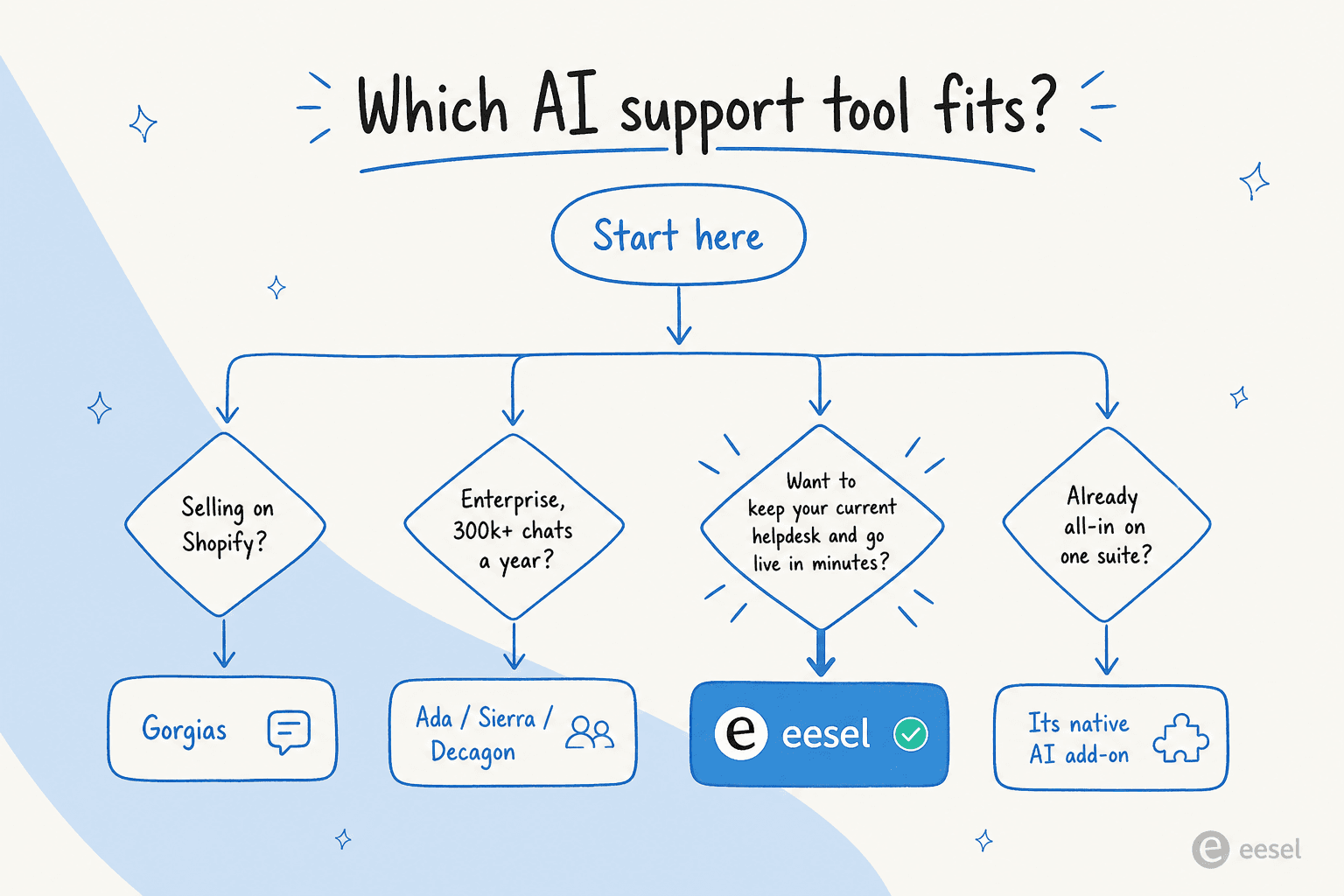
The decision really comes down to two questions
Strip away the feature lists and almost every choice here hinges on two things: do you keep your current helpdesk, and how do you want to be billed. This flow gets you to a shortlist in about ten seconds.
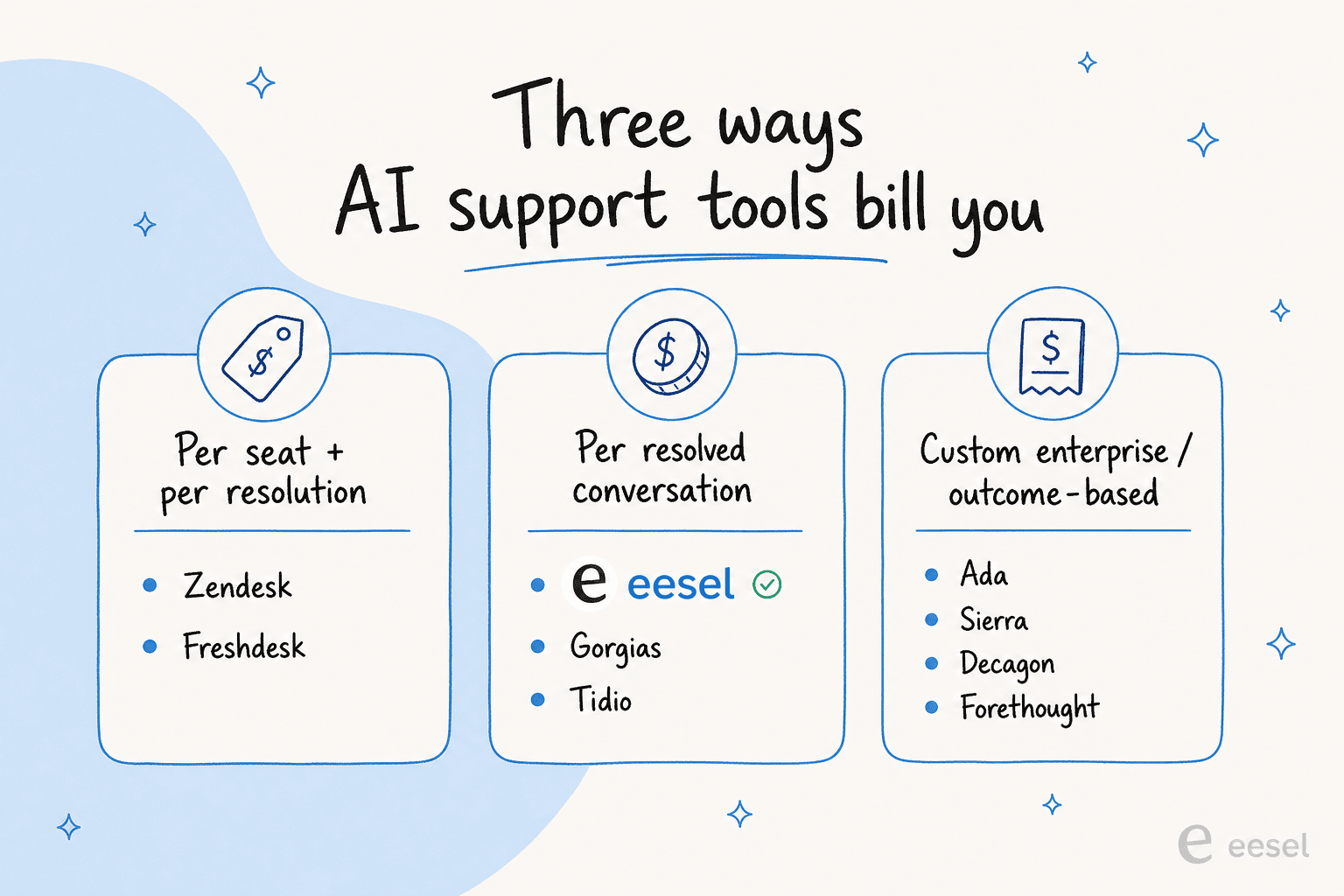
The billing question is the one buyers underestimate. The same 5,000 monthly AI resolutions cost wildly different amounts depending on whether you are billed per seat plus per resolution, per resolved conversation, or on a custom enterprise contract. Per-resolution models like Zendesk's have no monthly ceiling, which is exactly how a quiet month and a viral-spike month produce very different invoices.
Whatever you pick, the other lever is your knowledge base. Every tool here resolves tickets on top of your help center and ticket history, so the cleaner that is, the higher your resolution rate climbs. The good news is that the better tools learn from your existing history rather than making you write it all up front. If you want to go deeper on the economics, our guide to how much AI can save in customer support and the wider best AI helpdesk software roundup are good next reads.
Try eesel AI
If the "keep your helpdesk, go live in minutes" pitch is the one that fits, that is exactly what eesel AI is built for. It plugs into Zendesk, Freshdesk, Slack, and 100+ other tools, learns from your past tickets on day one, and runs as an autonomous agent or a copilot, all on transparent $0.40-per-interaction pricing with a spend cap you control. You can simulate it on your real ticket history before going live, and start free with a $50 credit and no credit card.
Try eesel free, or book a quick demo to see it run on your own setup.
Frequently Asked Questions

Share this article

Article by
Riellvriany Indriawan
Riell is a designer and writer at eesel AI with about two years of experience researching CX platforms, AI chatbots, and helpdesk software. She combines her design background with a sharp eye for how these tools actually look and feel in practice — making her comparisons unusually visual and user-focused.