|
VOOZH | about |
|
VOOZH | about |
Angular and AngularJS are two popular frameworks used for building dynamic web applications. While both are developed by Google, they are fundamentally different in terms of architecture, features, and performance.
AngularJS, released in 2010, is the older, JavaScript-based version, while Angular, introduced in 2016, is a complete rewrite using TypeScript. In this article, we will learn the differences between AngularJS and Angular.
AngularJS is an open-source front-end framework based on JavaScript that is mainly used to develop single-page web applications(SPAs). It is a continuously growing and expanding framework which provides better ways for developing web applications. It changes the static HTML to dynamic HTML. Its features like dynamic binding and dependency injection eliminate the need for code that we have to write otherwise.
AngularJS is rapidly growing and because of this reason, we have different versions of AngularJS with the final version being 1.8.3. It is also important to note that Angular is different from AngularJS. It is an open-source project which can be freely used and changed by anyone. It extends HTML attributes with Directives, and data is bound with HTML.
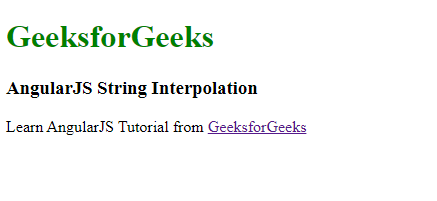
Example: This example describes the String interpolation in AngularJS.
Output
Angular is a popular open-source Typescript framework created by Google for developing web applications. Front-end developers use frameworks like Angular or React for presenting and manipulating data efficiently. Updated Angular is much more efficient compared to the older version of Angular, especially, since the core functionality was moved to different modules.
That's why it becomes so much fast and smooth compare to the older one. Newly added Angular CLI, & with the help of this command-line interface, we can install the required packages that facilitate creation & make the complex-structured code into a modular form that can be easy to manage.
Example: This example describes the String interpolation in Angular.
Output:
Category | Angular JS | Angular |
|---|---|---|
Architecture | It supports the Model-View-Controller design. The view processes the information available in the model to generate the output. | It uses components and directives. Components are the directives with a template. |
Written Language | Written in JavaScript. | Written in Microsoft’s TypeScript language, which is a superset of ECMAScript 6 (ES6). |
Mobile support | It does not support mobile browsers. | Angular is supported by all the popular mobile browsers. |
Expression Syntax | ng-bind is used to bind data from view to model and vice versa. | Properties enclosed in “()” and “[]” are used to bind data between view and model. |
Dependency Injection | It does not use Dependency Injection. | Angular Support Hierarchical and robust Dependency Injection |
Supported Languages | It only supports JavaScript. | It provides support for TypeScript and JavaScript. |
Routing | AngularJS uses $routeprovider.when() for routing configuration. | Angular uses @Route Config{(…)} for routing configuration. |
Structure | It is less manageable in comparison to Angular. | It has a better structure compared to AngularJS, easier to create and maintain for large applications but behind AngularJS in the case of small applications. |
CLI | It does not come with a CLI tool. | It comes with the Angular CLI tool. |
Examples Application | iStock, Netflix, and Angular JS official website. | Upwork, Gmail, and Wikiwand. |
In summary, while AngularJS and Angular serve similar purposes in web development, they cater to different needs and project scales. AngularJS is suitable for smaller, simpler projects or maintaining legacy applications, while Angular is designed for modern, large-scale applications that require enhanced performance, scalability, and maintainability. The choice between Angular and AngularJS depends on your project requirements, but Angular is generally the better option for new developments due to its advanced features, robust ecosystem, and continuous support.