|
VOOZH | about |
|
VOOZH | about |
2D Mensuration is the branch of mathematics that deals with the measurement of various flat geometric figures and shapes. This includes calculating areas and perimeters of two-dimensional shapes like squares, rectangles, circles, and triangles.
This mathematical discipline primarily involves determining:
Here are the terms you will come across in 2D mensuration. We have provided the term, abbreviation, unit, and definition for easy understanding.
| Terms | Abbreviation | Unit | Definition |
|---|---|---|---|
| Area | A | m2 or cm2 | The surface that the closed form covers is known as the area. |
| Perimeter | P | cm or m | A perimeter is the length of the continuous line that encircles the specified figure. |
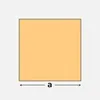
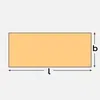
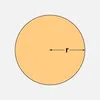
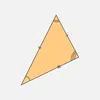
The following table provides a list of all mensuration formulas for 2D shapes:
| Shape | Area (Square units) | Perimeter (units) | Figure |
|---|---|---|---|
| Square | a2 | 4a | |
| Rectangle | l × b | 2(l + b) | |
| Circle | πr2 | 2πr | |
| Scalene Triangle | √[s(s-a)(s-b)(s-c)], Where, s = (a+b+c)/2 | a + b + c | |
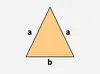
| Isosceles Triangle | ½ × b × h | 2a + b | |
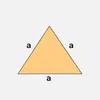
| Equilateral Triangle | (√3/4) × a2 | 3a | |
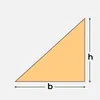
| Right Angle Triangle | ½ × b × h | b + hypotenuse + h | |
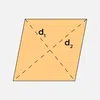
| Rhombus | ½ × d1 × d2 | 4 × side | |
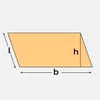
| Parallelograms | b × h | 2(l + b) | |
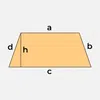
| Trapezium | ½ h(a + c) | a + b + c + d |
Q1 : Find the perimeter and area of an isosceles triangle whose equal sides are 5 cm and height is 4 cm.
Solution:
Applying Pythagoras’ theorem,
(Hypotenuse)2 = (Base)2 + (Height)2
=> (5)2 = (0.5 x Base of isosceles triangle)2 + (4)2
=> 0.5 x Base of isosceles triangle = 3
=> Base of isosceles triangle = 6 cm
Therefore, perimeter = sum of all sides = 5 + 5 + 6 = 16 cm
Area of triangle = 0.5 x Base x Height = 0.5 x 6 x 4 = 12 cm2
Q2 : A rectangular piece of dimension 22 cm x 7 cm is used to make a circle of the largest possible radius. Find the area of the circle formed.
Solution:
In questions like this, the diameter of the circle is lesser in length and breadth.
Here, the breadth Diameter of the circle = 7 cm
=> Radius of the circle = 3.5 cm
Therefore, area of the circle = π (Radius)2 = π (3.5)2 = 38.50 cm2
Q3 : A pizza is to be divided into 8 identical pieces. What would be the angle subtended by each piece at the center of the circle?
Solution:
By identical pieces, we mean that area of each piece is the same.
=> Area of each piece = (π x Radius2 x θ) / 360 = (1/8) x Area of circular pizza
=> (π x Radius2 x θ) / 360 = (1/8) x (π x Radius2)
=> θ / 360 = 1 / 8
=> θ = 360 / 8 = 45
Therefore, the angle subtended by each piece at the center of the circle = 45 degrees
Q4 : Four cows are tied to each corner of a square field of side 7 m. The cows are tied with a rope such that each cow grazes the maximum possible field and all the cows graze in equal areas. Find the area of the ungrazed field.
Solution:
For maximum and equal grazing, the length of each rope has to be 3.5 cm.
=> Area grazed by 1 cow = (π x Radius2 x θ) / 360
=> Area grazed by 1 cow = (π x 3.52 x 90) / 360 = (π x 3.52) / 4
=> Area grazed by 4 cows = 4 x [(π x 3.52) / 4] = π x 3.52
=> Area grazed by 4 cows = 38.5 m2
Now, area of square field = Side2 = 72 = 49 m2
=> Area ungrazed = Area of field – Area grazed by 4 cows
=> Area ungrazed = 49 – 38.5 = 10.5 m2
Q5 : Find the area of the largest square that can be inscribed in a circle of radius ‘r’.
Solution:
The largest square that can be inscribed in the circle will have the diameter of the circle as the diagonal of the square.
=> Diagonal of the square = 2 r
=> Side of the square = 2 r / 21/2
=> Side of the square = 21/2 r
Therefore, area of the square = Side2 = [21/2 r]2 = 2 r2