|
VOOZH | about |
|
VOOZH | about |
A rhombus is a type of quadrilateral with the following additional properties.
A Rhombus is also known as a Rhomb, a Lozenge, and a Diamond.
A rhombus exhibits symmetry across its diagonals. This means that if you fold a rhombus along one of its diagonals, the two resulting halves will perfectly overlap each other.
The figure above shows a rhombus shape where AB = BC = CD = DA and the diagonals AC and BD bisect each other at a right angle. This confirms its classification as a quadrilateral.
Related Reads,
Rhombus is a very common shape and can be seen in a variety of objects that we use in our daily lives. Various Rhombus-shaped objects are Jewelry, Kites, Sweets, Furniture, etc.
Note: All squares are rhombuses, but not all rhombuses are squares. This is because a square is a special type of rhombus that has all four sides equal in length and all four angles equal to 90 degrees. However, a rhombus can have angles that are not equal to 90 degrees.
Similarly, Every Rhombus is a Parallelogram but nit vice versa.
Read:
The area of the Rhombus is the space enclosed by all four boundaries of the Rhombus it is measured in unit squares. There are two ways of finding Areas of a Rhombus which are discussed below:
The area of the rhombus is the region covered by it in a two-dimensional plane. The formula for the area is equal to the product of the diagonals of the rhombus divided by 2. Given below is a rhombus with two diagonals d1 and d2:
The formula for the area of a Rhombus is:
Area of Rhombus = 1/2(d1 × d2) Sq. unit
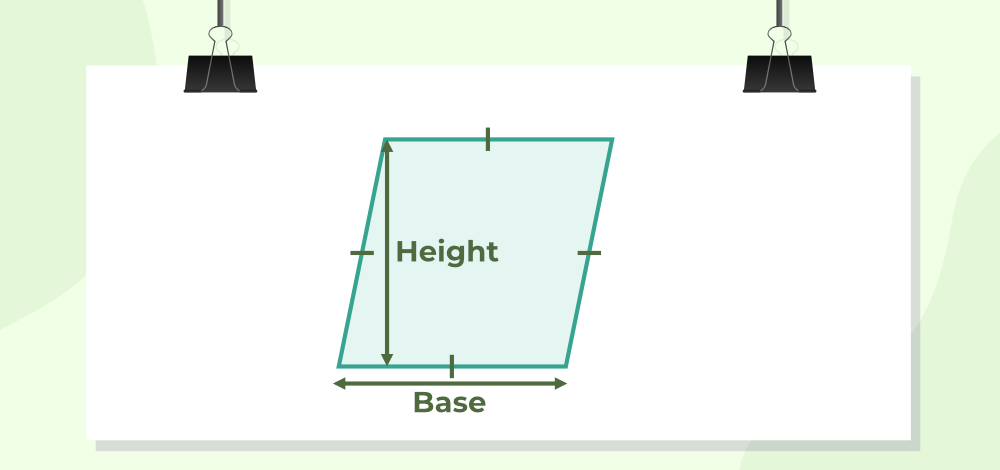
When the Base and Altitude of a Rhombus are given then the formula calculates its area:
👁 Rhombus with Height and BaseArea of Rhombus = Base × Height
The perimeter of a rhombus is defined as the sum of all its sides. Since all the sides of a rhombus are equal in length, it can be said that the Perimeter of a Rhombus is four times the length of one side.
Thus, if s denotes the length of a side of a rhombus,
Perimeter of Rhombus = 4 × s
Where s is the side of Rhombus
For instance, if each side of a rhombus measures 5 cm, its perimeter would be 4×5 cm, equating to 20 cm.
Read More:
The diagonals of a rhombus bisect each other at right angles. It means that they intersect at a 90-degree angle, a property not shared by all quadrilaterals.
Area = d1 × d2
Where, d1 and d2 are the lengths of the diagonals.
The properties of a rhombus are:
Let's see the comparison of rhombus with other common quadrilaterals in the table below.
Difference between Rhombus and Other Quadrilaterals | |||||
|---|---|---|---|---|---|
Features | Rhombus | Square | Rectangle | Parallelogram | Trapezoid |
| Sides | All sides have equal length | All sides have equal length | Opposite sides equal | Opposite sides equal | Only one pair of opposite sides parallel |
| Angles | Opposite angles equal | All angles are 90° | All angles are 90° | Opposite angles equal | No specific angle properties |
| Diagonals | Bisect each other at right angles and are not equal | Bisect each other at right angles and are equal | Bisect each other but not at right angles and are equal | Bisect each other but not at right angles and are not equal | No specific diagonal properties |
| Symmetry | Both line and rotational symmetry | Both line and rotational symmetry | Line symmetry | Line symmetry | Typically no line or rotational symmetry |
| Parallel Sides | The opposite sides are parallel | All sides are parallel | The opposite sides are parallel | The opposite sides are parallel | Only one pair of opposite sides parallel |
| Area Formula | Base × Height or ½ (Product of diagonals) | Side² | Length × Width | Base × Height | A = (a + b) (h)/2 |
| Special Properties | All sides are equal and it is a parallelogram | All properties of a rectangle and a rhombus | Diagonals are equal and bisect each other | Opposite sides are equal and parallel, opposite angles are equal | Only one pair of opposite sides is required to be parallel |
Also Read
Some solved example questions on Rhombus:
Example 1: MNOP is a rhombus. If diagonal MO =29 cm and diagonal NP = 14cm, What is the area of rhombus MNOP?
Solution:
Area of a rhombus = (d1)(d2)/2
Substituting the lengths of diagonals in the above formula, we have:
A = (29)(14)/2 = 406/2 = 203cm2Area of rhombus MNOP = 203cm2
Example 2: ABCD is a rhombus. The perimeter of ABCD is 40, and the height of the rhombus is 12. What is the area of ABCD?
Solution:
Perimeter = 40cm
Perimeter = 4 × side
40 = 4×side
⇒ side(base) = 10cm and height = 12cm (given)Now, Area of Rhombus = base × height
⇒ Area = 10 × 12 = 120 cm2
Thus, Area of rhombus ABCD is equal to 120cm2