|
VOOZH | about |
|
VOOZH | about |
A right-angle triangle is a type of triangle that has one angle measuring exactly 90 degrees (90°). It is also known as the right triangle.
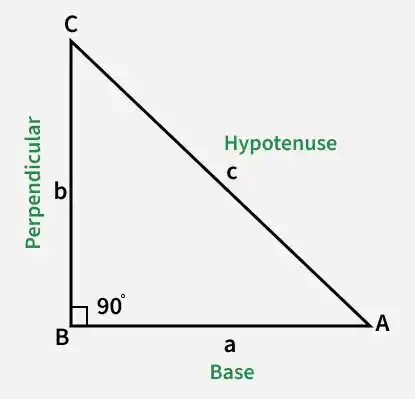
In a right triangle, the two shorter sides are called the perpendicular and the base and meet at the right angle (90°), while the longest side, opposite the right angle, is called the hypotenuse.
The sum of all the interior angles of the triangle is 180°, which is called the Angle Sum Property of a Triangle. So if any one angle is 90°, the sum of the other two angles is also 90°. They are used in many areas, from construction to navigation, and play a key role in trigonometry.
Right Triangle Formula: According to the Pythagorean theorem, in a right-angled triangle, the square of the hypotenuse is equal to the sum of the squares of the other two sides.
(Hypotenuse)2 = (Perpendicular)2 + (Base)2
Perimeter of Right-Angled Triangle: The perimeter of the right triangle is equal to the sum of the sides.
AB + BC + AC = (a + b + c) units.
Area of Right-Angled Triangle: The area of a right triangle is the space occupied by the boundaries of the triangle.
Area of a Right Triangle = (1/2 × base × height) square units.
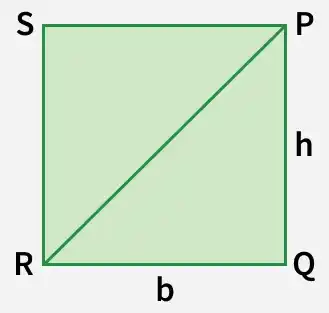
For any right-angle triangle, PQR right-angled at Q with hypotenuse PR.
Now if we flip the triangle over its hypotenuse, a rectangle is formed, which is named PQRS.
As we know, the area of a rectangle is given as the product of its length and width, i.e., area = length × breadth
Thus, the area of Rectangle PORS = b x h
Now, the area of the right-angle triangle is twice the area of the rectangle, then.
Thus,
Area of ∆PQR = 1/2 × Area of Rectangle PQRS
A = 1/2 × b × h
For a right triangle, the hypotenuse is calculated using the Pythagorean theorem. Theorem,
where,
Example 1: Find the area of a triangle if the height and hypotenuse of a right-angled triangle are 10 cm and 11 cm, respectively.
Given:
- Height = 10 cm
- Hypotenuse = 11 cm
Using Pythagoras' theorem,
(Hypotenuse)2 = (Base)2 + (Perpendicular)2
(11)2 = (Base)2 + (10)2
(Base)2 = (11)2 - (10)2 = 121 - 100
Base = √21 = 4.6 cm
Area of the Triangle = (1/2) × b × h
Area = (1/2) × 4.6 × 10
Area = 23 cm2
Example 2: Find out the area of a right-angled triangle whose perimeter is 30 units, height is 8 units, and hypotenuse is 12 units.
- Perimeter = 30 units
- Hypotenuse = 12 units
- Height = 8 units
Perimeter = base + hypotenuse + height
30 units = 12 + 8 + base
Base = 30 - 20 = 10 units
Area of Triangle = 1/2×b×h = 1/2 ×10 × 8 = 40 sq units
Example 3: If two sides of a triangle are given, find out the third side, i.e., if the base = 3 cm and the perpendicular = 4 cm, find out the hypotenuse.
Given:
- Base (b) = 3 cm
- Perpendicular (p) = 4 cm
- Hypotenuse (h) = ?
Using Pythagoras theorem,
(Hypotenuse)2 = (Perpendicular)2 + (Base)2
= 42 + 32 = 16 + 9 = 25 cm2
Hypotenuse = √(25)
Hypotenuse = 5 cm