Understanding Cyber Security in Critical Infrastructure
Last Updated : 24 Apr, 2026
Cybersecurity in critical infrastructure focuses on protecting essential systems and networks that support modern society from cyber threats and disruptions.
Modern society relies heavily on digital systems
Critical services operate through interconnected networks
Cyberattacks can impact public safety and the economy
Strong cybersecurity reduces national and organizational risks
Protection is both a technical and strategic priority
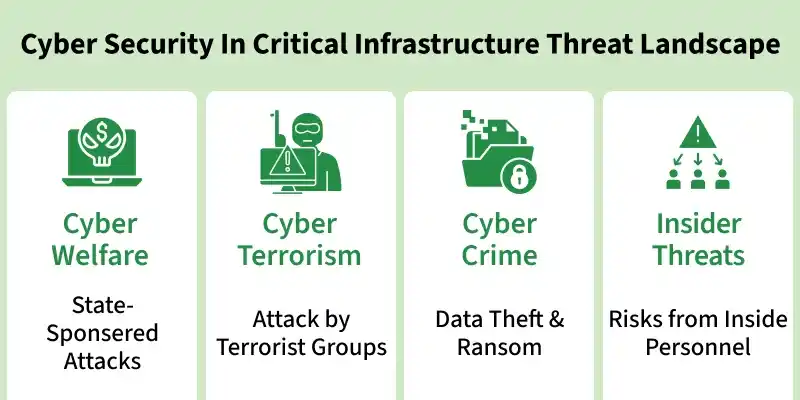
Cybersecurity in Critical Infrastructure Threat Landscape
Cyber threats may compromise critical infrastructure and can come in many different forms, such as:
Cyber Warfare: Cyber threats could be launched by states and actors granted state support to implement espionage, launching cyberattacks that collapse critical services or destroy advisory systems.
Cyber Terrorism: Cyber terrorist groups and other non-state actors can engage in such attacks to create a sense of chaos, terror and fear.
Cyber Crime: Bypassing security systems poses an appealing opportunity, as organized crime groups exploit vulnerabilities in critical infrastructures to steal or demand money or to produce service interruptions.
Insider Threats: Insiders who are evil-minded or employees who are negligent with care are very close to serious risks. They can access vital systems by either exploiting some vulnerabilities or unintentionally leading to security lapses.
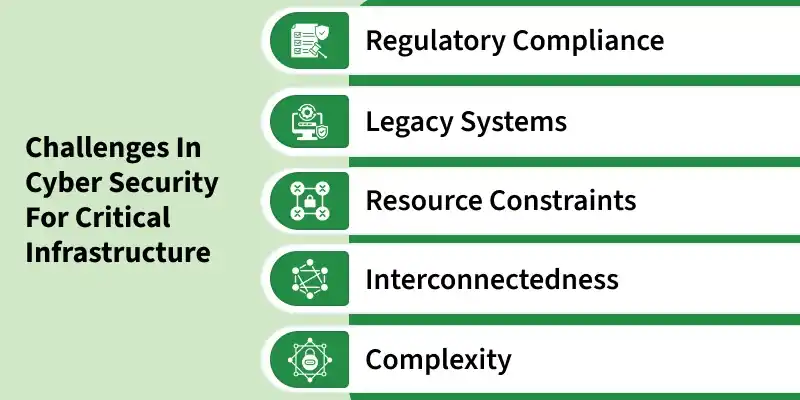
Major Challenges in Cybersecurity for Critical Infrastructure
Challenges of cybersecurity for critical infrastructure, which include:
Regulatory Compliance: Another layer of complexity and challenges arises due to complying with cybersecurity standards and laws, which forces organizations to manage a maze of requirements while preserving operational effectiveness.
Legacy Systems: The dominance of outdated systems is one of the biggest challenges to critical infrastructure cybersecurity. These outdated systems might be challenging to patch or upgrade as security was frequently overlooked during their creation. They are therefore simply a reward for hackers. These legacy systems often lack built-in features of security.
Resource Constraints: Limitations of financial or budget constraints lead to conflicting objectives that might restrict the amount of money allocated to cybersecurity precautions, leaving critical infrastructure open to sophisticated cyberattacks.
Interconnectedness: As the Critical infrastructure is networked or interconnected, it makes it more vulnerable to attack as a breach in one system might give access to others.
Complexity: Critical infrastructure systems are often complex that's why it is difficult to deploy thorough cybersecurity measures because systems are frequently complex, including a large number of components and stakeholders.
Cybersecurity in Critical Infrastructure Best Practices
Best practices of cybersecurity in critical infrastructure, which include:
1. Risk Assessment
Identifies threats and vulnerabilities
Helps prioritize security investments
Forms the foundation of security planning
2. Defense-in-Depth
Uses multiple layers of security
Includes firewalls, IDS, encryption and access control
Reduces impact of single security failure
3. Incident Response Planning
Predefined procedures for cyber incidents
Ensures quick detection, containment and recovery
Minimizes operational disruption
4. Collaboration and Information Sharing
Encourages cooperation between governments and organizations
Improves threat intelligence and preparedness
5. Employee Training
Educates staff about phishing and social engineering
Reduces human-related security risks
6. Continuous Monitoring
Real-time detection of suspicious activity
Enables proactive defense mechanisms
7. Patch Management
Regular updates close known vulnerabilities
Reduces chances of exploitation
Examples of Cybersecurity in Critical Infrastructure
Here are some examples of cybersecurity in critical infrastructure:
1. Transportation Security
Encryption of communication networks
Biometric authentication at airports and ports
Restricted access to critical assets
2. Power Grid Protection
Firewalls and intrusion detection systems
Network traffic monitoring and anomaly detection
Regular penetration testing and vulnerability assessments
3. Financial Sector Defense
Protection of banking and payment systems
Fraud detection and anomaly monitoring
Use of multi-factor authentication and tokenization
4. Healthcare System Resilience
Protection of electronic health records (EHRs)
Securing medical devices and telemedicine platforms
Use of encryption and secure authentication
Emergency response planning to ensure patient care continuity