|
VOOZH | about |
|
VOOZH | about |
The gradient is a fundamental concept in calculus that extends the idea of a derivative to multiple dimensions. It plays an important role in vector calculus, optimization, machine learning, and physics. The gradient of a function provides the direction of the steepest ascent, making it essential in areas such as gradient descent in machine learning and optimization problems.
Given a scalar function of multiple variables, the gradient is defined as a vector of its partial derivatives:
where each component represents the rate of change of with respect to .
For a function f(x,y), the gradient is:
For a function f(x,y,z), the gradient is:
1. Direction of Steepest Ascent: The gradient vector points in the direction where the function increases most rapidly.
2. Magnitude Represents Rate of Change: The length ∥∇f∥ indicates how steep the function is in that direction.
3. Gradient Perpendicular to Level Curves: If f(x,y) defines a surface, its gradient at a point is perpendicular to the level curves f(x,y)=c, where c is a constant.
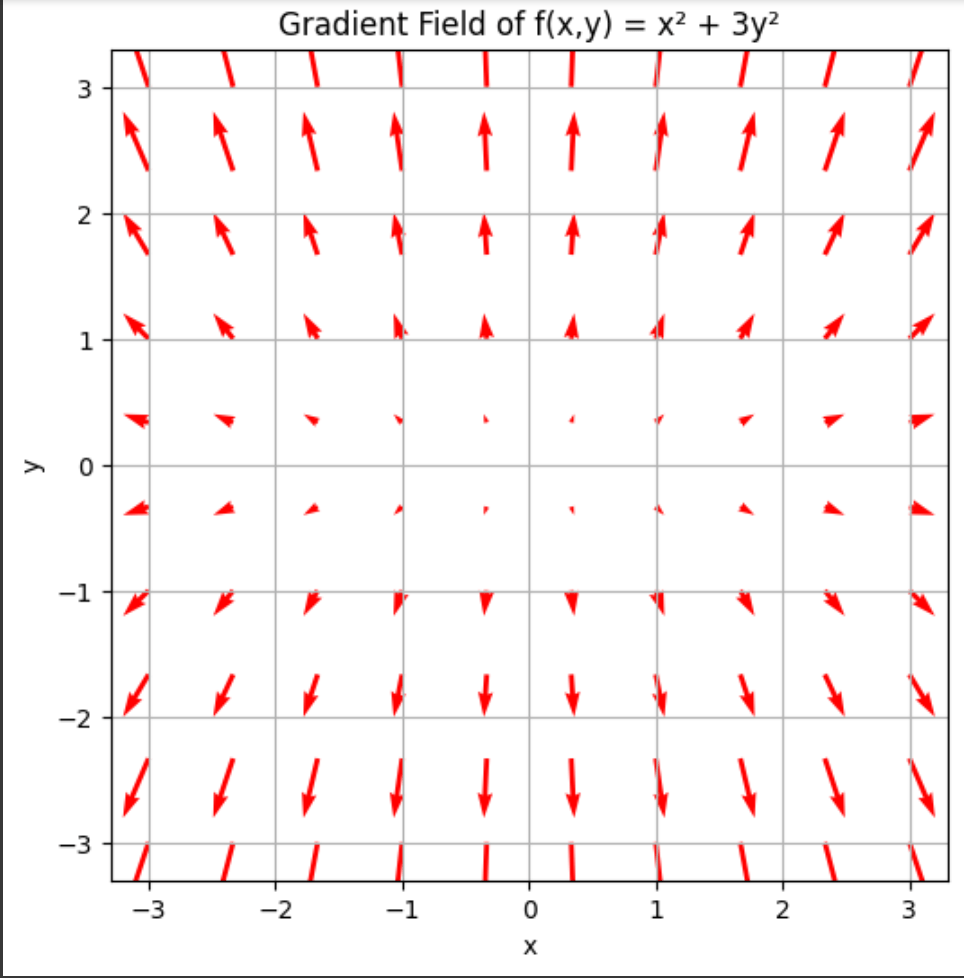
Consider the function:
The partial derivatives are:
Thus, the gradient is:
At (x,y)=(1,2):
This means the function increases most rapidly in the direction (2,12).
We can compute the gradient using SymPy (for symbolic differentiation) and NumPy (for numerical computation).
Output:
Gradient: [2*x, 6*y]
Output:
Gradient at (1,2): [2, 12]
Output:
In machine learning, the gradient guides gradient descent, an optimization algorithm used to minimize loss functions. The update rule is:
where:
In electromagnetism and gravity, the gradient of a potential function gives the field direction:
where 𝑉 is electric potential and 𝑈 is gravitational potential.
The gradient is used for edge detection in images. Operators like Sobel filters compute image gradients to highlight edges.
Robots use gradient-based path planning to navigate toward a goal while avoiding obstacles.