|
VOOZH | about |
|
VOOZH | about |
Linear mapping is a mathematical operation that transforms a set of input values into a set of output values using a linear function. It is often used as a preprocessing step to transform the input data into a more suitable format for analysis. It can also be used as a model in itself, such as in linear regression or linear classifiers.
The linear mapping function can be represented as follows
where
The weight matrix and bias vector are learned during the training process.
Let V and W be vector spaces over a field K. A function f: V -> W is called a linear map if, for any vectors u, v ∈ V and a scalar c ∈ K, the following conditions hold:
A linear transformation from a vector space into itself is called a Linear operator:
Zero-Transformation: For a transformation is called zero-transformation if:
Identity-Transformation: For a transformation is called identity-transformation if:
Let be the linear transformation where . Then, the following properties are true:
If
Then,
Let T be a mxn matrix, the transformation is linear transformation if:
Zero and Identity Matrix operations
Let's consider the linear transformation from such that:
Now, we will be verifying that it is a linear transformation. For that we need to check for the above two conditions for the Linear mapping, first, we will be checking the constant multiplicative conditions:
and the following transformation:
It proves that the above transformation is Linear transformation.
Examples of not linear transformation include trigonometric transformation, polynomial transformations.
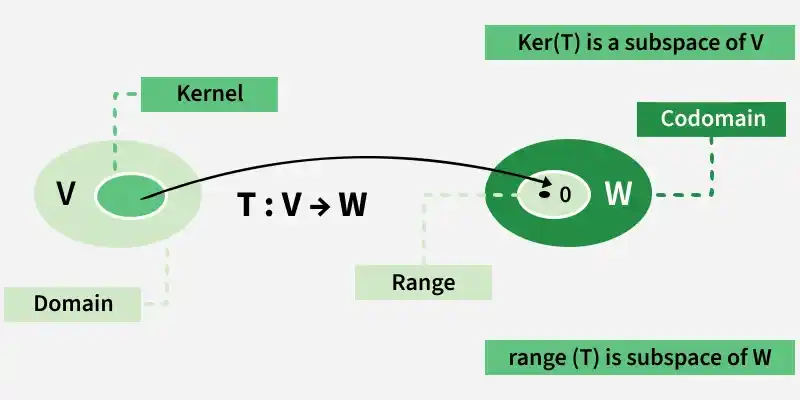
Let is linear transformation then such that: is the kernel space of T. It is also known as the null space of T.
The dimensions of the kernel space are known as nullity or null(T).
Let is linear transformation then such that: is the range space of T. Range space is always a non-empty set for a linear transformation on a matrix because:
The dimensions of the range space are known as rank (T). The sum of rank and nullity is the dimension of the domain:
Some of the transformation operators when applied to some vector give the output of vector with rotation with angle \theta of the original vector.
The linear transformation given by matrix: has the property that it rotates every vector in anti-clockwise about the origin wrt angle :
Let v
which is similar to rotating the original vector by
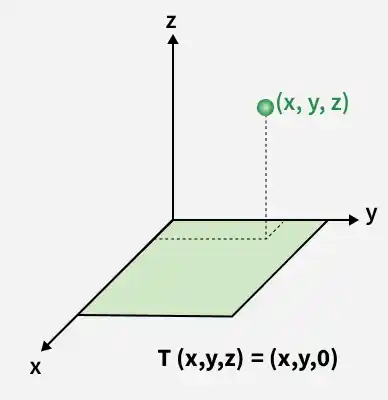
A linear transformation is given by:
T =
If a vector is given by v = (x, y, z). Then, . That is the orthogonal projection of the original vector.