Stochastic Variational Inference (SVI) is a method used to estimate complex probability distributions in large datasets. It’s based on variational inference where we approximate the true distribution with a simpler one, and improve it by maximizing a quantity called ELBO (Evidence Lower Bound). It uses mini batches of data and stochastic gradient ascent making it fast and scalable ideal for big data problems like topic modeling, Bayesian neural networks and variational autoencoders.
Variational Inference (VI) is a technique used in Bayesian statistics to approximate complex probability distributions that are difficult to compute directly.
Instead of using sampling methods VI turns the problem into an optimization task. It does this by choosing a simpler, parameterized distribution and adjusting it to be as close as possible to the true posterior distribution.
By maximizing the Evidence Lower Bound (ELBO) VI finds the best approximation efficiently making it well suited for large scale machine learning problems.
How Does SVI Work?
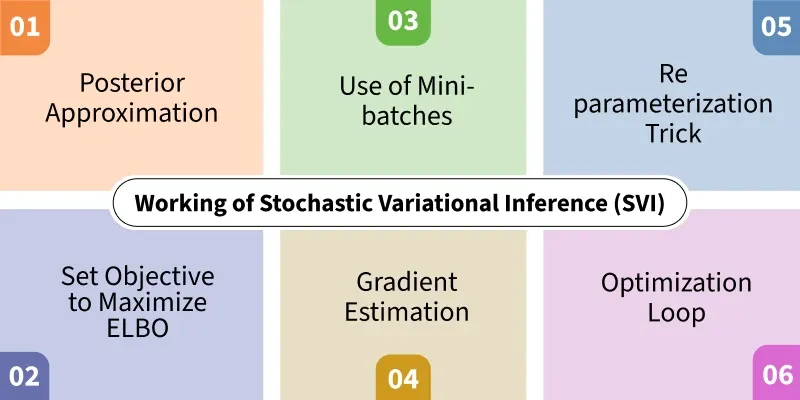
Posterior Approximation: SVI is used to approximate the posterior distribution when it is too complex to compute exactly. It does this by introducing a simpler, parameterized distribution that is easier to work with.
Set Objective to Maximize ELBO: Instead of directly minimizing the difference between and the true posterior, SVI maximizes the Evidence Lower Bound (ELBO). Maximizing the ELBO indirectly brings closer to .
Use of Mini batches: Unlike traditional variational inference, which processes the full dataset at once, SVI uses mini-batches. This means it computes an approximate gradient using only a small subset of the data, making it scalable to large datasets.
Gradient Estimation: To update the parameters of the variational distribution SVI uses stochastic gradient ascent. It estimates the gradient of the ELBO from mini batches and updates step by step.
Reparameterization Trick: When dealing with continuous variables like Gaussians, SVI uses the reparameterization trick. This lets us rewrite the random sampling process in a way that gradients can be computed using backpropagation.
Optimization Loop: The process repeats like sample a mini batch, estimate the ELBO gradient, update parameters and continue until the ELBO converges. Over time the variational distribution gets closer to the true posterior.
Applications
Topic Modeling:SVI is widely used in models like Latent Dirichlet Allocation (LDA) to discover topics from massive text corpora such as news articles, research papers or online reviews. It enables fast, scalable inference for millions of documents.
Bayesian Neural Networks: In Bayesian deep learning, SVI is used to estimate the posterior distribution of network weights, enabling uncertainty aware predictions. This is especially useful in safety critical applications like medical diagnosis or autonomous driving.
Variational Autoencoders (VAEs): SVI powers the training of VAEs which learn compressed latent representations of data. VAEs are used in image generation, anomaly detection and speech modeling.
Probabilistic Programming: Frameworks like Pyro, Edward, NumPyro and TensorFlow Probability use SVI for flexible, scalable Bayesian inference. It enables users to define custom probabilistic models and run inference easily.
Advantages
Scalable to Large Datasets: SVI uses mini batches allowing it to handle millions of data points efficiently unlike traditional variational inference or MCMC.
Faster Convergence: By leveraging stochastic gradient ascent and automatic differentiation SVI often converges faster than sampling based methods.
Compatible with Deep Learning: SVI integrates well with neural networks making it a natural fit for modern machine learning frameworks.
Easy to Implement with Modern Tools: Libraries like Pyro, TensorFlow Probability and NumPyro provide built in support for SVI simplifying its implementation.
Disadvantages
Biased Gradient Estimates: Since mini batches are used the gradient of the ELBO is only an estimate introducing noise that may lead to suboptimal convergence.
Limited Approximation Family: Using simple variational distributions may not capture complex posterior dependencies.
Sensitive to Hyperparameters: SVI requires careful tuning of learning rates, batch size and initialization for stable training.
Local Optima Risk: SVI optimizes a non convex objective (ELBO), SVI can get stuck in poor local optima specially with deep models.