|
VOOZH | about |
|
VOOZH | about |
Google Cloud Security Scanner is a security scanning tool offered by Google Cloud Platform that checks for common vulnerabilities in web applications hosted on GCP. It scans for a wide range of security issues such as cross-site scripting (XSS), missing security headers, out-of-date software, and other common vulnerabilities. It simulates an attack on the web application and analyzes the responses to identify vulnerabilities.
It can be integrated with Google App Engine, Compute Engine, and Kubernetes Engine. After the scan is complete, it generates a report highlighting all vulnerabilities found and providing recommendations on how to fix them; in this way, it allows for improving the security of the web application. It's a useful tool for security professionals and developers to identify and remediate potential vulnerabilities in their web applications running on GCP infrastructure.
Here are some key terminologies used in Google Cloud Security Scanner:
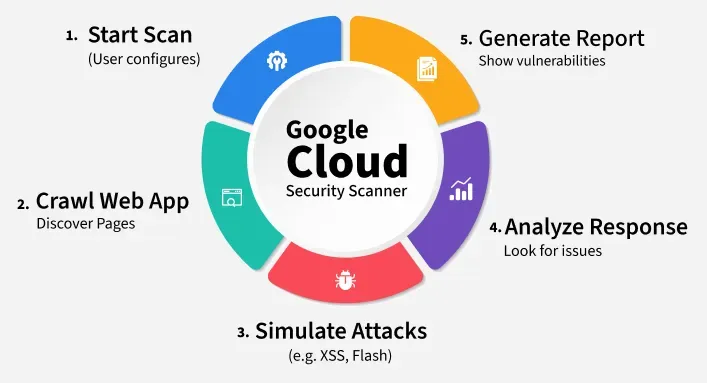
Google Cloud Security Scanner checks your web applications for security problems by pretending to be a real user and even a hacker. It visits your site, clicks on links, fills out forms, and watches how your application reacts. Then, it tries out common tricks that hackers use like adding fake scripts or checking if your application is using old software.If it finds anything unsafe (like missing security settings or outdated tools), it lets you know so you can fix it and keep your app secure.
Here is a step-by-step breakdown of how it works:
You begin by setting things up in the Google Cloud Console. Just enter the URL of your website or app, choose what kind of scan you want (like quick or full), and, if needed, add login details so the scanner can access protected pages.
Next, the scanner acts like a user browsing your site. It clicks links, fills out forms, and visits different pages—basically trying to explore everything it can, just like a search engine crawler.
Now comes the interesting part! The scanner tries out fake attacks, like injecting scripts (to test for XSS) or checking for weak spots in the code. Don’t worry it’s all safe and controlled!
It then checks how your app reacts. Does it handle the input safely? Does it leak any data? The scanner looks closely at the responses to figure out if there’s anything that could be dangerous.
Finally, you get a full report. It lists all the problems it found, how serious they are, and most importantly how to fix them. This helps you make your app safer and stronger.
There are several easy-to-use web application security scanning tools available in the market:
Acunetix is a web application security scanning tool that provides comprehensive scanning and reporting capabilities. It is designed to identify vulnerabilities in web applications, such as SQL injection, cross-site scripting (XSS), and broken authentication and session management. The tool uses a combination of automated and manual techniques to scan web applications and provide detailed reports on potential security risks.
Acunetix provides a user-friendly interface that makes it easy to use and navigate, even for those without a technical background. It also provides remediation guidance, helping organizations to quickly resolve vulnerabilities and improve the security of their web applications.
Qualys Web Application Scanning (WAS) is a cloud-based tool that provides automated vulnerability scanning, remediation guidance, and reporting capabilities for web applications. It is designed to help organizations identify security risks and vulnerabilities in their web applications, such as cross-site scripting (XSS), SQL injection, and broken authentication and session management.
Qualys WAS provides a cloud-based platform that makes it easy to use and manage and supports a wide range of web applications, technologies, and platforms. The tool integrates with the Qualys Cloud Platform, providing organizations with a unified view of their security operations and a streamlined approach to managing vulnerabilities.
Nessus is a widely used vulnerability scanning tool that provides a range of features, including web application scanning, compliance checking, and reporting capabilities. It is designed to help organizations identify security risks and vulnerabilities in their systems, networks, and web applications. Nessus provides a comprehensive and flexible scanning platform, with support for a wide range of operating systems, applications, and network devices. The tool can be run on-premises or in the cloud and provides a range of features to help organizations improve the security of their systems.
WebInspect is a web application security assessment tool that helps organizations identify and remediate vulnerabilities in web applications. It uses various techniques like dynamic and static analysis to identify security threats, such as cross-site scripting, SQL injection, and others, in web applications. The tool also provides reporting and management capabilities to help organizations track their security posture over time. WebInspect can be used as part of a comprehensive security program to reduce the risk of web application security incidents and meet regulatory compliance requirements.
OWASP ZAP (Zed Attack Proxy) is an open-source web application security scanner that helps organizations identify and remediate vulnerabilities in web applications. It is designed to be used by both security professionals and development teams, making it an accessible tool for organizations of all sizes. OWASP ZAP uses various techniques like active and passive scanning, and manual testing to identify security threats such as cross-site scripting, SQL injection, and others. The tool also provides reporting and management capabilities, as well as a large library of plugins to extend its functionality. OWASP ZAP is widely used as part of a comprehensive security program to reduce the risk of web application security incidents and meet regulatory compliance requirements.
The below comparison table showing how Google Cloud Security Scanner stacks up against other popular web application security scanners like OWASP ZAP, Acunetix, Qualys WAS, and Nessus:
| Feature / Tool | Google Cloud Security Scanner | OWASP ZAP | Acunetix | Qualys WAS | Nessus |
|---|---|---|---|---|---|
| Platform Support | GCP only (App Engine, GKE, etc.) | Any platform | Any platform | Any platform | Any platform |
| Pricing | Free (within GCP projects) | Free (open-source) | Paid | Paid | Paid |
| Ease of Use | Easy with GCP Console | Moderate (technical setup) | User-friendly UI | Easy via web dashboard | Moderate |
| Vulnerability Types Detected | XSS, missing headers, outdated libs | XSS, SQLi, etc. | XSS, SQLi, CSRF, etc. | XSS, SQLi, broken auth, etc. | Broad range, including system |
| Customization | Limited | High (custom scripts, plugins) | High | Medium | High |
| CI/CD Integration | Limited | Yes | Yes | Yes | Yes |
| Reporting | Basic reports | Basic to advanced | Detailed with risk levels | Detailed | Detailed |
| Scan Scope | Public-facing web apps on GCP | Full web app scan | Full web app scan | Full web app scan | Full network + web scan |
| Authentication Support | Yes (basic and custom) | Yes | Yes | Yes | Yes |
Google Cloud Security Scanner is helpful in many real-life situations. Let's try to connect it by discussing the following examples:
Let’s say you built a blog using Google App Engine. You allow users to leave comments. A hacker might try to inject harmful scripts into a comment (this is called Cross-Site Scripting or XSS). Google Cloud Security Scanner can test these comment boxes and detect if such attacks are possible before a hacker tries them.
You are about to launch a new e-commerce site on Google Kubernetes Engine. Before going live, you run a security scan to check for problems like:
This helps you fix issues early and launch with confidence.
If your team updates the website often, things can break. By running regular scans, you can catch new vulnerabilities as they appear. It is like routine health checkups but for your web app!
Some companies need to meet certain security standards or follow rules (like GDPR or HIPAA). Running security scans regularly helps prove you are keeping user data safe and following best practices.
Google Cloud Security Scanner provides several benefits, including:
Google Cloud Security Scanner is a powerful tool for identifying vulnerabilities in web applications running on the Google Cloud Platform, but it has some limitations:
These limitations should be taken into consideration when using Google Cloud Security Scanner and a comprehensive security program that includes multiple security tools and techniques is recommended to reduce the risk of web application security incidents.
Google Cloud Security Scanner is a simple and effective tool for detecting common web application vulnerabilities like XSS, missing headers, and outdated software on GCP-hosted apps. It simulates real-world attacks, analyzes responses, and provides actionable reports to help developers fix issues before they become serious threats. While it is cost-effective and well-integrated with GCP, its limited scope and platform dependency mean it is best used alongside other security tools for complete coverage.