|
VOOZH | about |
|
VOOZH | about |
In Kubernetes, StatefulSets are a special type of workload API object used to manage stateful applications. Unlike a Deployment (which is used for stateless apps), StatefulSets are designed for applications that require stable network identities, persistent storage, and ordered scaling or updates.
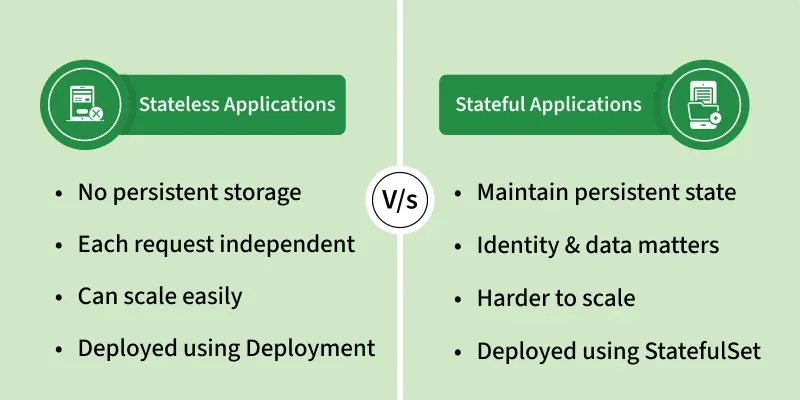
There are two main ways to deploy applications in Kubernetes:
A stateless application is an application that does not store any data or state about previous interactions. Each request is processed independently, and no information is saved once the request is completed. This means if the application crashes or restarts, it can continue working without needing to recover any past data.
In Kubernetes, stateless applications are usually deployed using Deployments because:
A stateful application is an application that maintains data or state across sessions and requests. Unlike stateless applications, they cannot treat every request as independent because they rely on previously stored information. If such an application crashes or restarts, it must be able to recover its state to continue functioning correctly.
In Kubernetes, stateful applications are deployed using StatefulSets because:
StatefulSets in Kubernetes are ideal for deploying stateful applications that require stable, unique network identifiers, persistent storage, and ordered, graceful deployment and scaling. They are suitable for applications like databases, key-value stores, and messaging queues that require consistent identity and storage.
Here is a step by step tutorial on how to use StatefulSets and some basic operations on StatefulSets.
Step 1. Create a StatefulSet file. you can do that by entering the following command:
touch example-statefulset.yamlStep 2. Open this file in a code-editor and write the following code into it:
apiVersion: apps/v1
kind: StatefulSet
metadata:
 name: gfg-example-statefulset
 annotations:
 description: "This is an example statefulset"
spec:
 selector:
 matchLabels:
 app: nginx
 serviceName: "gfg-example-service"
 replicas: 3 # remember this, we will have 3 identical pods running
 template:
 metadata:
 labels:
 app: nginx
 spec:
 containers:
 - name: nginx
 image: nginx
 ports:
 - containerPort: 80
 name: web
 volumeMounts:
 - name: www
 mountPath: /usr/share/nginx/html
 volumes:
 - name: www
 persistentVolumeClaim:
 claimName: myclaim
Step 3. Now we have to create a service file and a PersistentVolumeClaim file.
touch example-service.yamltouch example-persistentVolumeClaim.yamlStep 4. Enter the following code into the service file:
apiVersion: v1
kind: Service
metadata:
 name: gfg-example-service
 annotations:
 description: "this is an example service"
 labels:
 app: nginx
spec:
 ports:
 - port: 80
 name: web
 clusterIP: None
 selector:
 app: nginx
Step 5. Enter the following code into the PersistentVolumeClaim file:
apiVersion: v1
kind: PersistentVolumeClaim
metadata:
 name: myclaim
spec:
 accessModes:
 - ReadWriteMany
 resources:
 requests:
 storage: 8Gi # This means we are requesting for 8 GB of storage
Now lets apply these changes.
Step 6. Create the PersistentVolumeClaim
Now apply the PersistentVolumeClaim to the cluster:
kubectl apply -f example-persistentVolumeClaim.yamlThis will create the myclaim PVC required by the StatefulSet pods.
Note: Kubernetes does not automatically apply resource YAML files. Each resource such as StatefulSet, Service, and PersistentVolumeClaim must be explicitly created using
kubectl applyorkubectl create.
Step 7. Enter the following command in your terminal to create the gfg-example-statefulset:
kubectl create -f example-statefulset.yamlThis will create our gfg-example-statefulset, you will get a similar result:
Searching our StatefulSets in our terminal by the command
kubectl get statefulsetswe will find our gfg-example-statefulset in the list.
Step 8. Enter the following command in your terminal to create the gfg-example-service.
kubectl apply -f example-service.yamlthis will create a service with the name "gfg-example-service"
Step 9. Let's check our pods and services, for getting the list of pods enter the following command in your terminal:
kubectl get podsYou will get the list of the three gfg- pods that we create though defining three replicas in the example-stateful-set.yaml file. You will get a similar output:
for checking the list of services, enter the following command in your terminal:
kubectl get servicesThis will give you similar output:
Step 10. Now let's scale up our pods and check if it works! for scaling up the pods to 6 pods, enter the following command:
kubectl scale statefulset gfg-example-statefulset --replicas=6This will create 3 more pods and number of pods are now 6, to get list of pods enter the following command:
kubectl get podsYou will get a similar output:
Step 11. Now let's scale down pods to 3, for that enter the same command, just change the number of replicas back to 3:
kubectl scale statefulset gfg-example-statefulset --replicas=3Checking the list of pods by
kubectl get podsyou will see only 3 pods running:
To know more commands of kubectl refer to Kubectl Command Cheat Sheet.
Adding a StatefulSet: To add a StatefulSet to your Kubernetes cluster, use the command kubectl create -f [StatefulSet file name], replacing [StatefulSet file name] with the name of your StatefulSet manifest file.
kubectl create -f [StatefulSet file name]Scale Up / Down
Adjust the number of replicas in the StatefulSet to meet workload requirements. Pods are created or removed in order.
kubectl scale statefulset <name> --replicas=5Edit
Update the StatefulSet configuration (e.g., image version, environment variables).
kubectl edit statefulset <name>Delete
Remove the StatefulSet without deleting the associated PersistentVolumeClaims (PVCs), ensuring data remains intact.
kubectl delete statefulset <name>Rolling Updates
Update Pods in sequence (one at a time) to minimize downtime while ensuring application consistency.
kubectl rollout status statefulset <name>
kubectl rollout undo statefulset <name>
Deployment | StatefulSets |
|---|---|
Deployment is used to deploy stateless applications | StatefulSet is used to deploy stateful applications |
In Deployment, all pods are created parallelly | In StatefulSets, the pods are created one by one |
When we scale down a deployment a random pod is picked up and deleted | When we scale down StatefulSets, the last pod gets deleted |
In Deployment, a random name is assigned to the pods. | In StatefulSets, a sticky and predictable name is assigned |
In deployment all the ports use the same persistent volume | In the stateful set each pod uses its own persistent volume |