|
VOOZH | about |
|
VOOZH | about |
A ConfigMap stores non-sensitive configuration data (like URLs, hostnames, or settings) in key-value pairs, separate from application code. It helps make applications portable and easy to manage across different environments. ConfigMaps can be used as:
Example: DATABASE_HOST=localhost locally, and DATABASE_HOST=my-service in the cloud.
Note: ConfigMaps are not secure (use Secrets for sensitive data) and have a 1 MB size limit. For larger files, use Kubernetes Volumes.
In Kubernetes, you can create a ConfigMap either using kubectl commands or a YAML manifest.
1. Using kubectl (imperative commands):
kubectl create configmap demo-config --from-literal=database_host=172.138.0.1 --from-literal=debug_mode=1 --from-literal=log_level=verbose kubectl create configmap demo-config --from-file=config.properties2. Using a YAML manifest (declarative approach):
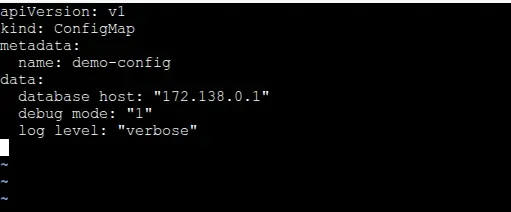
Create a file config.yaml with the following content:
apiVersion: v1
kind: ConfigMap
metadata:
 name: demo-config
data:
 database_host: "172.138.0.1"
 debug_mode: "1"
 log_level: "verbose"
Then apply it to your cluster:
kubectl apply -f config.yamlThis creates a ConfigMap named demo-config that stores your configuration data as key-value pairs, ready to be used by Pods in your cluster.
When defining ConfigMaps in Kubernetes YAML manifests, note that the values within the data field must be strings. However, if you need to store binary data, you can utilize the binaryData field instead. Here's an example illustrating this concept:
apiVersion: v1
kind: ConfigMap
metadata:
 name: binary-config
data:
 text-data: "This is a string value"
binaryData:
 binary-file: |
 U29tZSBiaW5hcnkgZGF0YQ==
In this YAML manifest, the data field contains a string value, while the binaryData field stores binary data represented by a base64-encoded string. This allows you to store both text and binary data within the same ConfigMap object.
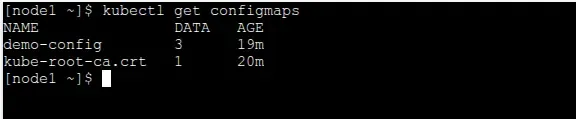
To view the ConfigMaps you've created in Kubernetes, you can use the kubectl get command. Here's how you can do it:
kubectl get configmapsThis command will list every ConfigMap in your Kubernetes cluster, along with their names and other pertinent details, when it is executed in your terminal or command prompt.
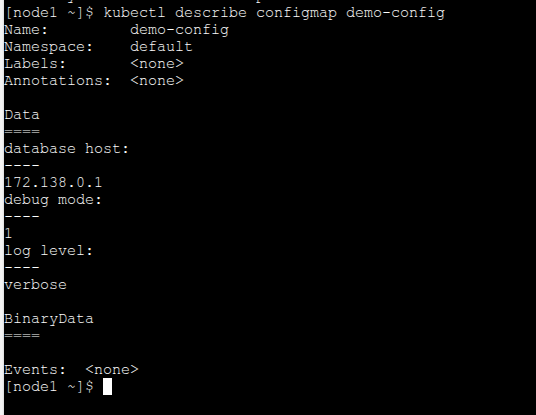
You can use the kubectl describe command in Kubernetes to view the key-value pairs that are kept in a ConfigMap. This is how you do it:
kubectl describe configmap <configmap-name>The name of the ConfigMap you wish to investigate should be substituted for <configmap-name>. This command will enable you to confirm the configuration data that has been stored by giving you comprehensive details about the given ConfigMap, including its key-value pairs.
This command retrieves the ConfigMap named "test-config", extracts its data field, and formats the output using JSONPath. Then, the output is piped to the jq tool for better formatting and readability.
kubectl get configmap <configmap-name> -o=jsonpath='{.data}' | jqWe must first construct a ConfigMap in order to use it as a file in a pod. The command kubectl create configmap can be used to accomplish this. The ConfigMap must be mounted as a volume in the Pod once it has been generated. The volumes part of the Pod specification can be used to accomplish this.
For instance, the following Pod specification mounts a volume named my-configmap at the path /etc/configmap for a ConfigMap with the name my-configmap:
apiVersion: v1
kind: Pod
metadata:
 name: my-pod
spec:
 containers:
 - name: my-container
 image: my-image
 volumeMounts:
 - name: configmap-volume
 mountPath: /etc/configmap
 volumes:
 - name: configmap-volume
 configMap:
 name: my-configmap
The containers in the Pod can access the files in the ConfigMap once the ConfigMap has been mounted into the Pod. These files can then be used by the containers to launch and operate.
Here is an illustration of how to use a container to access the files in a ConfigMap:
# Get a list of all the files in the ConfigMap
ls /etc/configmap
# Get the contents of a file in the ConfigMap
cat /etc/configmap/my-file.txt
In Kubernetes, you can mount ConfigMaps into Pods as files and then access those files as command-line arguments. This allows you to pass configuration data to your application without hardcoding it into your container image. Here's how you can achieve this:
Here's an example YAML configuration to illustrate this:
apiVersion: v1
kind: Pod
metadata:
 name: test-pod
spec:
 containers:
 - name: test-container
 image: <your-app-image>
 command: ["/bin/sh", "-c", "your-app-binary --config /mnt/test-config/config.properties"]
 volumeMounts:
 - name: config-volume
 mountPath: /mnt/test-config
 volumes:
 - name: config-volume
 configMap:
 name: test-config
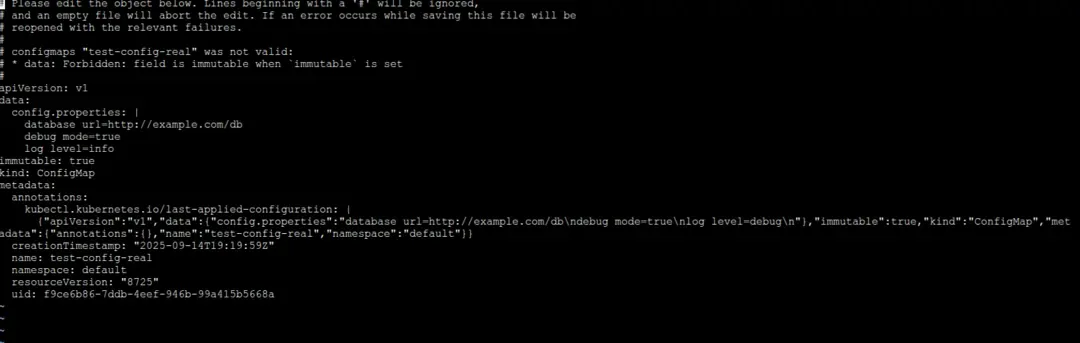
Read-only ConfigMaps that are unmodifiable once created are known as immutable ConfigMaps in Kubernetes. They come in handy when you want to make sure that the configuration data does not alter or become inconsistent during the course of your application. Here is an example of using immutable ConfigMaps:
Here's an example YAML configuration to illustrate using immutable ConfigMaps:
apiVersion: v1
kind: ConfigMap
metadata:
 name: test-config
 annotations:
 immutable: "true" # Set the immutable flag to true
data:
 config.properties: |
 database_url=http://example.com/db
 debug_mode=true
 log_level=debug
kubectl apply -f test-config.yamlBy using immutable ConfigMaps, you can help prevent inadvertent modifications that can compromise the stability of your application and guarantee that its configuration stays consistent and dependable.
The ConfigMaps can be edited by using two ways one is by changing the config maps in the config file and by using the command kubectl edit configmap command. It will open the kubernetes configmaps file and there you can make the changes required in that file.
You can also use kubectl update configmap command. to update the config maps for example as shown below.
kubectl update configmap my-configmap --from-literal=key1=value1 --from-literal=key2=value2| Feature | ConfigMap | Secrets |
|---|---|---|
| Purpose | Stores non-sensitive configuration data | Stores sensitive or confidential information |
| Data Encryption | Data is not encrypted | Data is encrypted |
| Use Cases | Storing environment variables, configuration files, etc. | Storing sensitive data like passwords, API keys, certificates |
| Access Control | Accessible to all pods within the cluster | Restricted access based on RBAC policies |
| Kubernetes API | Kubernetes API object of type ConfigMap | Kubernetes API object of type Secret |
| Visibility | Configurations are visible in plain text | Encrypted data is not visible in plain text |
| Usage | Suitable for non-sensitive data that needs to be shared | Suitable for sensitive data that requires encryption |