|
VOOZH | about |
|
VOOZH | about |
The word aggregate in the Aggregate Demand means 'Total', therefore, Aggregate Demand indicates the total demand of an economy. Aggregate Demand refers to the total demand for finished goods and services in the economy over a specific period. It also refers to a country's Gross Domestic Product (GDP) demand. Aggregate demand is also known as Aggregate Expenditure (AE) as AE is the total expenditure incurred by all the sectors of the economy. The aggregate demand includes factors such as personal consumption, investment, government demand, and net exports. An economy's aggregate demand increases when the variables' sum increases.
Note: Aggregate Demand is not the same as Market Demand. The former is the total demand for goods and services in an economy; however, the latter is the demand for one commodity in the market.
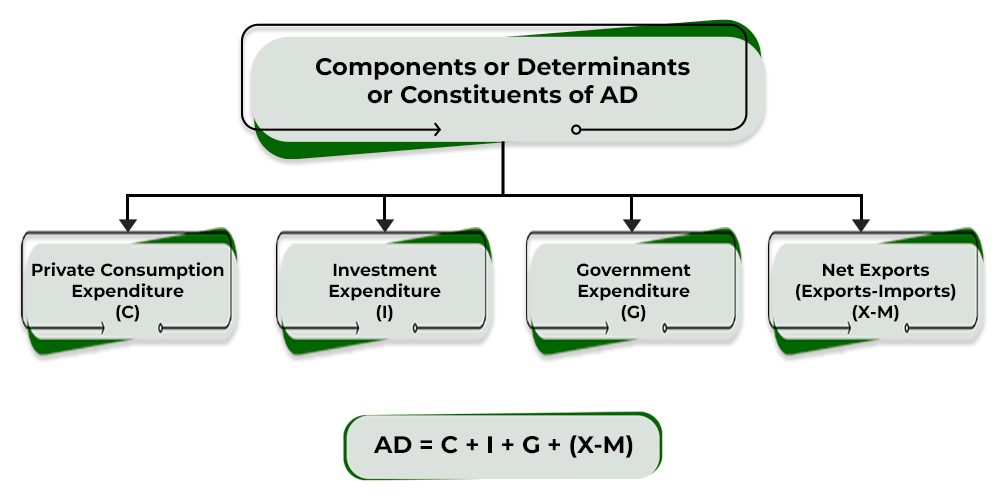
The Aggregate Demand of an economy is typically a sum of four components; viz., Government Expenditure (G), Consumption Expenditure (C), Investment Expenditure (I), and Net Export (X – M).
Government Expenditure is the total expenditure made by the government on the acquisition of public goods and social services to satisfy the need of the overall economy. The government expenditure includes all the consumption (C) and investment (I) expenditures like infrastructure, investments, defence and military equipment, public sector facilities, healthcare services, government employees, etc. The government expenditure, however, does not include transfer payments like pension plans, subsidies, and aid transfers to other countries. The level of Government Expenditure of an economy is determined by the government's policy which is usually guided by social welfare.
Consumption Expenditure or Private/Household Consumption Expenditure refers to the total spending of an individual or a household on the purchase of goods and services in an economy during an accounting year. Even though the spending of a consumer is affected by several factors like disposable income, per capita income, debt, consumer expectations of future economic conditions, and interest rates; disposable income plays a major role in it. It refers to the total income a household spends on savings and the purchase of goods and services. The spending of the households is majorly affected by disposable income as when the income of the consumer increases, the expenditure increases and vice-versa. The consumption expenditure; however, does not include spending on residential structures.
Investment Expenditure refers to the company's total expenditure on acquiring new capital goods and services like machinery and equipment, changes in inventories, and investments in non-residential and residential structures. The spending depends on factors such as interest rates, future expectations of the economy, and incentives of the government, such as tax benefits or subsidies.
The term total export refers to the demand for the products that are produced by domestic producers but are sold to the rest of the world, while total import refers to the demand for the products that are manufactured outside the domestic boundaries of the country but are imported to the country. Therefore, Net export refers to the difference between the Total Export (X) and Total Import (M) of the country.
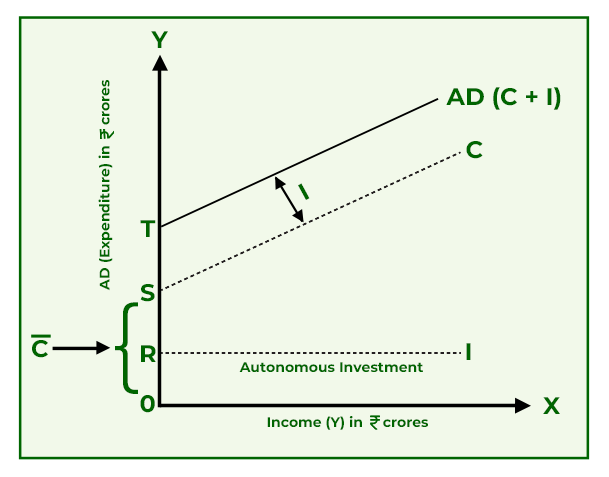
Although Aggregate Demand has four elements or components, the two-sector model of aggregate demand focuses on only two components; i.e., Investment Expenditure and Consumption Expenditure. According to this,
Aggregate Demand = Consumption + Investment
Or
AD = C + I.
The Aggregate Demand depends on the income and expenditure of an economy. Generally, when the income of an economy rises, the expenditure also rises, and vice-versa. Considering this, it can be stated that income and expenditure have a positive relationship.
(Amount in ₹ Crores)
Income | Consumption | Investment | AD |
|---|---|---|---|
| 0 | 30 | 30 | 60 |
| 100 | 110 | 30 | 140 |
| 200 | 190 | 30 | 220 |
| 300 | 270 | 30 | 300 |
| 400 | 350 | 30 | 380 |
| 500 | 430 | 30 | 460 |