|
VOOZH | about |
|
VOOZH | about |
1. Net Investment= Gross Investment – Depreciation
2. Net Indirect Tax = Indirect Taxes - Subsidies
3. Market Price= Market Price = Factor Cost + Net Indirect Taxes
OR
Factor Cost + (Indirect Taxes - Subsidies)
4. Net factor Income from Abroad (NFIA)= Factor income earned from abroad – Factor income paid abroad
OR
Net Compensation of Employees + Net Income from Property and Entrepreneurship + Net Retained Earnings
5. National Income (using NFIA) = Domestic Income + NFIA
6. Depreciation = Gross Value - Net Value
7. Leakagesin Different Types of Economies
Leakages in Different Types of Economies | |
|---|---|
| Two-Sector Economy (with Financial Market) | Savings |
| Two-Sector Economy (without Financial Market) | No Leakages |
| Three-Sector Economy | Savings + Taxes |
| Four-Sector Economy | Savings + Taxes + Imports |
8. Injections in Different Types of Economies
Injections in Different Types of Economies | |
|---|---|
| Two-Sector Economy (with Financial Market) | Investment |
| Two-Sector Economy (without Financial Market) | No Injection |
| Three-Sector Economy | Investment + Government Expenditure |
| Four-Sector Economy | Investment + Government Expenditure + Exports |
1. National Income and Related Aggregates
2. Domestic Income
Income from Domestic Product accruing to Private Sector = NDPFC - Income from Property and Entrepreneurship accruing to Government Administrative Departments - Savings of Non-Departmental Enterprises
3. Private Income = Factor Income earned (within domestic territory + from rest of the world) + Transfer Income received (within domestic territory + from rest of the world)
OR
= Income from Domestic Product Accruing to Private Sector + NFIA + Interest on National Debt + Current Transfers from Government + Net Current Transfer from Rest of the World
4.Personal Disposable Income = Personal Income - Personal Taxes Miscellaneous Receipts of Government
OR
= Personal Consumption Expenditure + Personal Savings
5. National Disposable Income = National Income + Net Indirect Taxes + Net Current Transfers from the rest of the world
OR
= National Consumption Expenditure + National Savings
6. Gross National Disposable Income = Net National Disposable Income + Depreciation
7. Product or Value Added Method of calculating National Income
Value of Output = Sales + Change in Stock
Change in Stock = Closing Stock – Opening Stock
OR
=Domestic Income or NDPFC + NFIA
8. Expenditure Method of calculating National Income
∑ Final Expenditure = Private Final Consumption Expenditure (PFCE) + Government Final Consumption Expenditure (GFCE) + Gross Domestic Capital Formation (GDCF) + Net Exports (NX)
= Gross Business Fixed Investment + Gross Residential Construction Investment + Gross Public Investment + Inventory Investment
OR
= Domestic Income or NDPFC + NFIA
9. Income Method of calculating National Income
OR
= Value of Output – Intermediate Consumption – Compensation of Employees – Mixed Income – Consumption of Fixed Capital – Net Indirect Taxes
Where,
NDPFC = Compensation of Employees + Profit + Rent & Royalty + Interest + Mixed income
10. National Income at Constant Price
11. Nominal GDP or GDP at Current Price
12. Real GDP or GDP at Constant Price
13. GDP Deflator or Price Index =
1. Aggregate Demand (AD) = C + I + G + (X - M)
= Private Consumption Expenditure + Investment Expenditure + Government Expenditure + Net Exports (Exports - Imports)
2. Aggregate Supply (AS) or National Income (Y) = Consumption (C) + Saving (S)
3. Consumption Function(C) = f(Y)
Where,
C = Consumption
f = Functional Relationship
Y = National Income
4. Average Propensity to Consume (APC)
5. Marginal Propensity to Consumer (MPC)
6. Saving Function(S) = f(Y)
Where,
S = Saving
f = Functional Relationship
Y = National Income
7. Average Propensity to Save (APS)
8. Marginal Propensity to Save (MPS)
9. Relationship between APC ad APS=APC + APS = 1
10. Relationship between MPC and MPS =MPC + MPS = 1
11. Values of APC, APS, MPC, and MPS
Value | APC | APS | MPC | MPS |
|---|---|---|---|---|
Negative | APC can never be less than zero, because of the presence of | APS can be less than zero when C>Y; i.e., before Break-even Point. | MPC can never be less than zero, as can never be more than | MPS can never be less than zero, as can never be more than |
Zero | APC can never be zero, because of the presence of | APS can be zero when C=Y; i.e., at Break-even Point. | MPC can never be zero, when | MPS can never be zero, when |
One | APC can be one when C=Y; i.e., at BEP | APS can never by one as savings can never be equal to income | MPC can never be zero, when | MPS can never be zero, when |
More than One | APC can be more than one when C>Y; i.e., before Break-even Point. | APS can never be more than one as savings can never be more than income | MPC can never be less than zero, as can never be more than | MPS can never be less than zero, as can never be more than |
12. Equation of Consumption Function
Where,
C = Consumption
b = MPC
Y = Income
13. Equation of Saving Function
Where,
S = Saving
1-b = MPS
Y = Income
14. Marginal Efficiency of Investment (MEI)
AD = AS
S = I
16. Investment Multiplier
OR
The maximum value of the Multiplier is ∞ when MPC = 1
The minimum value of Multiplier is 1 when MPC = 0
1. Measures of Government Deficit
OR
= (Revenue Expenditure + Capital Expenditure) – (Revenue Receipts + Capital Receipts excluding Borrowings)
OR
= (Revenue Expenditure – Revenue Receipts) + (Capital Expenditure – Capital Receipts excluding Borrowings)
OR
= Revenue Deficit + (Capital Expenditure – Capital Receipts excluding Borrowings)
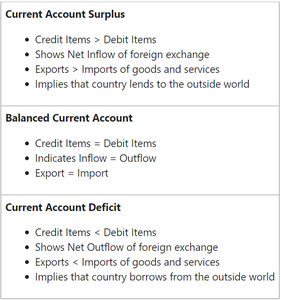
1. Balance of Trade = Exports of Goods – Imports of Goods
2. Balance on Current Account
3. Balance on Capital Account