|
VOOZH | about |
|
VOOZH | about |
National Income is the aggregate value of all goods and services produced by firms in a given financial year. It can be stated that when the aggregate revenue generated by the firms is paid out to factors of production, it equals aggregate income or National Income. There are different variants or aggregates of National Income and each of the aggregates has a specific meaning, use, and method of measurement.
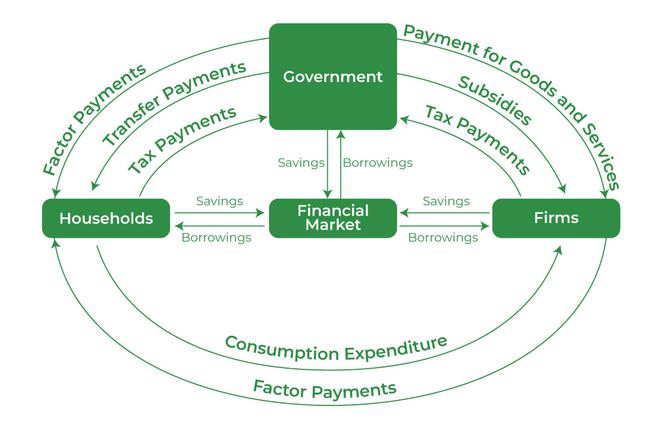
Before understanding the different aggregates of national income, it is important to know how income is generated and circulated in an economy. The circular flow of income represents the continuous movement of goods, services, and money between the two main sectors of an economy—households and firms. In this simple two-sector model, households provide factors of production such as land, labor, capital, and entrepreneurship to firms. In return, firms make factor payments in the form of rent, wages, interest, and profit.
👁 ImageThe income received by households is then spent on the goods and services produced by firms. This creates a continuous loop of production, income, and expenditure within the economy. The real flow of goods and services moves from firms to households, while the money flow moves from households to firms. This circular movement ensures that the total value of production, income, and expenditure remains equal, forming the foundation for measuring national income.
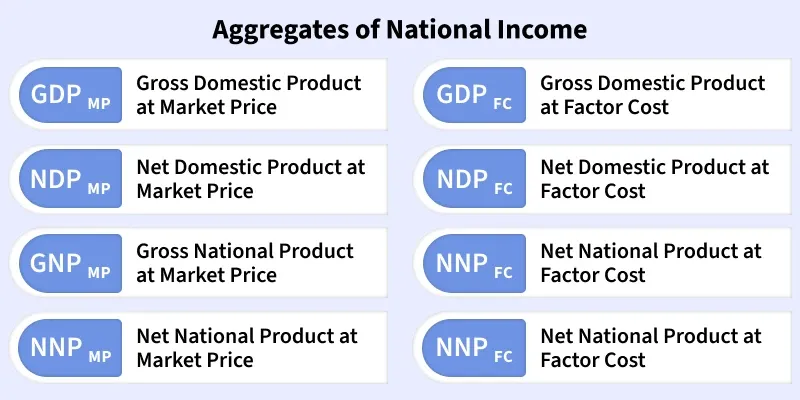
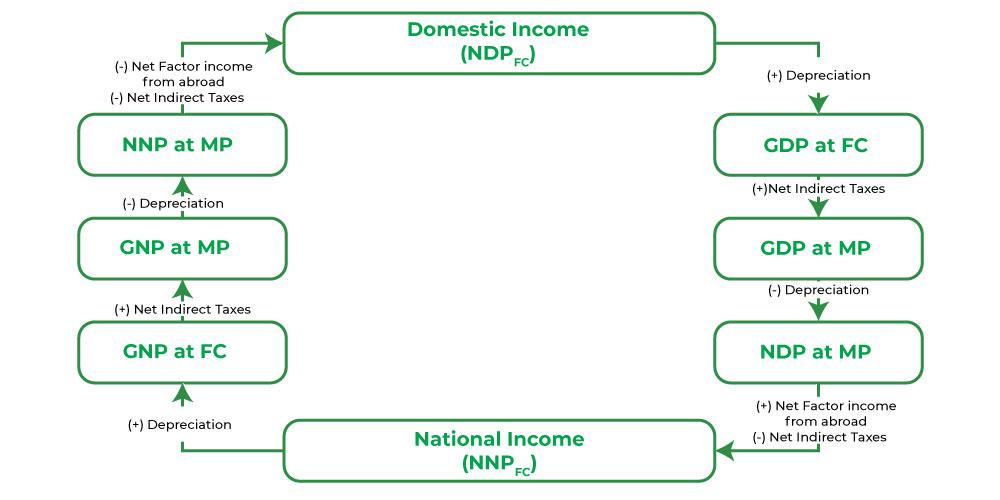
A number of goods and services are produced in a year by different production units within an economy. It is not possible to add those goods and services in terms of their quantity; therefore, these are added in terms of money. There are eight aggregates in National Income for measuring the value of goods and services in terms of money. These are as follows:
GDPMP refers to the gross market value of all the final goods and services produced during a year within the domestic territory of a country.
Gross in GDPMP means that the total value of final goods and services includes depreciation, i.e., no provision has been made for it.
Domestic in GDPMP means that the final goods and services produced are located within the domestic boundaries of the country.
Product in GDPMP indicates that only final goods and services are included.
Market Price in GDPMP means that the amount of indirect taxes paid is included in GDP; however, the subsidies are excluded from it.
The rest of the aggregates are determined by making some adjustments in GDPMP.
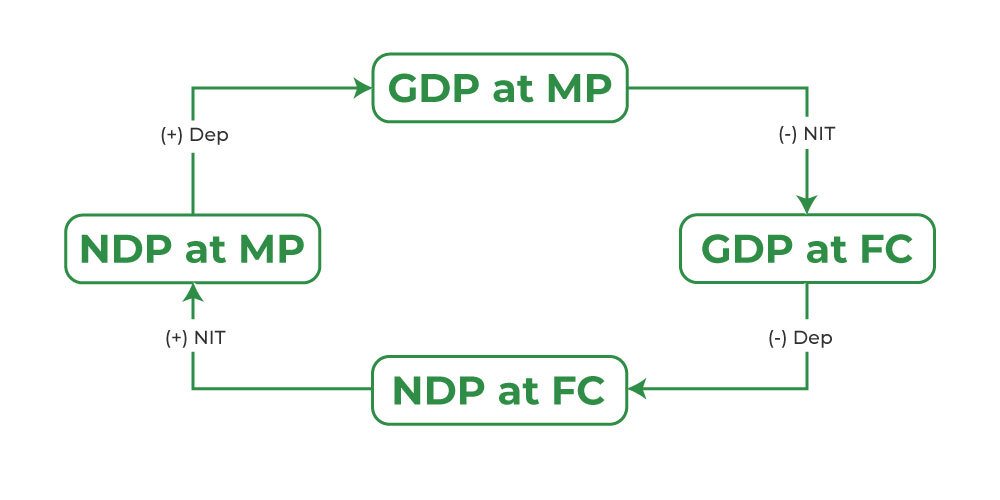
GDPFC refers to the gross money value of all the final goods and services produced during a year within the domestic territory of a country. It can be determined as:
GDPFC = GDPMP - Net Indirect Taxes
NDPMP refers to the net market value of all the final goods and services produced during a year within the domestic territory of a country. It can be determined as:
NDPMP = GDPMP - Depreciation
NDPFC refers to the net money value of all the final goods and services produced during a year within the domestic territory of a country. It can be determined as:
NDPFC = GDPMP - Net Indirect Taxes - Depreciation
NDPFC is also known as Domestic Factor Income or Domestic Income.
👁 ImageDomestic in each of these aggregates states that the contribution of only those producers whether they are resident or non-resident will be included who are producing within the domestic territory of the country.
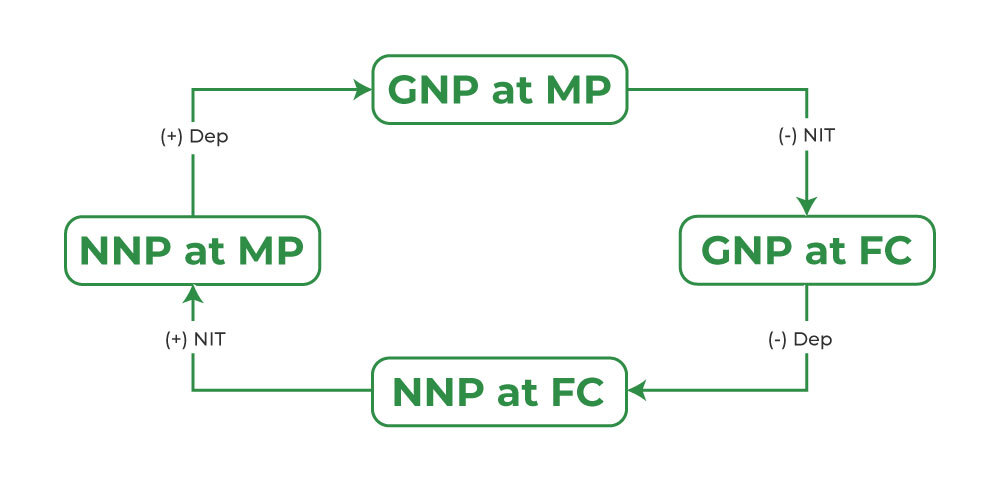
GNPMP refers to the gross market value of all the final goods and services produced during a year by the normal residents of a country. It can be determined as:
GNPMP = GDPMP + Net Factor Income from Abroad
GNPMP of a country can be less than its GDPMP if NFIA is negative. However, it can be more than GDPMP if NFIA is positive.
GNPFC refers to the gross money value of all the final goods and services produced during a year by the normal residents of a country. It can be determined as:
GNPFC = GNPMP - Net Indirect Taxes
NNPMP refers to the net market value of all the final goods and services produced during a year by the normal residents of a country. It can be determined as:
NNPMP = GNPMP - Depreciation
NNPFC refers to the net money value of all the final goods and services produced during a year by the normal residents of a country. It can be determined as:
NNPFC = GNPMP - Net Indirect Taxes - Depreciation
NNPFC is also known as National Income.
👁 ImageNational in each of these aggregates states that the contribution of only those producers who are normal residents of a country will be included. It does not matter if the production is being held outside the domestic territory of the country.
Basis | Domestic Income | National Income |
|---|---|---|
| Meaning | It refers to the net money value of all the final goods and services produced during a year within the domestic territory of a country. | It refers to the net money value of all the final goods and services produced during a year by the normal residents of a country. |
| Nature of Concept | Domestic Income is a territorial concept. It includes the value of all the final goods and services produced within the domestic territory of a country. | National Income is a national concept. It includes the value of all the final goods and services produced in the whole world. |
| Category of Producers | All producers within the domestic territory of the country are included in Domestic Income. | All producers who are normal residents of the country are included in National Income. |
| NFIA | Domestic Income does not include NFIA. | National Income includes NFIA. |
Basis | Gross Domestic Product at Market Price (GDPMP) | National Income (NNPFC) |
|---|---|---|
| Meaning | It refers to the gross market value of all the final goods and services produced during a year within the domestic territory of a country. | It refers to the net money value of all the final goods and services produced during a year by the normal residents of a country. |
| Nature of Concept | GDPMP is a territorial concept. It includes the value of all the final goods and services produced within the domestic territory of a country. | National Income is a national concept. It includes the value of all the final goods and services produced in the whole world. |
| Category of Producers | All producers within the domestic territory of the country are included in GDPMP. | All producers who are normal residents of the country are included in National Income. |
| Net Indirect Taxes | GDPMP is at market price; therefore, net indirect taxes are included. | National Income is at factor cost; therefore, net indirect taxes are excluded. |
| Depreciation | Depreciation is included in GDPMP | Depreciation is not included in National Income. |
National Income can be measured by calculating the total value of goods and services produced, total income earned, or total expenditure made in an economy during a given year. Since production, income, and expenditure are interrelated, all three methods ideally give the same value of national income. However, in practice, due to data limitations, minor differences may occur. The three main methods of measuring national income are the Income Method, Expenditure Method, and Value Added Method (also called the Output Method).
The income method measures national income by adding up all the factor incomes earned by the factors of production within the domestic territory of a country. These include wages, rent, interest, and profit. Transfer payments, illegal earnings, and capital gains are excluded as they do not arise from productive activities.
Steps involved:
Formula:
NNPFC = Compensation of Employees + Rent + Interest + Profit + Mixed Income + NFIA
This method measures national income as the sum of all final expenditures made in the economy during a given period. It includes expenditure on consumer goods and services, investment goods, and government purchases. Only final expenditure is included, not intermediate expenditure, to avoid double counting.
Components:
Formula:
GDPMP = C + I + G + (X – M)
To find NNPFC, adjustments are made:
NNPFC = GDPMP – Depreciation – Net Indirect Taxes + NFIA
The value added method estimates national income by summing up the value added by all producing units in the economy. Value added is the difference between a firm’s value of output and the value of its intermediate consumption.
Steps involved:
Precautions:
Step 1: Prepare an equation by placing the aggregate to be determined on the left side of the equal-to sign and the aggregate given on the right side.
For example, NDPMP = GNPFC ± Adjustments.
Step 2: Identify the Adjustments required and then calculate the answer.
In the above example, as we have to determine NDPMP from GNPFC, there are three adjustments required.
Hence, the final equation to determine NDPMP will become NDPMP = GNPFC - Depreciation - NFIA + NIT.
Example 1: Calculate National Income or NNP at FC.
Particulars | ₹ in crores |
|---|---|
| GNP at MP | 7,000 |
| Subsidies | 400 |
| Net Factor Income from Abroad | 300 |
| Depreciation | 100 |
| Indirect Tax | 500 |
NNP at FC = GNP at MP - Depreciation - NIT (Indirect Taxes - Subsidies)
= 7,000 - 100 - (500-400)
= ₹6,800 crores
Note: We will not adjust NFIA as there is national value in both NNP at FC and GNP at MP.
Example 2: Calculate NNP at FC.
Particulars | ₹ in crores |
|---|---|
| GDP at MP | 6,500 |
| Goods and Services Tax (GST) | 500 |
| Factor Income from Abroad | 260 |
| Factor Income to Abroad | 400 |
| Subsidies | 110 |
| Consumption of Fixed Capital | 150 |
NNP at FC = GDP at MP - Consumption of Fixed Capital + NFIA (Factor Income from Abroad - Factor Income to Abroad) - NIT (Goods and Services Tax - Subsidies)
= 6,500 - 150 + (260 - 400) - (500 - 110)
= ₹5,820 crores
Example 3: Calculate Factor Income from Abroad.
Particulars | ₹ in crores |
|---|---|
| GNP at MP | 7,000 |
| Indirect Taxes | 500 |
| Replacement of Fixed Capital | 150 |
| Factor Income to Abroad | 270 |
| Subsidies | 50 |
| NDP at FC | 4,600 |
GNP at MP = NDP at FC + Replacement of Fixed Capital + NFIA (Factor Income from Abroad - Factor Income to Abroad) + NIT (Indirect Taxes - Subsidies)
Therefore,
Factor Income from Abroad = GNP at MP - NDP at FC - Replacement of Fixed Capital + Factor Income to Abroad - NIT (Indirect Taxes - Subsidies)
= 7,000 - 4,600 -150 + 270 - (500 - 50)
= ₹2,070 crores
Note: Replacement of Fixed Capital is another name for Depreciation.
Example 4: Calculate
i) Indirect Tax
ii) Depreciation
iii) Domestic Income or NDP at FC
Particulars | ₹ in crores |
|---|---|
| GNP at FC | 80,000 |
| Subsidies | 15,000 |
| GNP at MP | 1,00,000 |
| National Income or NNP at FC | 75,000 |
| GDP at MP | 1,10,000 |
i) GNP at FC = GNP at MP - NIT (Indirect Tax - Subsidies)
Indirect Tax = GNP at MP + Subsidies - GNP at FC
= 1,00,000 + 15,000 - 80,000
= ₹35,000 crores
ii) NNP at FC = GNP at FC - Depreciation
Depreciation = GNP at FC - NNP at FC
= 80,000 - 75,000
= ₹5,000 crores
iii) Domestic Income or NDP at FC = GDP at MP - Depreciation - NIT (Indirect Tax - Subsidies)
= 1,10,000 - 5,000 - (35,000 - 15,000)
= ₹85,000 crores
Example 5: The Net Domestic Product at Factor Cost of an economy is ₹5,000 crores. Its capital stock is worth ₹3,000 crores and it depreciates @20% per annum. The Subsidies, Indirect Taxes, Factor Income to the rest of the world, and Factor Income from the rest of the world are ₹70 crores, ₹150 crores, ₹400 crores, and ₹400 crores respectively. Find out the Gross National Product at Market Price.
Gross National Product at Market Price = Net Domestic Product at FC + Depreciation + Net Indirect Taxes (Indirect Taxes - Subsidies) + Net Factor Income from Abroad (Factor Income from the rest of the world - Factor Income to the rest of the world)
= 5,000 + 20% of 3,000 + (150 - 70) + (400 - 400)
= 5,000 + 600 + 80 + 0
= ₹5,680 crores
While measuring national income, economists must take several precautions to ensure accuracy and consistency. National income should include only the value of goods and services produced during the current year through productive economic activities. Any income or expenditure that does not arise from production, or that has already been counted earlier, must be excluded. These precautions differ for each method of measurement but share the goal of avoiding double counting and ensuring that only real, domestic, and current production is captured.
The income method calculates national income by summing up all factor incomes earned within the domestic territory. Hence, only genuine factor earnings from productive activities should be included.
The expenditure method adds up all final expenditures on goods and services. Therefore, only spending that directly leads to final consumption or investment should be counted.
The value added method measures income by summing the value added by each production unit. Careful distinction between intermediate and final goods is crucial here.
Net Indirect Taxes = Market Price - Factor Cost
Depreciation = Gross Value - Net Value
Net Factor Income from Abroad = National Value - Domestic Value
GDPFC = GDPMP - Net Indirect Taxes
NDPMP = GDPMP - Depreciation
Domestic Income orNDPFC = GDPMP - Depreciation - Net Indirect Taxes
GNPMP = GDPMP + Net Factor Income from Abroad
GNPFC = GNPMP - Net Indirect taxes
NNPMP = GNPMP - Depreciation
National Income or NNPFC = GNPMP - Depreciation - Net Indirect Taxes