|
VOOZH | about |
|
VOOZH | about |
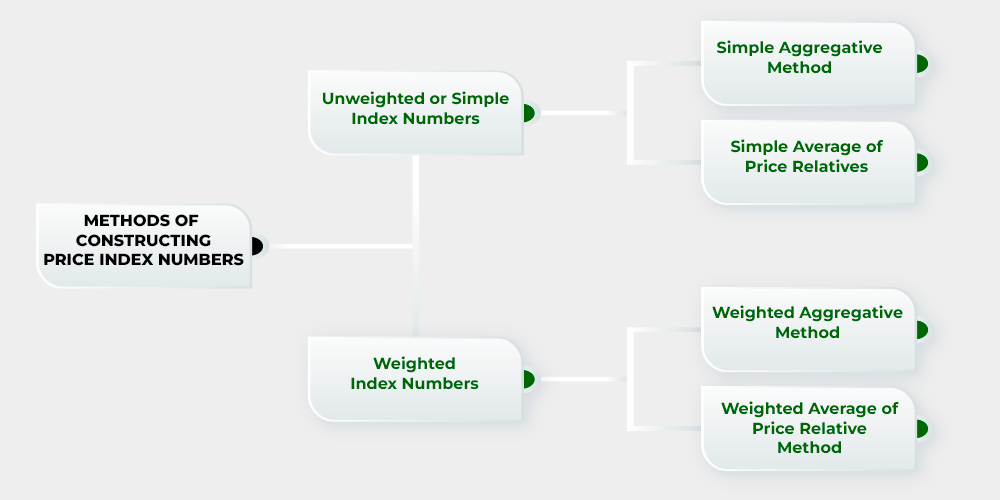
A statistical measure that helps in finding out the percentage change in the values of different variables, such as the price of different goods, production of different goods, etc., over time is known as the Index Number. The percentage change is determined by taking a base year as a reference. This base year is the year of comparison. When an investigator studies different goods simultaneously, then the percentage change is considered the average for all the goods. There are two broad categories of Index Numbers: viz., Simple or Unweighted and Weighted Index Numbers.
👁 ImageAn Index Number in which each item must have some weight as no weight is expressly assigned to any item is known as Unweighted Index Number. It is also known as Simple Index Number and can be constructed with the help of two techniques; viz., Simple Aggregative Method and Simple Average of Price Relatives Method.
A method in which the aggregate prices of all the selected commodities in the current year are expressed as the aggregate price of all the commodities in the base year is known as Simple Aggregative Method. It is the simplest method to construct index number. The steps required to construct index number through this method are as follows:
Where,
P01 = Index Number of the Current Year
∑p1 = Total of the current year's price of all commodities
∑p0 = Total of the base year's price of all commodities
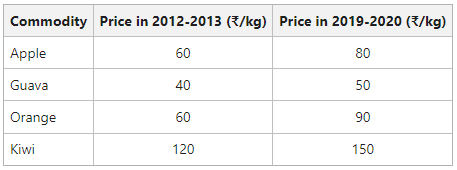
From the following data, construct Index Numbers for 2019-2020, taking 2012-2013 as the base year by using Simple Aggregate Method.
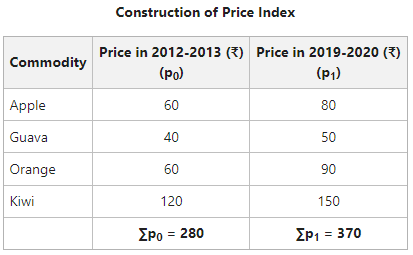
Price Index for year 2019-2020 with year 2012-2013 as the base:
The value of Price Index (132.14) reveals that in the year 2019-2020, there is a net increase of 32.14% in the prices of given commodities as compared to the year 2012-2013.
1. Influenced by the magnitude of the prices: If the price of a commodity is higher, it will have a great influence on the index number. It means that the commodities with higher prices receive greater weightage than the commodities with lower prices. For example, in the above example price of Kiwi is higher than the price of Orange, Guava, and Apple; hence, Kiwi will influence the index number more than other fruits.
2. Equal Weights are assigned to every item: While constructing index, equal weights are assigned to every item and the relative importance of different commodities is not taken into account. For example, In this index, equal importance is given to eraser and milk.
3. Prices of various commodities may be quoted in different units: Another disadvantage of this method is that the price of various commodities may be shown in different units, such as rupees per kg, rupees per litre, rupees per quintal, etc. Therefore, with this method, the index is influenced by the quoted units of the commodities, which means that some commodities may get more importance as they are quoted in a specific unit.
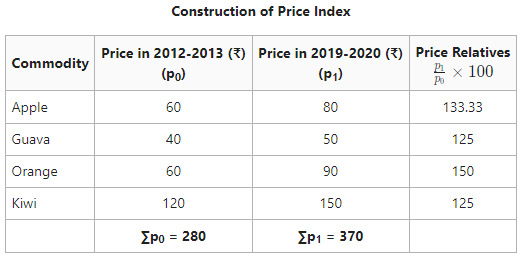
This index number is an improvement over the previous method, as it is not affected by the unit in which the prices of the commodities are quoted. The steps required to construct index number through this method are as follows:
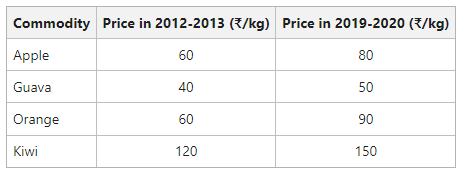
From the following data, construct an index for 2019-2020, taking 2012-2013 as the base by using Simple Average of Price Relatives Method.
The Price Index Number (133.33) shows that there is an increase of 33.33% in the prices of commodities in the year 2019-2020 as compared in the year 2012-2013.