System Design of Airbnb | Hotel Reservation System
Last Updated : 5 Dec, 2025
The system design of a platform like Airbnb or a hotel reservation system involves creating an efficient, scalable and highly available architecture to handle millions of users, listings and bookings in real-time. These platforms not only provide users with the ability to search and book accommodations but also manage a various of interconnected components, including dynamic pricing of hotels, user authentication, payment processing, and communication between hosts and guests etc.
Here, we will understand how to build such type a scalable, highly available architecture with low latency along with concisely implemented security considerations.
What is a Hotel Reservation System?
A hotel reservation system is a software that helps hotel operators manage and optimize the booking flow. It manages the occupancy of rooms, tracks bookings and cancellations, manages payment, and allows guests to check-in and check-out. By helping automate these pieces of the bust flow, hotels increase their occupancy, increase the experience for their guests, and correctly record each accommodation modality.
System Stakeholders and Their Roles
Hotel Owners/Management (Monitor operations, pricing, and occupancy)
Customers/Guests (Browse, book, and manage reservations)
Hotel Staff (Check-in, manage room status, assist guests)
Third-Party Partners (Provide integrations like payments, marketing)
Key Features of Airbnb-like System
An Airbnb-like system allows users to create profiles, list properties, and search for accommodations. It streamlines booking and payments, enables reviews for transparency, and also it includes a messaging system for direct communication between hosts and guests.
Requirements Gathering for the System
The system's requirements are divided into both functional and non-functional aspects to understand the goals clearly. Functional requirements define key features such as user authentication, property listings, and payment processing, while non-functional requirements ensure the system is fast, scalable, and secure, delivering a smooth and reliable experience for all users.
Functional Requirements
User Authentication and Profile Management
Property Listings and Search
Booking and Reservation System
Payment Processing
Reviews and Ratings
Messaging and Communication
Non-Functional Requirements
High Availability & Reliability
Low Latency for Search
Scalability for Peak Loads
Data Consistency & Security
Fault Tolerance
Global Accessibility and Localization
System Capacity Estimation
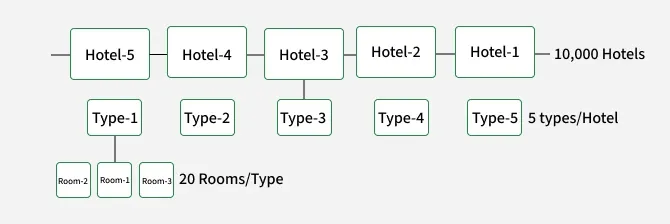
A well-planned capacity model ensures that the system remains responsive under heavy usage and avoids storage-related issues. To estimate the system capacity, we need to make certain assumptions and consider key factors such as the total number of hotels, rooms, bookings, media storage, and user data. This will allow us to accurately calculate the storage and cache requirements needed.
User Sessions: 1M active sessions × 10 KB = 10 GB RAM.
Hotel Metadata: Cache top 20% hotels (~200 GB).
Overall Capacity Estimation Summary
Bookings/year - 3.65 million
Storage (Bookings + Media) - 7–8 TB
Daily Active Users (DAU) - 1 million
Cache RAM - 200+ GB (Redis)
High Level Design
When designing an Airbnb-like system high level design (HLD), the first step is to outline the key components—things like the search engine, booking service, payment gateway, and user interface—and figure out how they all work together.
Before jumping into the design, it's important to understand both functional and non-functional requirements, such as scalability, availability, and response time, to make sure the system can handle real-world demands. A solid approach is to identify crucial use cases and map out data flow early on, which helps define service boundaries and ensures a modular, well-structured system.
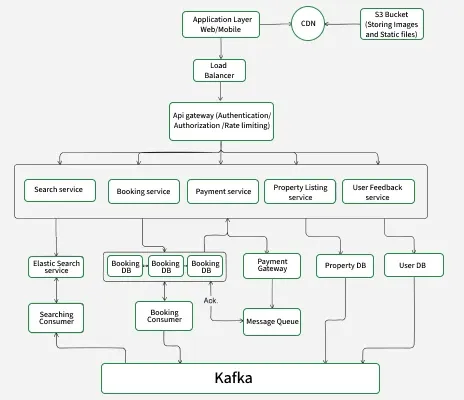
👁 hld High level diagram of Hotel reservation system
Overview of Major Components
S3 Bucket - In simple words it is amazon simple storage service (S3) which is used to store and organize various types of data, including files, images, videos, documents, backups, and more.
CDN - It is geographical distributed networks of servers that stores copies of website content (like images, videos, scripts, and CSS) in data centers around the world. This helps improve website performance and user experience by delivering content faster and more efficiently. For more details refer this.
Load Balancer - It is software application (Sometimes hardware machines) which distributes the traffic among the scaled servers so that the peak traffic can manages efficiently by system.
Services/Microservices - Microservices are the software architectural process in which we a complex big services is broken down into small services which are well tested and deployed to work properly.
Elastic Search cluster - It is a group of the elastic search nodes that work together to store, indexing, and searching the large volume of data in real time and at low latency.
Kafka - It is an open-source messaging system built to handle large amounts of data in real time, making it perfect for creating systems that respond to events as they happen.
Interaction Between Components and Services
User Access : Firstly, users interact with interface via web browsers or mobile apps and try to access the static assets (images, CSS, JavaScript).
Content Delivery (CDN + S3 Bucket) : CDN caches static files (property images, videos and UI assets) and store it in S3 Bucket, ensuring low latency.
Traffic Routing (Load Balancer) : Incoming requests are distributed across servers by the Load Balancer to prevent overload and ensure high availability.
Routes requests to appropriate microservices (ex. "/search" -> Search services).
Core Microservices Processing :
Property Listing Service: It manages all the property details, host info, and availability of rooms.
Booking Service: It handles all the processes which are related to reservations, cancellation, checks availability, and updates the Booking DB.
Payment Service: This will connect to Payment Gateway (Stripe/PayPal/Razorpay) to handle transactions.
User Feedback Service: With the help of this you can give reviews/ratings to rooms/hotels which stores in a dedicated DB
Search Service: We are using Elasticsearch for fast property searches (filters, location-based queries).
Database Layer :
Property DB: Contains property details, pricing, and host info.
Booking DB: Tracks reservations, dates, and guest/host data.
User DB: Stores user profiles, credentials, and preferences.
Event-Driven Workflow (Kafka + Consumers) :
Kafkais an open-source distributed event streaming platform used to build real-time data synchronization in streaming applications. It enables high-throughput, low-latency transmission of data between systems through a pub-sub model.
Consumers (e.g., Booking Consumer, Search Consumer) process events (e.g., update search indexes after new listings).
For ex - When a new listing is added, the producer will push it into Kafka topics, and the consumer (Search) will fetch the details and update the Elasticsearch cluster so that users can also search for the new listings.
Search Optimization (Elasticsearch) : Elasticsearch indexes property data for near-instant search results (e.g., 'beachfront homes in Bali') and is continuously updated via Kafka events, such as new listings or price changes
Payment Processing : Payment Service validates transactions, processes refunds, and communicates with external Payment Gateways (Stripe, PayPal).
Scalability & Fault Tolerance :
Database Replication: Booking/Property DBs are replicated for redundancy.
Kafka: Ensures decoupled, reliable event processing (e.g., even if a service fails, events are retried).
Load Balancer + Auto-Scaling: Handles traffic spikes to prevent down-time.
Low-Level Design
The Low-Level Design (LLD) takes the big-picture High-Level Design (HLD) and breaks it down into detailed, step-by-step instructions for developers to easily build the system. It defines classes, methods, and data structures, showing how everything interacts to turn architectural plans into actual working code. Basically, it’s the blueprint that makes sure Airbnb’s system components are structured properly and function smoothly together.
Object-Oriented Design: Key Classes
Object-oriented design helps break down complex systems into manageable, reusable components. By defining key classes with clear responsibilities, we create a structured framework that makes the system scalable, maintainable, and easy to extend. Let’s explore how these classes bring order to the Airbnb management system!
Search Class
This search class allows users to find vacation rentals by storing information such as destination, travel dates, guest count, price range, and available amenities. It includes methods for setting price ranges, adding amenities, and showing search results, making it simple to manage and filter listings according to user preferences.
Booking Service
This booking class helps manage bookings by storing details like booking ID, user ID, property info, check-in/check-out dates, price, and status. It lets users view booking details, cancel bookings, mark them as completed, and check if a booking is still active.
Payment Class
This Python class handles payment details, tracking the payment ID, booking ID, amount, method, and status. It allows processing payments by updating the status and displaying payment information, making it easy to track transactions.
Property class
This Property Service class handles hotel and room management, ensuring only admins can add hotels, update hotel details, manage room types, or mark rooms as under maintenance. It interacts with a database connector to store and update information efficiently.
User Feedback
This Python class helps manage user reviews by storing ratings and comments for properties. It ensures ratings stay between 1 and 5 stars, lets users add and view reviews, and calculates the average rating for a property.
Sequence Diagram
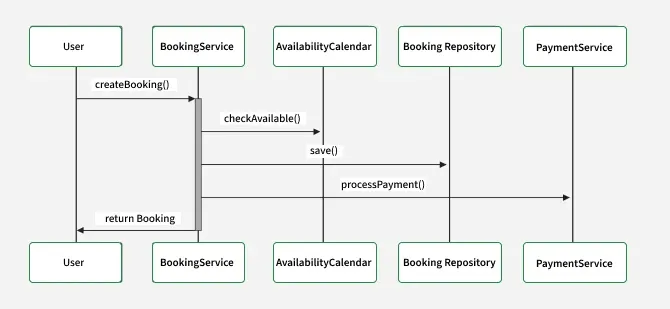
A sequence diagram provides a visual representation of how system components interact within a specific process, illustrating the sequence of messages exchanged between objects over time.
An API Gateway acts as the central point for all service interactions, handling requests and directing them to the appropriate backend service. Whether it’s searching for flights, booking reservations, or processing payments, this structured approach ensures efficiency, security, and seamless communication across different services.
Search Service
GET /search?location=Paris&check_in=2024-01-15&guests=2
GET /search/filters?amenities=wifi,pool (Like min-max)
Booking Service
POST /bookings (Create booking)
GET /bookings/{id} (Retrieve booking)
DELETE /bookings/{id} (Cancel booking)
Payment Service
POST /payments (Process payment)
GET /payments/{id}/status (Check status)
Property Listing Service
GET /admin/hotels (List all hotels with filters)
PUT /admin/hotels/{id} (Update hotel details: name, status)
DELETE /admin/hotels/{id} (Remove hotel)
POST /admin/hotels (Add new hotel with address, star rating)
User Feedback Service
POST /properties/{id}/reviews (Add review)
GET /properties/{id}/reviews (List reviews)
GET /properties/{id}/rating (Average rating)
Database Design
A well-designed database is essential for keeping an Airbnb management system efficient and scalable. It organizes critical data—flights, bookings, payments, and users—ensuring smooth transactions and quick retrieval. In this section you will understand which type of database is required and how we can implement it in a well-descriptive manner.
Which is better, SQL or NoSQL?
In an Airbnb-like system, picking the right database is essential for efficiency. SQL databases are great for structured data like user profiles, booking details, and payment transactions which confirms the strong consistency and complex queries. Meanwhile, NoSQL databases handle unstructured data like reviews, photos, and chat messages which offers scalability and flexibility for high-traffic environments.
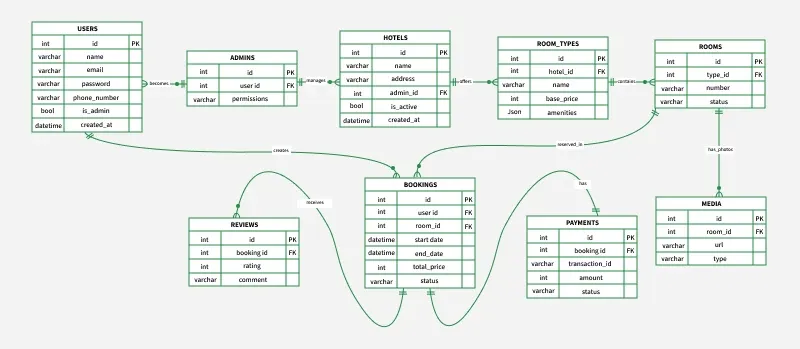
So in this section we will dive into the relational database schema for a hotel reservation system, explaining how different tables interact to maintain smooth operations and data management.
USERS: Stores user information (id, name, email, password, phone_number, is_admin, created_at). The is_admin field links to the ADMINS table via a "becomes" relationship, indicating users who are admins.
ADMINS: Contains admin-specific data (id, user_id, permissions). It references USERS via user_id (FK), and admins can manage HOTELS through the "manages" relationship.
HOTELS: Holds hotel details (id, name, address, admin_id, is_active, created_at). It is managed by ADMINS (admin_id as FK) and contains ROOM_TYPES via the "offers" relationship.
ROOM_TYPES: Stores room type information (id, hotel_id, name, base_price, amenities in JSON). It references HOTELS via hotel_id (FK) and contains ROOMS through the "contains" relationship.
ROOMS: Represents individual rooms (id, type_id, number, status). It references ROOM_TYPES via type_id (FK) and can have associated MEDIA via the "has_photos" relationship. ROOMS are booked in BOOKINGS via the "reserved_in" relationship.
BOOKINGS: Tracks booking details (id, user_id, room_id, start_date, end_date, total_price, status). It references USERS (user_id) and ROOMS (room_id) as FKs. BOOKINGS are linked to PAYMENTS ("has") and REVIEWS ("receives").
Handling Transactions & Consistency
Airbnb's idempotency approach ensures reliable transactions in its distributed payment system, preventing double payments and maintaining data consistency. It leverages unique transaction identifiers, idempotency keys, centralized logging, robust retry logic, and atomic database transactions to guarantee accuracy and integrity.
Caching & Performance Optimization
Optimizing performance is crucial for making a hotel reservation or Airbnb-like system fast and scalable. Using a CDN for static assets like images, CSS, and JavaScript helps reduce latency by serving content from servers closer to users, speeding up load times. On the other part Redis improves speed by caching frequently accessed data, reducing database strain. Additionally, rate limiting and throttling prevent abuse and ensure fair resource usage, maintaining stability during peak traffic and ensuring smooth performance overall.
Scalability & Fault Tolerance
We have taken into consideration the strategies that follow to help us get scalability, fault tolerance, and high availability in order to make sure that our hotel reservation system is capable of managing expansion while maintaining reliability :
Load Balancing (NGINX, HAProxy): We believe about using HAProxy and NGINX to split up incoming traffic among several servers. By effectively balancing the traffic, this would assist avoid server overloads and guarantee high availability, especially during periods of strong booking demand.
Microservices Auto-Scaling (Kubernetes): We can explore the potential of Kubernetes to automatically scale microservices based on demand. This would allow the system to handle traffic surges effectively by spinning up additional instances and optimizing resource usage across a distributed architecture.
Disaster Recovery & Backup Strategies: We aim to regularly perform backups and replicate important data across several locations to ensure stability. Automated failure would divert traffic to backup systems in the event of a loss, reducing downtime and ensuring a speedy recovery while maintaining data integrity.
Security Considerations
Data Encryption (TLS, AES) : For a safe connection between users and servers, we consider about encrypting data while it is in route using TLS. AES encryption would also be used to safeguard secret information and prevent unwanted access to sensitive data that is at rest, such as payment information.
Fraud Detection & Prevention : We can consider to use the machine learning models to identify fraudulent activity, including payment fraud and fake listings. To stop scams and assure a secure experience for both hosts and guests, behavioral analysis would be utilized in addition to verification processes (such as ID checks).
DDoS Protection & Rate Limiting : In order to filter out malicious traffic and preserve service availability, we want to deploy DDoS protection using tools such as Cloudflare. In order to prevent abuse and ensure system responsiveness in the case of an attack, rate limiting would also be utilized to limit excessive requests.
Real-World Challenges & Solutions
Building a reliable hotel reservation system isn’t just about handling everyday traffic—it has to performunder pressure. Whether it’s holiday booking surges, global accessibility, or preventing reservation conflicts, the system must be ready for anything. In this section, we’ll break down the solutions that help keep operations smooth, no matter how intense the demand gets:
Managing Seasonal Traffic Spikes Our technique uses Kubernetes orchestration to automatically scale resources during special events and holiday rushes. When paired with worldwide CDN distribution, this offers consistent availability and quick content delivery during spikes in demand.
Global Data Accessibility We employ multi-region database replication together with carefully positioned CDN nodes, and we have users all over the world. This design uses final consistency models and Redis-powered regional caching to provide low-latency access while preserving data integrity.
Preventing Reservation Conflicts To avoid double bookings from simultaneous requests, we employ the techniques written in above "Handling Transactions & Consistency" section above.