|
VOOZH | about |
|
VOOZH | about |
TrueFoundry recognized in Gartner Hype Cycle for Platform Engineering 2026. Read the full report →
Join our VAR & VAD ecosystem — deliver enterprise AI governance across LLMs, MCPs & Agents. Become a Partner →
Get instant access to a live TrueFoundry environment. Deploy models, route LLM traffic, and explore the full platform — your sandbox is ready in seconds, no credit card required.
Blazingly fast way to build, track and deploy your models!
The Model Context Protocol (MCP) has emerged as a game-changing standard for connecting AI applications to external data sources and tools. As organizations seek to build more sophisticated agentic AI systems, the choice of MCP gateway becomes critical for ensuring security, scalability, and operational efficiency.
While AWS has introduced its own MCP gateway solution as part of its Bedrock ecosystem, many enterprises are discovering that alternatives like TrueFoundry offer superior features, flexibility, and enterprise-grade capabilities.
In this comprehensive guide, we'll explore the AWS MCP Gateway landscape and examine five leading alternatives that are transforming how organizations deploy and manage their AI infrastructure. Whether you're dealing with multi-cloud requirements, seeking better cost control, or need enhanced observability features, understanding these alternatives will help you make an informed decision for your enterprise AI strategy.
The AWS Model Context Protocol Gateway represents Amazon's approach to standardizing how AI applications interact with external data sources and tools within the AWS ecosystem. Built on top of the open-source MCP specification developed by Anthropic, AWS MCP Gateway serves as a bridge between Amazon Bedrock language models and various AWS services, enabling seamless integration of enterprise data with AI applications.
Key features of AWS MCP Gateway include native integration with Amazon Bedrock's Converse API, support for tool use capabilities that allow models to request information from external systems, and seamless connectivity to AWS services such as Amazon S3, DynamoDB, RDS databases, CloudWatch logs, and Bedrock Knowledge Bases. The platform leverages AWS's existing security mechanisms, including IAM for consistent access control, making it an attractive option for organizations already heavily invested in the AWS ecosystem.
Also Read: What is MCP Gateway
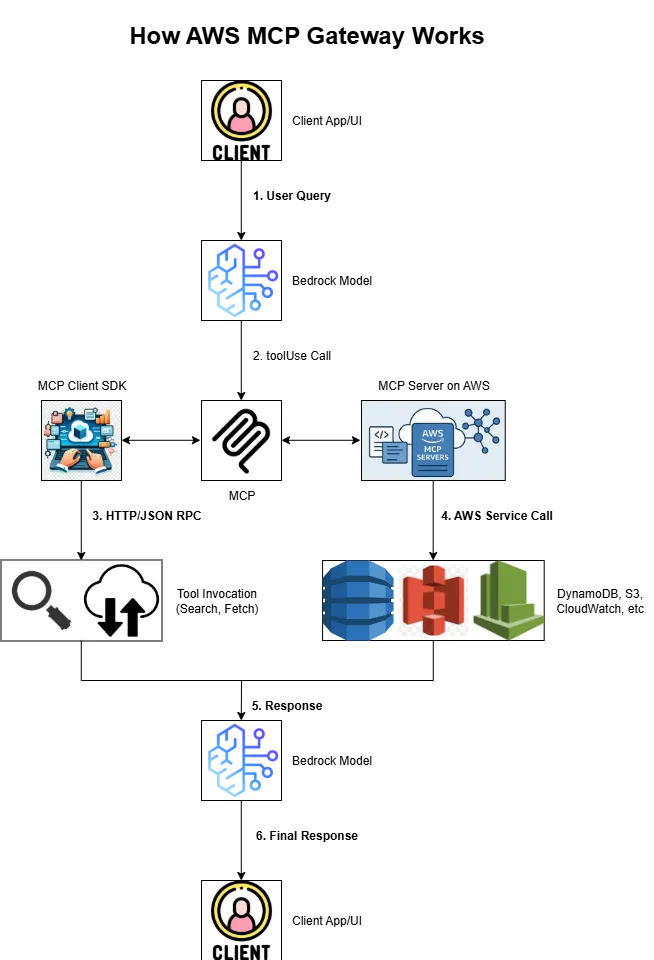
AWS MCP Gateway implements a client-server architecture that follows the standardized Model Context Protocol to enable secure, two-way communication between AI applications and AWS services. The system consists of three primary components: MCP clients embedded in AI applications like Amazon Bedrock, MCP servers that provide standardized access to specific AWS data sources, and the communication flow that follows well-defined protocol specifications.
The operational flow begins when an AI application hosted on Amazon Bedrock processes a user query and determines it needs additional information not available in its training data. The system then generates a toolUse message requesting access to specific tools, which the MCP client application receives and translates into an MCP protocol tool call. This request is routed to the appropriate MCP server connected to AWS services, where the server executes the tool and retrieves the requested data from systems like Amazon S3, DynamoDB, or CloudWatch.
The architecture supports three essential primitives that form the foundation of MCP interactions: Tools (functions that models can call to retrieve information or perform actions), Resources (data that can be included in the model's context such as database records or file contents), and Prompts (templates that guide how models interact with specific tools or resources). This design enables AWS customers to establish a standardized protocol for AI-data connections while reducing development overhead and maintenance costs through the elimination of custom integrations for each AWS service.
While AWS MCP Gateway offers solid integration within the AWS ecosystem, there are several compelling reasons organizations evaluate alternatives.
1. Avoiding Vendor Lock-In
AWS MCP Gateway tightly couples your AI infrastructure to Amazon services, making multi-cloud strategies or migrations challenging. Organizations seeking flexibility across providers may find this limiting.
2. Cost Considerations
AWS pricing can become complex and unpredictable, especially for high-volume AI workloads. Multi-dimensional pricing across gateway services, API requests, and premium features often results in unexpected charges. Alternatives often provide more transparent and predictable pricing models.
3. Flexibility and Customization
AWS MCP Gateway focuses primarily on AWS service integration, lacking comprehensive LLMOps capabilities, advanced routing strategies, and extensive provider support. Purpose-built AI gateway solutions enable custom routing, multi-LLM support, and enhanced workflow management.
4. Performance and Observability
Specialized AI gateways often deliver lower latency, better cost tracking, and richer monitoring compared to AWS’s service-specific dashboards. Developers benefit from unified interfaces, advanced tracing, and more intuitive management tools.
5. Enterprise Governance
For enterprises, governance is critical. Dedicated AI gateways provide guardrails, content filtering, PII protection, and role-based access control across multiple LLM providers — capabilities that AWS MCP Gateway handles only partially out-of-the-box.
Key Metrics for Evaluating Gateway
| Criteria | What should you evaluate ? | Priority | TrueFoundry |
|---|---|---|---|
| Latency | Adds <10ms p95 overhead for time-to-first-token? | Must Have | ✅ Supported |
| Data Residency | Keeps logs within your region (EU/US)? | Depends on use case | ✅ Supported |
| Latency-Based Routing | Automatically reroutes based on real-time latency/failures? | Must Have | ✅ Supported |
| Key Rotation & Revocation | Rotate or revoke keys without downtime? | Must Have | ✅ Supported |
| Key Rotation & Revocation | Rotate or revoke keys without downtime? | Must Have | ✅ Supported |
| Key Rotation & Revocation | Rotate or revoke keys without downtime? | Must Have | ✅ Supported |
| Key Rotation & Revocation | Rotate or revoke keys without downtime? | Must Have | ✅ Supported |
| Key Rotation & Revocation | Rotate or revoke keys without downtime? | Must Have | ✅ Supported |
TrueFoundry MCP Gateway stands as the premier enterprise-grade alternative to AWS MCP Gateway, offering a comprehensive solution that combines performance, security, and extensive functionality in a single platform. Built specifically for production AI workloads, TrueFoundry delivers sub-3ms internal latency while handling over 350 requests per second on just 1 vCPU, significantly outperforming both AWS and other alternatives in benchmark tests.
Key Features:
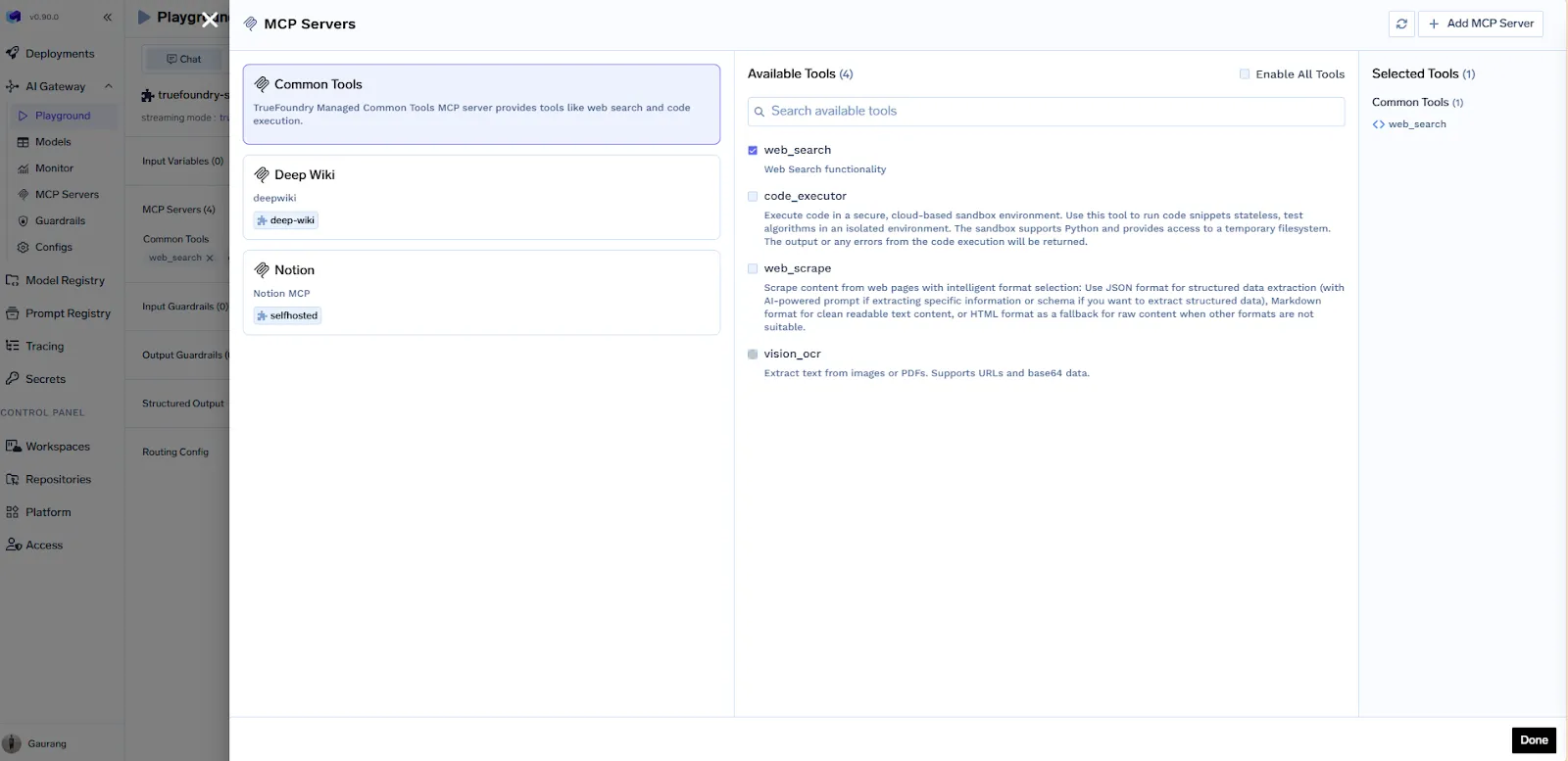
TrueFoundry's MCP Gateway capabilities enable organizations to securely manage integrated MCP servers while providing developers with seamless access to tools and data sources. The platform offers OAuth2 authentication for MCP servers, fine-grained authorization controls, and comprehensive monitoring of tool usage metrics. Unlike AWS MCP Gateway's ecosystem limitations, TrueFoundry supports any MCP server regardless of the underlying infrastructure.
Why Choose TrueFoundry:
For enterprises searching for the best MCP gateway needing enterprise-grade reliability without vendor lock-in find TrueFoundry ideal for managing multiple LLM providers with granular cost and access control. The platform particularly appeals to teams requiring comprehensive observability, predictable costs, and integration with existing enterprise infrastructure while maintaining the flexibility to deploy across any cloud or on-premises environment.
Composio represents an upcoming approach in the MCP ecosystem that focuses on standardized tool abstraction and developer-centric MCP Gateway workflows. Rather than acting as a traditional proxy or platform, it emphasizes discoverable, protocol-driven access to external services and tools via the Model Context Protocol.
Key Characteristics:
Composio fits into the broader MCP Gateway landscape by offering a gateway-aligned architectural pattern that prioritizes consistency and tool standardization. It complements more comprehensive enterprise-grade solutions by highlighting how MCP can be used as a core building block in modular AI stacks.
Kong AI Gateway extends the battle-tested Kong platform with AI-specific capabilities, making it an attractive option for organizations already using Kong for traditional API management. Built on Kong's mature infrastructure, it provides comprehensive API governance with specialized features for LLM traffic management.
Key Features:
Kong's AI Gateway offers sophisticated semantic processing capabilities, including semantic caching and routing powered by Redis for vector similarity search. The platform provides semantic prompt guard functionality and AI-specific rate limiting based on tokens rather than just requests.
Considerations: Kong's pricing complexity is well-documented, with costs often exceeding $30 per million requests and multi-dimensional pricing models that create cost unpredictability. The enterprise pricing requires sales consultation, making cost planning difficult for high-volume AI workloads.
LiteLLM serves as an open-source Python library focused on providing a unified interface across 100+ LLM providers with complete flexibility and community-driven development. It excels at advanced routing algorithms and comprehensive team management through highly customizable configurations.
Key Features:
LiteLLM provides robust team management capabilities with virtual keys, budget controls, tag-based routing, and team-level spend tracking. The platform supports comprehensive retry logic and fallback mechanisms for production reliability.
Considerations: Requires 15-30 minutes of technical setup with Python expertise and YAML configuration. All features require manual configuration, creating a steep learning curve and additional maintenance overhead compared to managed solutions.
Anthropic MCP Connector serves as a protocol-driven interface allowing Claude models to connect to external tools, databases, and services via the Model Context Protocol (MCP). It focuses on interoperability and tool integration for AI workflows.
Key Features:
Considerations: Currently limited to MCP-compliant tools; full enterprise gateway features (like multi-LLM fallback, routing, caching) are minimal. Requires technical setup and trust in remote servers; potential security concerns if using unverified MCP servers.
The landscape of Model Context Protocol gateways extends far beyond AWS's offering, with specialized solutions providing superior capabilities for enterprise AI deployments. While AWS MCP Gateway serves organizations deeply embedded in the AWS ecosystem, alternatives like TrueFoundry MCP Gateway deliver enhanced performance, flexibility, and comprehensive enterprise features without vendor lock-in constraints.
Enterprises often look for AWS MCP gateway alternatives to avoid vendor lock-in or to achieve better performance across multiple cloud providers. Other systems like TrueFoundry MCP gateway tend to offer lower latency, more granular observability, or the ability to run within a private VPC, which is critical for meeting strict data residency requirements.
Top alternatives include TrueFoundry, Docker’s container-native gateway, and open-source tools like Obot. TrueFoundry stands out as an enterprise-grade control plane that provides a unified registry for any model. It offers significantly more flexibility for hybrid environments and deeper telemetry than standard cloud provider services.
TrueFoundry is an ideal AWS MCP gateway alternative because it offers sub-3ms latency and a unified registry for any model. It enables teams to manage infrastructure securely while providing deep visibility into tool calls, ensuring agentic workflows remain fast, secure, and compliant with enterprise standards.
No, standard API gateways are not direct replacements for a dedicated MCP gateway as they lack native protocol support. While they handle traditional HTTP traffic, an MCP-specialized gateway provides the necessary tool abstraction, agent-specific security, and real-time observability essential for managing the complex interactions within production-grade agentic workflows.
Yes, specialized alternatives like TrueFoundry provide significantly deeper observability into the entire agent-tool interaction loop. You gain detailed traces of tool calls, precise latency tracking, and cost-per-token monitoring. This level of insight allows engineering teams to debug complex agentic behaviors more effectively than basic cloud-native logs.
TrueFoundry AI Gateway delivers ~3–4 ms latency, handles 350+ RPS on 1 vCPU, scales horizontally with ease, and is production-ready, while LiteLLM suffers from high latency, struggles beyond moderate RPS, lacks built-in scaling, and is best for light or prototype workloads.
Product
Company
Resources



.webp)







.webp)
.webp)
.webp)
.webp)
.webp)
.webp)

.webp)
.webp)