|
VOOZH | about |
|
VOOZH | about |
TrueFoundry recognized in Gartner Hype Cycle for Platform Engineering 2026. Read the full report →
Join our VAR & VAD ecosystem — deliver enterprise AI governance across LLMs, MCPs & Agents. Become a Partner →
Get instant access to a live TrueFoundry environment. Deploy models, route LLM traffic, and explore the full platform — your sandbox is ready in seconds, no credit card required.
Blazingly fast way to build, track and deploy your models!
The Model Context Protocol (MCP) is quickly becoming a foundational layer for connecting AI agents to tools, APIs, and enterprise systems. As adoption grows, MCP gateways have emerged as the critical control plane that governs, secures, and scales these interactions. Instead of letting agents connect directly to tools, organizations now rely on MCP gateways to enforce security, manage observability, and simplify operations across complex AI ecosystems.
This blog breaks down the 10 best MCP gateways in 2026, their core philosophies, key features, pros and cons, and where each one fits best in modern AI infrastructure.
An MCP gateway is the centralized control layer that manages how AI agents interact with MCP servers, tools, and external systems through the Model Context Protocol (MCP). Instead of allowing agents to connect directly to multiple tools and services, the gateway acts as a secure intermediary that handles authentication, access control, routing, observability, rate limiting, auditing, and policy enforcement.
As AI agents become more autonomous and gain access to enterprise systems, MCP gateways are becoming essential infrastructure. Without a gateway, organizations often face fragmented security policies, inconsistent permissions, poor visibility into agent behavior, and operational complexity across multiple MCP servers and environments.
MCP gateways solve these challenges by providing a unified management layer for all agent-to-tool interactions. They help organizations secure AI systems, monitor tool usage, enforce governance policies, and scale MCP deployments reliably across teams and production environments. In many ways, MCP gateways are becoming the equivalent of API gateways for the agentic AI ecosystem.
Here’s a quick comparison of the leading MCP gateway solutions in 2026 to help you understand how they differ in performance, scalability, security, and integration capabilities.
| Gateway | Response Time | Concurrency | Memory Usage | CPU Efficiency | Management / Monitoring |
|---|---|---|---|---|---|
| TrueFoundry | ~3ms | 350 RPS/Core | Minimal overhead | Excellent | Easy & extensive unified observability |
| Docker | 50–200ms | 50+ servers/node | ~50MB+ per server | Very good | Limited MCP-native observability |
| IBM Context Forge | 100–300ms | Config-dependent | Medium | Good | Highly flexible, limited built-in observability |
| Microsoft MCP Gateway | 80–150ms | Cloud-limited (Azure scaling) | Cloud-managed | Good | Complicated but extensive Azure monitoring |
| Lasso Security | 100–250ms | Plugin-dependent | High (security overhead) | Moderate | Security-first observability & threat detection |
| Lunar.dev MCPX | 4–20ms overhead | High (enterprise-grade) | Low–medium | Very good | Strong governance + audit-focused monitoring |
| MintMCP | 50–120ms | High (role-based scaling) | Medium | Good | Enterprise-grade audit trails & dashboards |
| UCL (Unified Context Layer) | 30–80ms | Very high (PaaS scaling) | Managed (abstracted) | Good | Fully managed, built-in observability |
| Zapier MCP | 200–500ms | High (rate-limited tasks) | Low | Moderate | Basic workflow-level monitoring |
| Workato MCP | 150–400ms | Very high (enterprise iPaaS scale) | Managed | Good | Strong enterprise audit + workflow monitoring |
TrueFoundry’s approach is simple: if organizations are already managing AI infrastructure for LLMs, there is little value in fragmenting operations across separate systems for MCP tools. Instead, TrueFoundry unifies LLM infrastructure and MCP management into a single control plane with shared security, observability, governance, and performance characteristics. This centralized approach simplifies AI operations while giving engineering teams a consolidated platform for monitoring, deployment, and cost management.
One of the platform’s standout advantages is its performance-focused architecture. TrueFoundry achieves sub-3ms latency under load by handling authentication and rate limiting in-memory instead of relying on database queries. For AI agents making hundreds of MCP tool calls per interaction, this reduction in latency compounds into significantly faster and more responsive systems.
The platform also emphasizes enterprise-grade operational simplicity. Teams can deploy containerized MCP servers, integrate them directly with the AI Gateway, and manage authentication, access control, custom configurations, guardrails, fallback mechanisms, load balancing, and rate limits from a unified interface. Interactive playgrounds further accelerate development by generating production-ready code snippets across multiple languages, helping teams move quickly from experimentation to deployment.
Most importantly, TrueFoundry delivers unified observability and billing. Organizations already tracking LLM performance and costs gain visibility into MCP tool usage and infrastructure metrics from the same dashboard, preventing operational blind spots and unexpected budget overruns.
TrueFoundry is best suited for organizations already operating significant AI workloads and looking to extend existing infrastructure rather than introduce fragmented tooling. Its unified architecture is particularly appealing to enterprises that prefer centralized AI infrastructure management from a single vendor.
The platform is also a strong fit for engineering teams seeking an easy-to-manage, feature-rich enterprise solution with integrated deployment, monitoring, finetuning, and orchestration capabilities. Teams adopting agentic workflows and MCP ecosystems can benefit from its operational simplicity, broad integrations, and cloud-native deployment offerings.
Docker entered the MCP ecosystem by extending its core expertise in containerization to AI tooling infrastructure. Its philosophy is straightforward: MCP servers should be treated like any other workload that requires isolation, security, reproducibility, and environment management. Instead of introducing a completely new operational model, Docker allows engineering teams to manage MCP deployments using familiar container-based workflows and orchestration patterns.
A major advantage of Docker’s approach is security through isolation. Each MCP server can run inside a sandboxed container with controlled CPU and memory allocation, restricted host filesystem access, and tightly scoped execution environments. This helps mitigate risks such as tool poisoning attacks, unauthorized system access, and runaway processes. Docker also supports cryptographically signed container images, ensuring stronger supply chain security and deployment trust.
Combined with Docker Compose orchestration and Docker Desktop integration, the platform lowers the barrier to secure experimentation and deployment. Developers can quickly spin up isolated MCP environments locally before promoting them into production infrastructure.
Pros
Cons
IBM’s MCP Gateway, through its Context Forge project, focuses on enabling highly flexible and distributed MCP deployments. Its core philosophy centers around federation, allowing multiple MCP gateways to work together across different environments, regions, or infrastructure stacks. Features such as auto-discovery, health monitoring, and capability merging make it one of the more architecturally ambitious offerings in the ecosystem.
The platform also emphasizes enterprise-level customization and integration. It supports multiple authentication methods including JWT Bearer tokens, Basic Auth, and custom header schemes, along with AES-encrypted credentials for secure tool access. Multi-database compatibility across PostgreSQL, MySQL, and SQLite allows organizations to integrate it into existing infrastructure without major architectural changes.
A key differentiator is virtual server composition, which lets multiple MCP servers appear as a single logical endpoint for agents. However, IBM explicitly labels Context Forge as an alpha/beta-stage project without official commercial support. While powerful, its operational complexity and infrastructure-heavy setup make it better suited for organizations with strong internal DevOps expertise rather than teams seeking simple or fully managed MCP solutions.
Pros
Cons
Microsoft’s MCP Gateway strategy is tightly integrated with the broader Azure ecosystem. Instead of offering a standalone MCP platform, Microsoft extends MCP capabilities across existing Azure services, allowing enterprises to build on their current cloud infrastructure rather than manage separate AI tooling systems.
A major advantage is the platform’s deep Azure-native integration. Azure AD (Entra ID) simplifies authentication and RBAC management, while Azure API Management enables policy enforcement and OAuth 2.0 flows with minimal additional setup. Kubernetes-native deployment through Azure Container Apps also provides scalable MCP hosting using familiar orchestration patterns.
The platform is designed primarily for large Azure-centric enterprises prioritizing operational robustness and infrastructure flexibility. However, its Azure-first architecture can introduce management complexity, vendor lock-in concerns, and integration challenges for organizations operating across multi-cloud or hybrid environments.
Pros
Cons
Lasso Security takes a security-first approach to MCP infrastructure, focusing on what it describes as the “invisible agent” problem- the lack of visibility and control over AI agent actions and tool interactions. Recognized as a 2024 Gartner Cool Vendor for AI Security, the platform is designed to help organizations secure AI agents and MCP workflows where traditional security tools often fall short.
Its plugin-based architecture enables modular security controls such as real-time security scanning, token masking, AI safety guardrails, and threat detection. This allows enterprises to incrementally add security capabilities instead of adopting a rigid all-in-one security stack. Lasso also emphasizes supply chain security through tool reputation analysis, which evaluates MCP servers based on behavior patterns, code analysis, and community feedback.
The platform is particularly focused on AI-native threats, including jailbreak attempts, unauthorized access behavior, and data exfiltration risks. This specialized security posture makes it especially relevant for regulated industries and organizations handling sensitive enterprise data that require detailed auditability and continuous monitoring of AI agent activity.
Pros
Cons
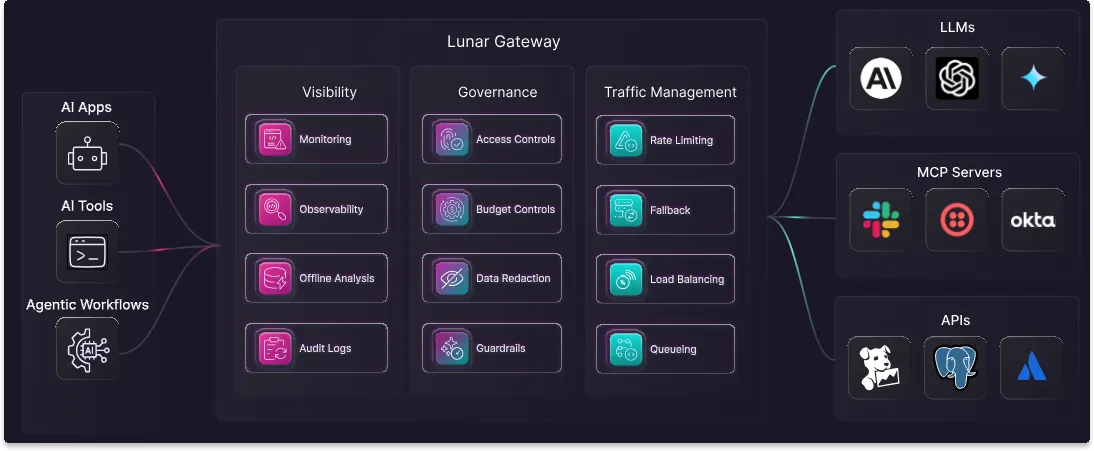
Lunar.dev MCPX is a lightweight, enterprise-focused MCP gateway designed to centralize and secure all agent-to-tool interactions through a unified control layer. Its primary focus is governance, auditability, and secure orchestration, making it particularly suitable for organizations that require strong oversight over how AI agents access internal tools and enterprise systems.
The platform emphasizes granular policy enforcement, allowing teams to define exactly which tools, methods, and permissions are available to specific agents or users. Combined with immutable audit trails and centralized secret management for API keys, OAuth tokens, and credentials, MCPX provides strong visibility and control across the MCP ecosystem.
Despite its governance-heavy design, Lunar.dev MCPX maintains strong performance characteristics, with reported p99 latency overheads around 4ms. This balance between security controls and runtime efficiency makes it attractive for enterprises that need robust governance without significantly impacting AI agent responsiveness.
Pros
Cons
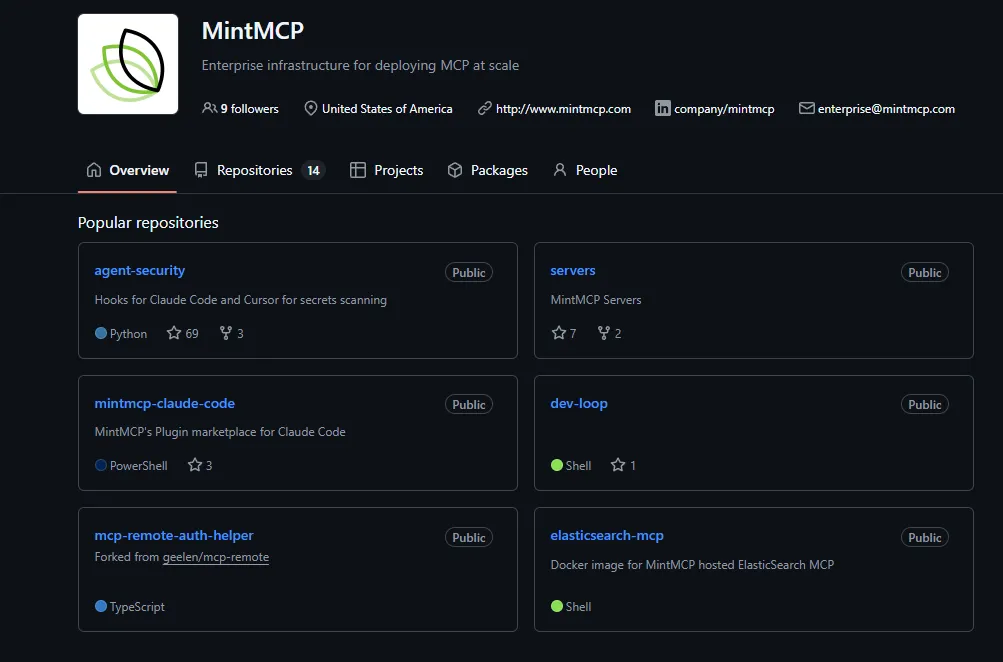
MintMCP positions itself as an enterprise-grade MCP gateway focused on governance, compliance, and secure AI agent infrastructure. As AI agents gain broader access to enterprise systems through MCP tools, MintMCP addresses the growing need for centralized control, auditability, and secure deployment workflows. The platform is SOC 2 Type II compliant and designed to transform local MCP servers into production-ready managed services.
A major differentiator is its role-based MCP architecture. Instead of exposing full server capabilities to every user or agent, MintMCP creates curated endpoints with only the minimum required tools and permissions. This granular access model helps organizations reduce unnecessary exposure while maintaining operational flexibility for teams and AI agents.
The platform also emphasizes rapid enterprise deployment through one-click hosting for STDIO-based MCP servers, integrated OAuth 2.0/SAML/SSO authentication, real-time monitoring dashboards, and detailed audit trails for compliance requirements such as SOC 2 and GDPR. Combined with pre-built enterprise connectors for systems like Snowflake, Elasticsearch, and Gmail, MintMCP focuses heavily on making governed MCP adoption easier for large organizations.
Pros
Cons
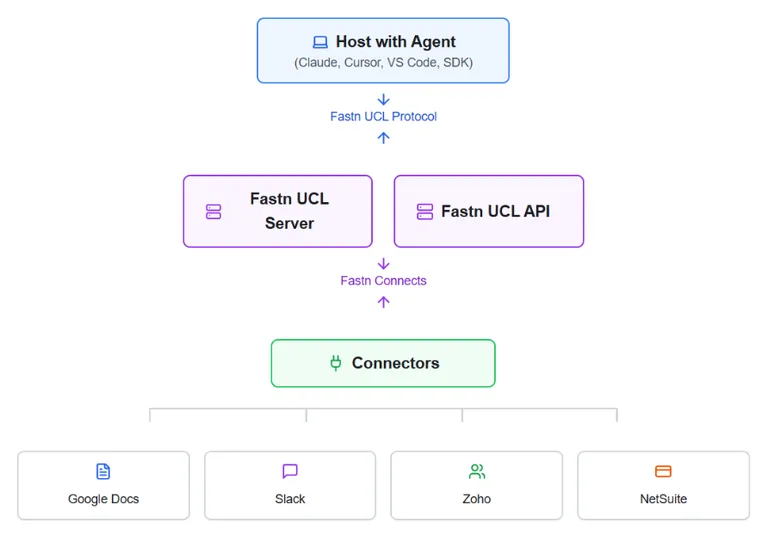
Unified Context Layer (UCL) positions itself as a “Vercel-for-MCP” platform, combining fully managed MCP infrastructure with a large pre-built integration ecosystem. Its focus is on simplifying the entire lifecycle of building, hosting, deploying, and scaling AI agents and MCP servers, allowing teams to focus more on application development rather than infrastructure management.
The platform follows an all-in-one PaaS approach, offering zero-maintenance infrastructure alongside a library of over 1,000 pre-built tools and integrations. This hybrid “build + buy” model makes UCL particularly attractive for SaaS companies and developer teams looking to accelerate AI product development without stitching together separate hosting, orchestration, and integration layers.
UCL also emphasizes enterprise readiness through multi-tenant architecture, compliance-focused infrastructure, and managed scalability. Support for SOC 2, ISO, HIPAA, and PCI-ready environments, combined with a 99.9% uptime SLA, positions the platform as a strong option for organizations building AI-native SaaS products that require secure, production-grade MCP deployments.
Pros
Cons
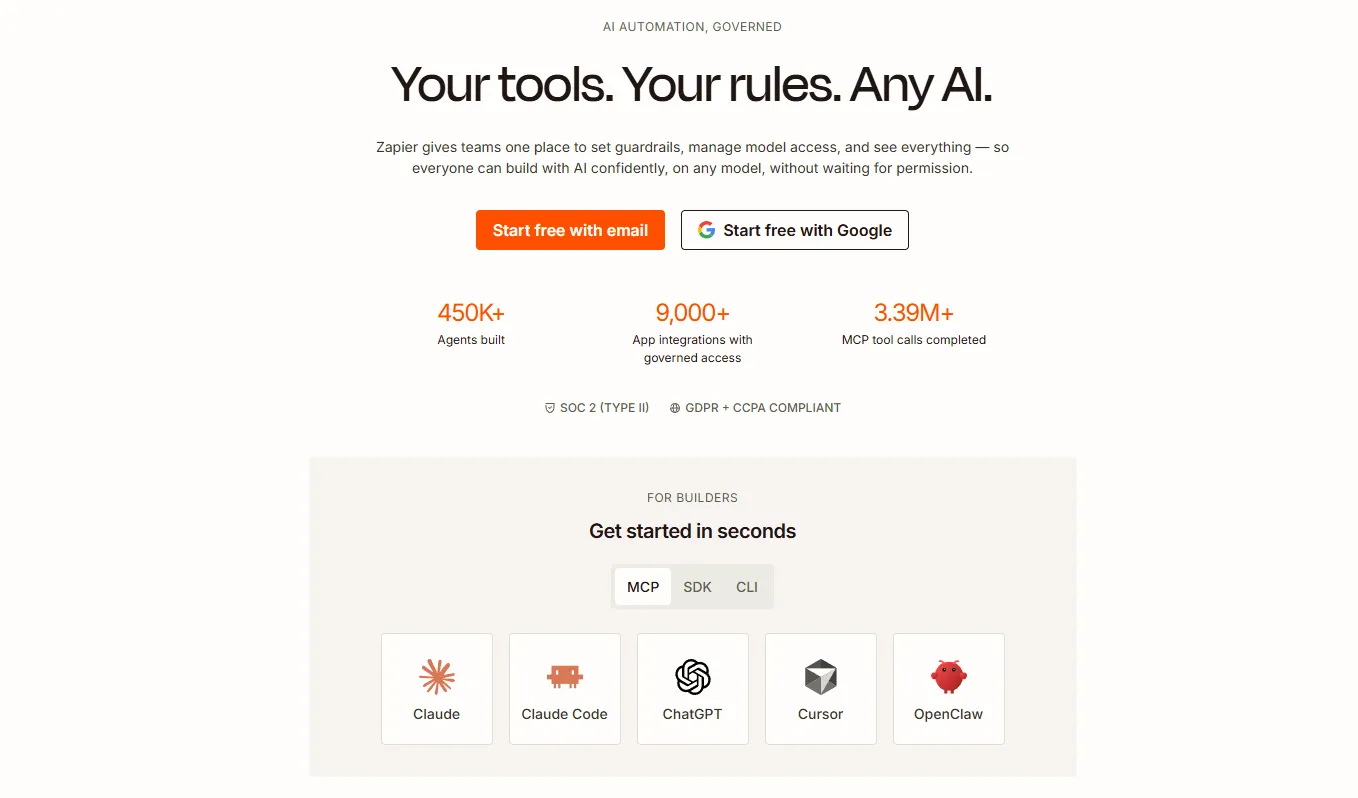
Zapier has entered the MCP ecosystem by turning its massive automation platform into an MCP-accessible integration layer. Instead of focusing on deep infrastructure management or governance, Zapier prioritizes simplicity and breadth, allowing AI agents to connect with thousands of applications through a secure MCP endpoint with minimal setup effort.
Its biggest advantage is the scale of its integration ecosystem. With access to over 8,000 applications, Zapier provides one of the broadest MCP-compatible app libraries available, making it especially useful for rapid prototyping, SMB workflows, and lightweight enterprise automations. Developers can quickly generate MCP endpoints and expose selected “Zapier Actions” without building custom integrations from scratch.
The platform also benefits from Zapier’s existing authentication and automation infrastructure, simplifying credential management for connected services. However, Zapier is designed more for accessibility and integration breadth than for ultra-low latency or enterprise-grade governance. Its task-based pricing model can also become expensive for AI agents making large volumes of tool calls.
Pros
Cons
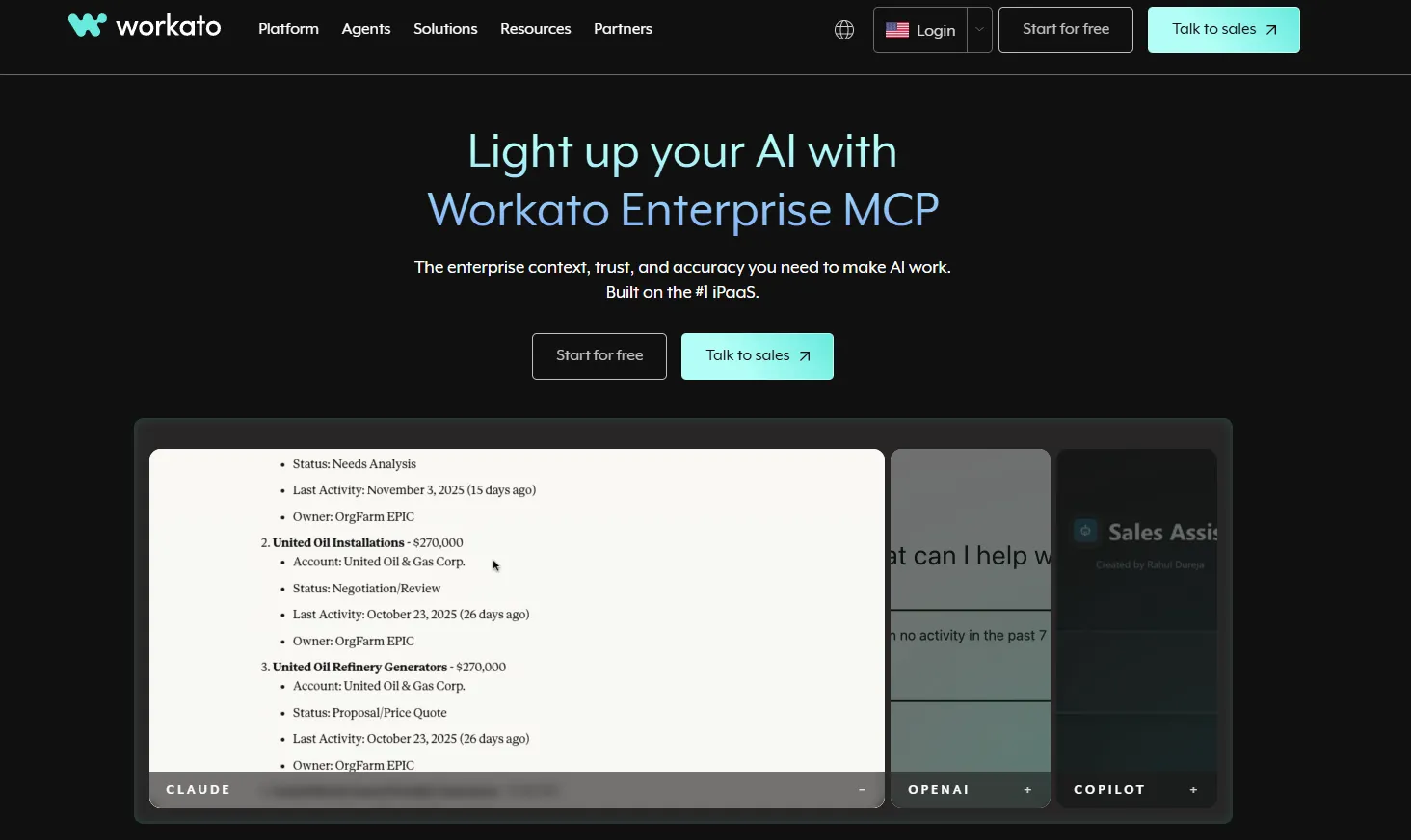
Workato approaches MCP infrastructure through its established enterprise iPaaS ecosystem, enabling organizations to expose existing automation workflows and integrations to AI agents through secure MCP endpoints. Rather than building a standalone MCP gateway, Workato extends its mature automation platform into the agentic AI space, allowing enterprises to reuse governed workflows, integrations, and security controls already running in production.
A major advantage is its extensive enterprise integration ecosystem. With access to over 12,000 applications and connectors, organizations can rapidly connect AI agents to complex business systems without building custom integrations from scratch. Pre-built low-code workflows can be quickly adapted into MCP-enabled automations, helping organizations extend AI capabilities across existing enterprise systems.
Workato strongly emphasizes governance, auditability, and enterprise-grade reliability over lightweight experimentation or ultra-low-latency execution. Its secure runtime, mature compliance capabilities, and proven automation infrastructure make it especially appealing for large organizations already invested in the Workato ecosystem. However, the platform’s enterprise-first nature and higher total cost of ownership may make it less suitable for startups or smaller development teams.
Pros
Cons
Choosing an MCP gateway is not just about comparing features, it is about selecting a platform that aligns with your organization’s infrastructure strategy, security requirements, operational maturity, and long-term AI roadmap.
Key factors to evaluate include:
Different gateways optimize for different priorities. Some focus on centralized AI infrastructure management, others prioritize security and governance, while some emphasize deployment flexibility or integration breadth. The right choice depends on your existing infrastructure, engineering capabilities, and the level of control your organization requires.
Choose TrueFoundry if:
TrueFoundry is particularly well-suited for organizations looking to consolidate deployment, observability, authentication, governance, and cost management into a single AI infrastructure layer. Its unified architecture simplifies AI operations while delivering high-performance MCP orchestration for production-scale agentic systems.
An MCP server is the component that exposes tools, APIs, data sources, and actions to AI agents through the Model Context Protocol (MCP). These servers provide the actual capabilities agents interact with, such as querying databases, accessing enterprise applications, executing workflows, reading files, or calling external APIs.
An MCP gateway, by contrast, acts as the centralized control and orchestration layer between AI agents and MCP servers. Rather than allowing agents to connect directly to every MCP server, the gateway manages authentication and authorization, routing, rate limiting, observability, auditing, and security policies across all MCP interactions.
The key difference is that MCP servers focus on providing functionality, while MCP gateways focus on governance, scalability, and operational management. As AI systems grow more complex, gateways help organizations maintain consistent security controls, centralized monitoring, and manageable infrastructure across multiple agents and MCP servers.
An MCP client/connector and an MCP gateway serve different roles in the MCP ecosystem. An MCP client or connector is responsible for connecting AI agents or applications to MCP servers. It allows agents to discover tools, send requests, and interact with external systems through the MCP protocol.
An MCP gateway sits between MCP clients and MCP servers as a centralized control layer. Instead of directly exposing MCP servers to every client, the gateway manages authentication, access control, routing, observability, auditing, rate limiting, and security policies across all MCP interactions.
In simple terms, MCP clients focus on enabling connectivity, while MCP gateways focus on governance and operational management. As AI systems scale, gateways become important for maintaining consistent security, monitoring, and control across multiple agents and MCP servers.
The MCP Gateway market is evolving rapidly, but a few clear patterns are emerging. The strongest platforms are those that balance three critical priorities: robust security, operational simplicity, and architectural flexibility.
As AI agents gain broader access to enterprise systems, security and governance are becoming non-negotiable. At the same time, organizations need centralized observability and management to handle growing MCP complexity without operational overhead. Flexibility also matters, enterprises want infrastructure that can scale and adapt as agentic AI workflows evolve.
More importantly, MCP gateways are only the beginning of the broader infrastructure stack required for autonomous AI systems. Agent-to-agent communication, workflow orchestration, and multi-modal tool ecosystems will introduce even more governance and operational challenges over time.
The vendors most likely to succeed will be those that go beyond basic protocol support and solve real enterprise problems around security, scalability, monitoring, and reliability. For organizations adopting agentic AI today, choosing a gateway that can evolve alongside future AI infrastructure requirements will be critical.
TrueFoundry AI Gateway delivers ~3–4 ms latency, handles 350+ RPS on 1 vCPU, scales horizontally with ease, and is production-ready, while LiteLLM suffers from high latency, struggles beyond moderate RPS, lacks built-in scaling, and is best for light or prototype workloads.
TrueFoundry is the best MCP gateway for enterprises due to its production-grade governance features like RBAC and secret management. It provides a managed control plane that allows organizations to deploy and scale connections across hybrid clouds while maintaining strict security and auditability standards required for high-stakes AI workloads.
To evaluate the best MCP gateway, assess its security controls, routing capabilities, scalability, observability, and ease of integration with your existing infrastructure. A strong solution should securely manage access to MCP servers, handle traffic reliably, provide clear monitoring visibility, and fit seamlessly into your production environment.
The best MCP gateway should offer strong authentication and authorization, intelligent request routing, monitoring and logging, rate limiting, and support for multiple MCP servers. Enterprise-ready solutions also provide federation capabilities, policy controls, and seamless cloud or on-prem deployment.
The most secure MCP gateway is one that provides robust authentication mechanisms, role-based access control, encrypted communication, and centralized policy enforcement. Security also depends on how well the gateway integrates with identity providers and protects tool credentials in production environments.
Yes, TrueFoundry’s MCP gateway is a great choice. It is designed for production AI systems, offering secure access control, scalable routing, observability, and enterprise-grade governance. It is well-suited for teams that need centralized control over MCP servers while maintaining reliability and operational simplicity.
Product
Company
Resources




.webp)
.webp)
.webp)
.webp)
.webp)






.webp)
.webp)
.webp)
.webp)
.webp)
.webp)

.webp)
.webp)